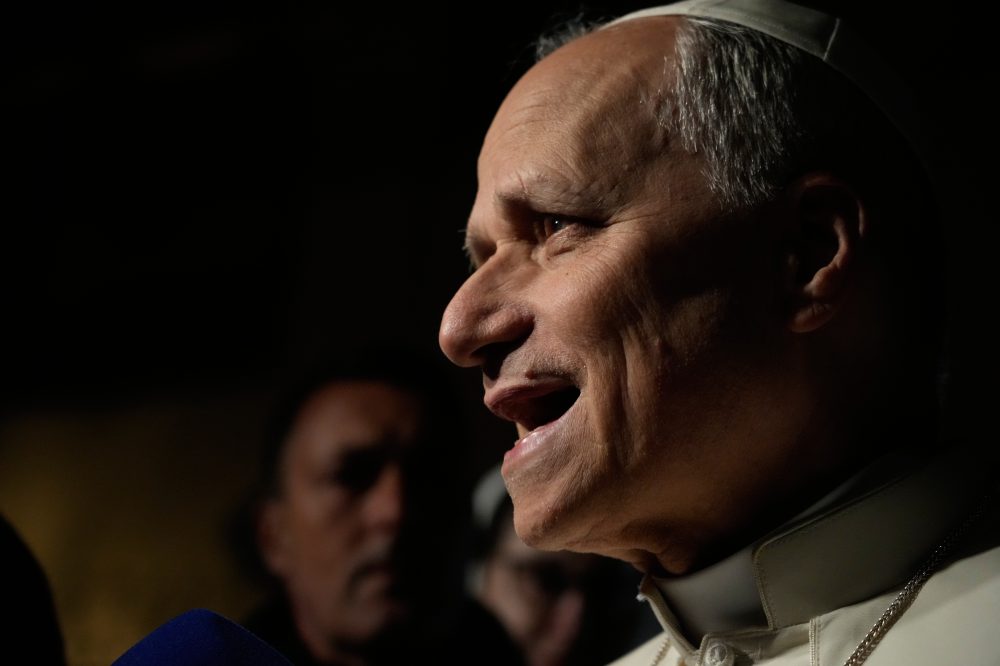

VATICAN CITY (AP) — Following his election, Pope Leo XIV declared himself a “son of St. Augustine,” leading some Algerians to believe his heritage traced back to the North African nation where the 5th century religious leader lived and passed away.
While Leo’s statement actually referenced his Augustinian spiritual beliefs, his connection to the Algeria-born St. Augustine — a prominent Christian figure recognized by the country’s Sunni Muslim population — has helped create a positive introduction to Algeria, which will host him Monday during the first papal visit in the nation’s history.
The pontiff’s two-day visit launches an extensive journey through four African nations — Algeria, Angola, Cameroon and Equatorial Guinea — featuring such complex logistics that it mirrors the extensive travels of St. John Paul II during his early papacy.
The 70-year-old pontiff will travel over 17,700 kilometers (approximately 11,000 miles) across 18 flights during the 11-day expedition beginning Monday, delivering addresses and religious services in French, Spanish, Portuguese and English. He’s focusing on a region vital to Catholic Church expansion, though it presents distinct obstacles.
Given the diverse cultural backgrounds and historical contexts, his discussion topics will span widely, encompassing migration issues and the exploitation of natural and human resources in an area that generates much of the globe’s oil, yet where large segments of the population experience poverty. Vatican officials indicate Leo will address corruption within frequently authoritarian governments and examine the responsibilities of political leaders in nations where two presidents have maintained power for multiple decades.
Massive gatherings are anticipated in Cameroon, where Catholics comprise 29% of the population and 600,000 individuals are expected to participate in one of Leo’s religious services. The pope will conduct a “peace meeting” in Bamenda, a northwestern Cameroonian city affected by separatist conflicts.
“To see His Holiness Pope Leo XIV arrive in Cameroon, for us who are Catholic Christians, it further strengthens our faith, it further strengthens our ties with our God,” said Simon Pierre Ngombo, a Catholic Cameroonian. “It is a perfect moment to touch each other’s hearts.”
Algeria will provide the American pontiff an opportunity to encourage harmonious relationships between Christians and Muslims during a period of international tensions surrounding the U.S.-Israeli conflict in Iran. Despite ongoing warfare, Vatican officials stated no additional security protocols are being implemented.
Leo, who has established himself as an American alternative to U.S. President Donald Trump, plans to visit Algiers’ Great Mosque, with interfaith discussions expected to feature prominently, according to Algiers Archbishop Cardinal Jean-Paul Vesco.
Algeria’s northern coastline witnessed a devastating civil conflict during the 1990s, locally termed the “black decade,” resulting in approximately 250,000 deaths as military forces battled an Islamist uprising. Recently, Algeria continued addressing its colonial past, with lawmakers voting to classify France’s colonization of the North African nation as criminal and demanding compensation for property seized during France’s 130-year occupation.
The papal visit “acts as a bridge between the Christian and Muslim worlds, while reflecting the richness of the country’s history,” Vesco informed the official Algerian news agency, APS.
Nevertheless, Algerian officials rejected Vatican requests for Leo to visit Médéa (50 kilometers/30 miles south of Algiers) to pray at the Tibhirine monastery, where Islamic militants kidnapped and murdered seven French Trappist monks on May 21, 1996, during the civil war.
“Algeria has no intention of reopening a painful chapter of its history,” the government publication El Moudjahid stated while supporting the administration’s decision.
Leo is anticipated to acknowledge the monks’ sacrifice, who were among 19 priests, nuns and other Catholics killed during the conflict. They received beatification in 2018 as faith martyrs during what marked the first such ceremony in the Muslim world.
Africa contributed over half of the 15.8 million new Catholics baptized in 2023, representing 8.3 million new African Catholics, based on recent Vatican data.
The continent annually provides thousands of men for priesthood and women for religious communities, transforming a region that previously received Western missionaries into one that sends its religious personnel worldwide.
Vatican records show Angola and Cameroon regularly generate some of the continent’s highest numbers of seminary students annually. By December 2024, Angola maintained 2,366 priestly candidates in major seminaries while Cameroon had 2,218, trailing only the African ordination leaders Nigeria, Congo and Tanzania.
However, this rapid expansion has created difficulties. Previous popes addressing African clergy frequently emphasized the importance of maintaining celibacy vows. Pope Benedict XVI’s 2009 visit to Angola and Cameroon was marred by his travel comments suggesting condoms might worsen the AIDS epidemic, prompting criticism from numerous public health authorities.
A significant concern facing the Holy See involves ethnic divisions affecting church operations. This particularly impacts bishop appointments, as they often oversee territories encompassing multiple ethnic communities and face rejection from priests or congregants, explained Rev. Fortunatus Nwachukwu, second-in-command at the Vatican’s missionary evangelization department.
This issue is called the “son of the soil syndrome,” while the Holy See maintains “the church should speak of the ‘son of the church,’” he stated.
The African church also grapples with polygamy practices, raised so persistently by African bishops as a crucial matter that the Holy See published a complete doctrinal document last year emphasizing monogamy’s importance and established a specialized study committee.
Catholic teaching maintains marriage as a monogamous, permanent bond between one man and one woman. This stance creates conflict with cultural traditions in African regions, particularly in farming and nomadic communities where multiple wives capable of bearing many children are viewed as essential for survival.
Leo will conduct numerous meetings with Catholic clergy, bishops and regular believers where he can stress Catholic family values, stated Vatican spokesperson Matteo Bruni.
Several countries Leo will visit, all former European territories, rank among the world’s largest oil and mineral producers, including gold, diamonds and iron, whose extraction has revolutionized their economies recently.
However, Leo is expected to emphasize negative consequences of exploiting Africa’s natural and human resources that have enriched only a select few while damaging the environment.
This particularly applies to Equatorial Guinea, where President Teodoro Obiang Nguema Mbasogo has governed since 1979 and faces accusations, along with his family, of extensive corruption and authoritarian rule.
This represents an issue Pope Francis emphasized throughout his papacy and expressed in his 2015 environmental encyclical, “Praised Be,” which Leo has vigorously supported and advanced.