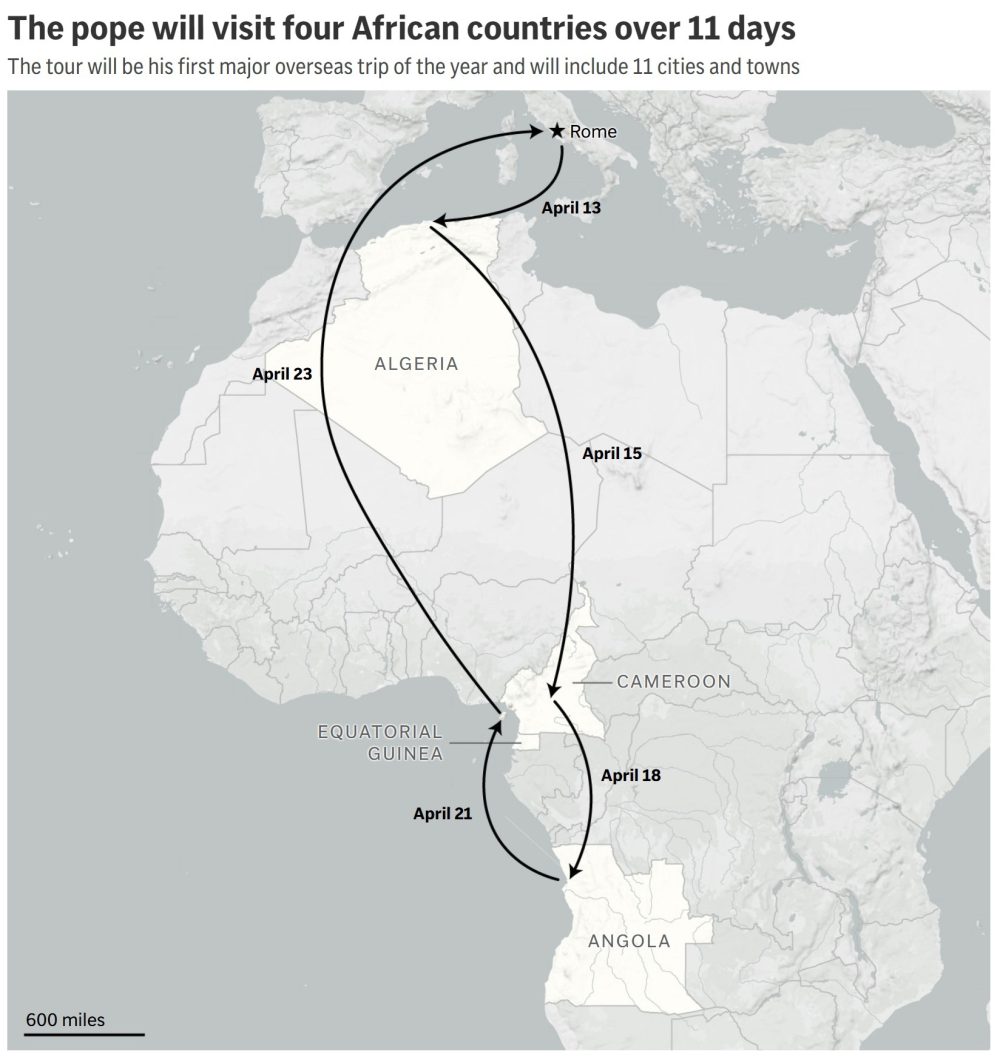

Pope Leo XIV has launched an ambitious 11-day journey spanning four African nations, a complex undertaking that mirrors the extensive travels of St. John Paul II during his early papacy.
During his extensive tour, Leo plans to address several critical issues including peaceful relations between Christians and Muslims, the excessive exploitation of Africa’s natural and human resources, governmental corruption, and migration challenges.
The following breakdown examines each destination and key highlights of the papal itinerary:
Algeria holds special significance for Leo due to his connection with St. Augustine, who serves as the inspiration for his religious order and spent his life in this region. The Pope will travel to Annaba, present-day Hippo, where the renowned 5th century saint served as bishop.
Migration issues and Christian-Muslim relations will feature prominently during the Algeria visit. This former French territory, now a predominantly Sunni Muslim nation along North Africa’s Mediterranean shoreline, will see Leo honor migrants who perished in Mediterranean shipwrecks while attempting to reach Europe. The pontiff will also visit Algiers’ Great Mosque.
In 2023, Algeria’s parliament passed legislation declaring France’s colonial rule a criminal act, demanding property restitution and other measures to address historical injustices from the 130-year French occupation.
Leo’s Cameroon visit will feature a notable “peace gathering” in the northwestern city of Bamenda on April 16, including testimonials from a Mankon traditional leader, a Presbyterian moderator, an imam, and a Catholic sister.
Cameroon’s western territories have experienced ongoing violence since English-speaking separatists began their uprising in 2017, seeking independence from the French-speaking majority to create their own nation. This conflict has resulted in over 6,000 deaths and displaced more than 600,000 people, according to International Crisis Group data.
Northern Cameroon also faces violence from Boko Haram militants, as the Islamic extremist movement’s Nigerian insurgency has extended into Cameroonian territory.
Cameroon possesses substantial reserves of petroleum, natural gas, cobalt, bauxite, iron ore, precious metals, and diamonds. Mining and drilling operations represent nearly one-third of national exports, based on Extractive Industries Transparency Initiative findings.
However, advocacy organizations and Catholic Church leaders have expressed concern that extraction profits seldom benefit rural and indigenous populations living near mining sites, while international corporations and a privileged domestic minority claim most revenues.
Although French and British companies have historically controlled Cameroon’s extraction sector, Chinese firms have significantly expanded their presence recently, especially in eastern gold mining areas.
In 2023, UN specialists documented serious human rights violations and environmental damage from mercury usage in eastern Cameroon’s gold mining activities.
The eastern region’s gold rush has prompted hundreds of children to leave school and work in dangerous makeshift mines, earning approximately one dollar for ore sold in local underground markets, UNICEF reports.
In Angola, where Catholics comprise roughly 58% of the population, Leo will conduct prayers at the Sanctuary of Mama Muxima, a Marian shrine that ranks among Angola’s most significant Catholic pilgrimage destinations.
Portuguese colonizers originally constructed this church near the 16th century’s end after establishing a fortress at Muxima. The site became central to Portugal’s transatlantic slave trade, where enslaved individuals received baptism before boarding ships bound for the Americas.
Modern Angola ranks as Africa’s fourth-largest oil producer and among the globe’s top 20, according to International Energy Agency statistics. The nation also leads world diamond production in third place and possesses substantial gold deposits and valuable critical minerals.
Despite abundant natural wealth, World Bank estimates from 2023 indicate over 30% of Angolans survive on less than $2.15 daily.
This nation of approximately 38 million people achieved Portuguese independence in 1975 but continues recovering from a catastrophic civil war that commenced immediately after independence and continued intermittently for 27 years until 2002. The conflict claimed an estimated 500,000 lives.
Vatican officials announced that Leo will specifically address Angolan youth with messages of hope and healing.
Equatorial Guinea’s economy experienced dramatic transformation following mid-1990s offshore oil discoveries, with petroleum now representing nearly half the GDP and over 90% of exports, African Development Bank data shows.
Despite this wealth, more than half of this authoritarian oil state’s citizens remain impoverished, according to last year’s World Bank assessment.
This former Spanish colony operates under Africa’s longest-serving leader, Teodoro Obiang Nguema Mbasogo, who has governed since 1979 amid widespread corruption and authoritarian rule accusations.
Multiple advocacy groups, including Human Rights Watch, have documented how oil revenues have enriched the ruling Obiang dynasty rather than benefiting the general population, where at least 70% of nearly 2 million citizens live in poverty.
The government faces persistent allegations of harassing, arresting, and intimidating political opposition members, critics, and media professionals.
Beyond addressing extraction industry problems, Vatican spokesperson Matteo Bruni indicated Leo will discuss corruption issues and proper governmental responsibilities throughout his African tour.