
BEDZIN, Poland — Researchers have made extraordinary discoveries in a southern Polish house that once sheltered Jewish resistance fighters during World War II, uncovering hidden bunkers, underground passages, and artifacts that tell a powerful story of survival and defiance.
Among the most moving finds was an armband displaying the Star of David, discovered by the Cukerman’s Gate Foundation during their methodical search of the property.
“This armband is a witness, it’s like directly touching that evil which people created for other people,” Karolina Jakoweńko from the Cukerman’s Gate Foundation, which organized the search, told The Associated Press. Seeing it felt like a “jolt,” she said.
The two-story red brick structure sits in what was once the Jewish ghetto during the war. Young people from left-wing Zionist groups established a “kibbutz” there — essentially a support network designed to help members survive and fight back against Nazi forces.
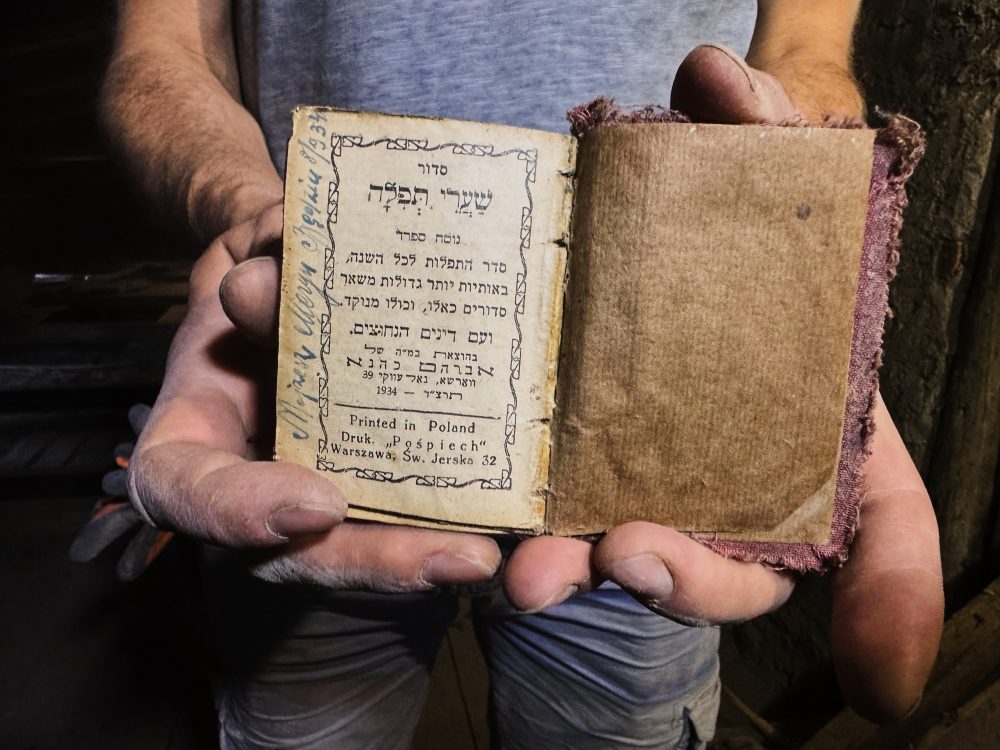
During recent preparation work for renovations, Jakoweńko and her team methodically searched the attic, removing floorboards piece by piece and sifting through debris collected in buckets. Their careful examination revealed items from multiple time periods, including a Jewish prayer book from 1934 and the significant armband.
The foundation made even more dramatic discoveries last year when they found a bunker and underground passage on the property, guided by survivor accounts and oral histories they had gathered. Research indicates three separate bunkers existed around the building.
“The entry to the bunker was through the kitchen oven,” Piotr Jakoweńko said, pointing to a second bunker located under the kitchen, where bricks were arranged differently. “We are not aware any of the people here survived when the Nazis discovered this place. Perhaps as many as 60 were hiding here.”
Finding these hiding places required painstaking examination of every section of the property, with archaeological experts providing guidance throughout the process.
Wojciech Mazan, one of the volunteers who helped with the search, said their work was grueling but it mirrored what the Jewish youth was doing to dig out the tunnel and bunkers. “We feel some closeness to them in this energy. The house is speaking to us.”
Before the war began, approximately 27,000 Jewish residents called Bedzin home, making up half the town’s population. Additional Jewish families lived in surrounding communities in this coal-mining region near Germany, creating one of Poland’s most diverse and economically thriving Jewish populations. Nazi authorities officially established ghettos for Jewish residents in 1942.
The building now being preserved represents a crucial location in the history of Jewish resistance throughout Nazi-occupied Poland. While the Warsaw Ghetto uprising in 1943 remains the most widely known example of Jewish resistance, numerous other resistance efforts occurred throughout the country.
According to Joanna Król-Komła from the POLIN Museum of the History of the Polish Jews in Warsaw, this site could become an important destination for Holocaust education across Europe.
“There are only a few authentic places in Europe where Jews hid that have been preserved,” she said. “But in those cases, the story is usually told from the perspective of the righteous — those who saved Jews.” In Bedzin, by contrast, the preserved hiding place was organized by Jews themselves.
When Nazi forces began dismantling the Bedzin ghetto during summer 1943, Jewish residents had successfully obtained approximately 20 firearms from outside the ghetto walls. They understood that the Warsaw Ghetto, which had a larger and better-equipped resistance movement, had been destroyed in May.
The Jews in Bedzin knew well they stood no chance to survive and some chose to die weapons in hand, shooting at the Nazis who found them, Król-Komła said.
Frumka Płotnicka, a female fighter and courier from the Warsaw resistance movement who was sent to Bedzin to help organize local Jews, died in a third bunker that hasn’t been found yet, according to Karolina Jakoweńko.
She said the acts of resistance in the community went beyond shooting back at the Nazis. “Whether building bunkers or trying to hide a child or an aging parent, this is all resistance. It doesn’t always have to be a fight with weapons in hand. The fact that they wanted to survive was a form of resistance.”
Prior to World War II, Poland housed Europe’s largest Jewish community, with approximately 3.3 million residents. Although Nazi Germany, which controlled Poland during the conflict, bears responsibility for the Holocaust, Poland continues to grapple with historical instances where Polish neighbors participated in local attacks against Jewish communities.
In Bedzin, however, the local community is actively working to revive its Jewish history. Karolina Jakoweńko, who is originally from Bedzin, said “this Jewish history, for me, gave meaning to this town.”
She also recognized the Polish family who constructed the red brick house between the wars, Maria and Józef Polak, who lived alongside Jewish residents throughout the conflict, with children playing together, as allowed under Bedzin ghetto regulations. Family accounts shared with Jakoweńko describe how the woman saw the courtyard filled with bodies after Nazi forces killed the Jewish people who had been hiding.
Following the war’s end, the Polish family and their descendants decided against fencing the property, welcoming Jewish visitors and others. Recently, they agreed to transfer ownership to the Cukerman’s Gate Foundation, which intends to establish a museum called “the Bedzin Ghetto Fighters’ House.”