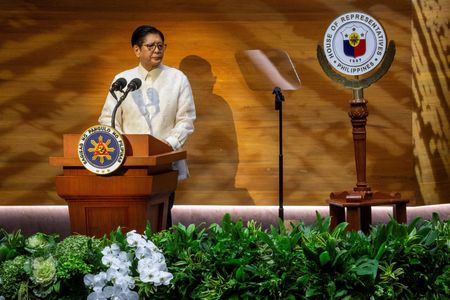

Philippine President Ferdinand Marcos Jr. took a firm public stand against corruption Monday, telling Congress he serves the Filipino people — not his relatives or allies — as his administration moves toward filing multiple charges against his cousin, former House Speaker Martin Romualdez.
“I am not the president of my family. I am not the president of my friends. I am the president of the Philippines, and my duty is to the Filipino people,” Marcos declared in what was his second-to-last annual address to Congress before his term concludes in 2028.
The anti-corruption push stems from allegations Marcos himself revealed last year involving widespread irregularities in a series of flood-control projects valued at billions of pesos. Those projects were tied to accusations of kickbacks paid to various officials and politicians, with Romualdez among those implicated. The former speaker was subsequently forced out of his leadership position.
Despite those earlier disclosures, questions about accountability have remained unresolved, fueling public frustration at a time when many Filipinos are struggling with rising prices and inflation that has surpassed the government’s own targets.
“This pains me, but we have to do what is right,” Marcos said.
Romualdez responded with a statement maintaining his innocence and saying he was ready to face any charges that might be brought against him.
Marcos is navigating a turbulent political landscape. His governing alliance with Vice President Sara Duterte has collapsed, and she is now facing an impeachment trial. Meanwhile, polling from Pulse Asia shows his public trust rating has dropped to just 28%, with 51% of those surveyed expressing distrust in him.
Jean Encinas-Franco, a political science professor at the University of the Philippines, said the president’s words carried political weight because they signaled a willingness to hold even family members accountable. However, she cautioned that words alone won’t be enough.
“Rhetoric is fine, but actions are better,” she said, noting the administration will ultimately be measured by whether cases are actually filed and prosecuted.
Outside the Congress building, hundreds of demonstrators gathered, carrying signs and banners calling not just for corruption accountability, but also for lower consumer prices and better wages for workers.
On the economic front, Marcos asked lawmakers to pass tax relief measures aimed at easing the burden of rising costs. These include broader income tax exemptions for workers and the elimination of the minimum corporate income tax for small businesses.
Marcos also addressed the long-running dispute in the South China Sea, though he stopped short of naming China directly. He cited the 10th anniversary of a 2016 international arbitration ruling that determined China’s broad territorial claims in the waterway had no legal standing — a decision that was a major legal victory for the Philippines. Filipinos, he said, “do not yield.”
“This is not a claim that we advance alone, nor one that we will abandon,” Marcos said.
China continues to reject that ruling and maintains its claims over the strategically important waterway.
Although Marcos’ single six-year term ends in 2028, he has not made clear who he supports as a successor. Early surveys show that despite her ongoing impeachment trial, Vice President Duterte remains the top choice among respondents for the 2028 presidential race.