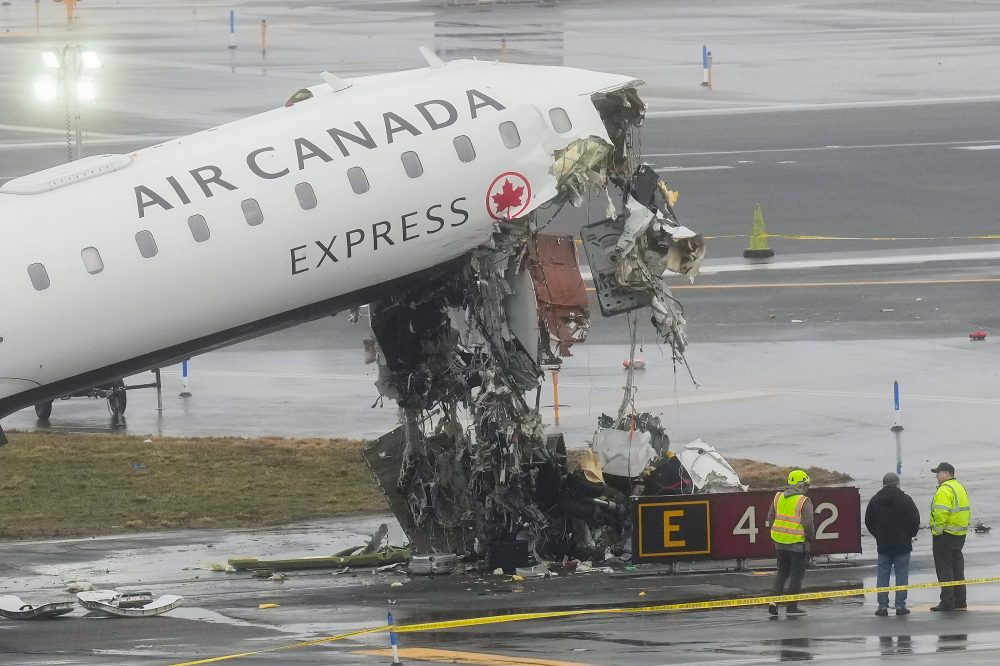

NEW YORK — In the aftermath of a devastating collision between an Air Canada aircraft and a fire truck at LaGuardia Airport that claimed the lives of both pilots, passengers became their own rescuers in a desperate bid for survival.
As fuel fumes filled the air and wreckage hung from the destroyed cockpit area, travelers forced open emergency exits, leaped from the aircraft’s wings, and then assisted fellow passengers who were following behind them, including some who were bleeding or had sustained head injuries.
“Strangely enough, I wasn’t scared or panicked. On the contrary, I think most of us were pretty aware of what happened,” passenger Clément Lelièvre recalled. “So we all went outside; we got other people out.”
Approximately 40 individuals from the regional aircraft traveling from Montreal, along with two fire truck occupants, required hospital treatment. While several sustained significant injuries, the majority were discharged by Monday morning, with others able to leave the scene without medical attention.
While investigators pressed forward Tuesday with their examination of what led to the devastating accident, accounts of how people survived began surfacing — including the story of a flight attendant who was discovered injured but alive outside the plane.
Lelièvre praised the pilots’ “incredible reflexes” for preventing additional casualties. He described how the flight crew applied maximum braking power immediately upon landing.
The Sunday evening disaster occurred after the fire truck received authorization to inspect another aircraft that had canceled its departure due to an unusual smell and began moving across the airport surface. Airport communications captured an air traffic controller urgently instructing the fire truck to halt.
About 20 minutes following the incident, the same controller appeared to accept responsibility. “We were dealing with an emergency earlier,” the controller stated. “I messed up.”
According to Mary Schiavo, former Department of Transportation Inspector General, investigators will focus heavily on how airport air traffic and ground vehicle coordination functioned during the crash.
Transportation Secretary Sean Duffy noted that while LaGuardia maintains adequate staffing levels, the facility struggles with a controller shortage.
The runway where the accident took place will remain shuttered for “days” throughout the investigation, National Transportation Safety Board Chair Jennifer Homendy announced during Monday’s press briefing. She explained that investigators must examine extensive debris.
Officials retrieved the aircraft’s cockpit and flight data recorders by creating an opening in the plane’s roof, then transported them to the NTSB laboratory in Washington for examination, Homendy reported.
She indicated it remained premature to address many accident-related questions, though additional details were anticipated Tuesday.
The incident forced LaGuardia’s complete closure — affecting the New York area’s third-largest aviation facility — during an already challenging period for American airports due to a partial government shutdown.
Operations resumed Monday afternoon using a single runway with significant delays. The shutdown created additional complications at other airports, particularly affecting Delta, which maintains substantial LaGuardia operations.
The Jazz Aviation flight, operating under Air Canada’s banner, carried 72 passengers and four crew members from Montreal-Pierre Elliott Trudeau International Airport. Canadian authorities also dispatched an investigative team.
Both the pilot and copilot who perished in LaGuardia’s first fatal accident in 34 years were Canadian-based, according to Kathryn Garcia, executive director of the Port Authority of New York and New Jersey, which manages the airport.
Jeannette Gagnier, great aunt of one pilot, named him as Antoine Forest and said aviation had always been his dream.
Air traffic controllers remain unaffected by the partial government shutdown that has created extended security checkpoint delays at airports recently, though previous shutdowns have impacted them.
The FAA has faced persistent air traffic controller shortages for years.
LaGuardia operates one of 35 major American airports equipped with advanced surface surveillance technology designed to monitor aircraft and vehicle movements across airport grounds.
Former FAA air traffic control chief Mike McCormick explained that an alarm audible in the background of air traffic control recordings likely originated from this system and would have warned the tower about the impending collision.
FAA data indicates 1,636 runway incursions occurred last year.