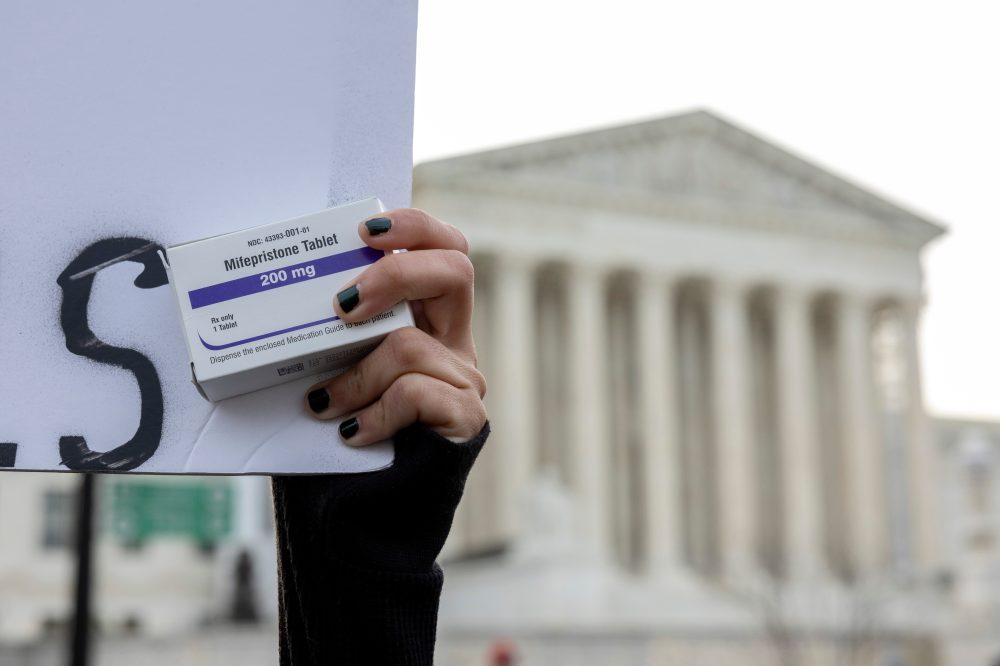

States with existing abortion restrictions are shifting their legislative focus this year toward blocking medication sent from out-of-state telehealth providers, as new data reveals a significant trend in how women access reproductive care.
Research published Tuesday provides insight into this legislative strategy. The data indicates that women residing in states with abortion prohibitions increasingly turned to telehealth-prescribed pills in the past year rather than crossing state lines to access procedures.
Nearly four years have passed since the Supreme Court’s decision eliminated Roe v. Wade protections, and most states with the legislative support for comprehensive bans have already enacted them. This year, only one state has implemented a new prohibition.
As numerous state legislatures conclude their 2026 sessions, here’s the current landscape of abortion-related legislation.
Republican Governor Larry Rhoden of South Dakota approved legislation last week establishing felony charges for advertising, distributing, or selling abortion medications.
Mississippi lawmakers have passed comparable legislation in both chambers this year. The House and Senate must reconcile differences in their respective versions before sending the final bill to Republican Governor Tate Reeves.
Research from the Guttmacher Institute, an organization that advocates for abortion access, identifies at least three states—Florida, Oklahoma, and Texas—with existing statutes specifically prohibiting providers from mailing these medications to patients. Louisiana has designated mifepristone, one of the abortion drugs, as a controlled dangerous substance.
Legislation targeting pill distribution has passed single chambers in Arizona, Indiana, and South Carolina during the current session. Republicans maintain control of all three state legislatures and hold gubernatorial offices in two states. However, Democratic Governor Katie Hobbs in Arizona could veto any restrictive measures that reach her desk.
Tuesday’s Guttmacher research illuminates the rationale behind abortion opponents’ emphasis on medication restrictions.
The findings suggest that 2025 marked the first year when more women in the 13 states with complete abortion bans accessed pills via telehealth compared to those who traveled elsewhere for procedures.
These prescriptions originate from providers in states that have enacted post-Roe legislation designed to shield doctors who prescribe abortion medications to patients in restrictive states.
The projected rise in mailed medications coincides with Guttmacher estimates showing decreased travel to states such as Colorado, Illinois, Kansas, and New Mexico for abortion services.
Guttmacher develops its projections using monthly survey data from randomly selected U.S. abortion providers, combined with historical information from all national providers.
This pattern aligns with trends documented in additional provider surveys.
Several states have initiated court challenges against federal regulations permitting telehealth prescriptions of mifepristone.
Successful challenges requiring in-person consultations would significantly hamper out-of-state providers’ ability to deliver pills to ban states.
Louisiana has filed such litigation in federal court, while Florida and Texas attorneys general have submitted a case in Texas. These two states, alongside Idaho, Kansas, and Missouri, are pursuing similar arguments in Missouri courts.
Additionally, Texas has initiated civil lawsuits and Louisiana has brought criminal charges against providers allegedly shipping pills across state lines.
The Food and Drug Administration’s approval of generic mifepristone last year drew criticism from abortion opponents.
Wyoming stands alone this year in implementing new abortion restrictions.
Legislation signed by Republican Governor Mark Gordon in March established Wyoming as the fifth state prohibiting abortion around six weeks of pregnancy—often before women discover they’re pregnant. Similar to other states, Wyoming’s ban takes effect when cardiac activity becomes detectable.
Previous Wyoming attempts to restrict abortion have faced court defeats.
In January, the Wyoming Supreme Court overturned a comprehensive abortion ban covering all pregnancy stages.
No state has enacted legislation enabling criminal prosecution of women who obtain abortions.
While such proposals continue emerging, they typically fail early in the legislative process.
The most progress any such measure achieved was a South Carolina Senate subcommittee hearing last year. Tennessee scheduled a subcommittee hearing for similar legislation this month but canceled it.
Pregnancy Justice, which champions pregnant individuals’ rights, reports tracking new “abortion-as-homicide” bills in six states during 2026—down from 13 states the previous year.
Major established anti-abortion organizations reject this approach. “Women require compassion and support,” stated Ingrid Duran, National Right to Life’s state legislative director. “Not prosecution.”
New York University School of Law professor Melissa Murray explains that introducing bills penalizing women can erode the perception that such policies are unacceptable.
“You keep pushing the boundary, pushing the envelope, eventually you will get what you’re seeking,” Murray explained. “It will no longer feel fanciful or shocking.”
She emphasized that women already face pregnancy-related criminal charges in some cases. This month, Georgia police charged a woman with murder following alleged use of an abortion pill combined with oxycodone.
Abortion-related questions will appear on November ballots in at least three states.
Missouri legislators are requesting voters overturn the reproductive freedom rights they added to the state constitution in 2024.
Other states are asking voters to approve constitutional amendments reflecting existing state abortion statutes.
Nevada voters must approve a state constitutional amendment permitting abortion until fetal viability—typically considered around 21 weeks—for a second time after initial passage in 2024.
Virginia’s ballot measure would constitutionally guarantee reproductive freedom rights, including contraception access and abortion decision-making during the first two pregnancy trimesters.