
NEW YORK – The head of the New York Federal Reserve expressed confidence Monday that current interest rate policies can effectively navigate the economic turbulence stemming from Middle East conflicts, even as he warned of likely inflation increases ahead.
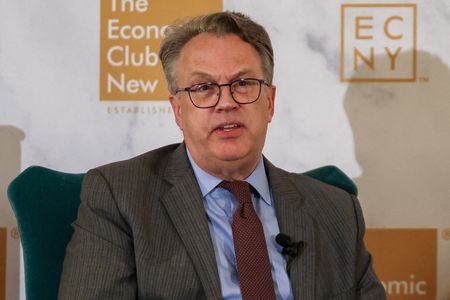
John Williams, who leads the New York Fed and serves as vice chair of the Federal Open Market Committee, addressed these concerns during remarks prepared for the Staten Island Economic Development Corporation.
“This is an unusual set of circumstances,” Williams stated. “But the current stance of monetary policy is well positioned to balance the risks to our maximum employment and price stability goals.”
The Fed official highlighted how Middle East warfare “could result in a large supply shock with pronounced effects that simultaneously raises inflation — through a surge in intermediate costs and commodity prices — and dampens economic activity,” noting “this has begun to play out already.” He also pointed to emerging disruptions in supply chains.
Despite acknowledging “high” uncertainty around inflation projections, Williams predicted that “the significant increase in energy prices resulting from developments in the Middle East will likely boost overall inflation in coming months.” However, he suggested some relief could come later this year if oil prices decline when hostilities end.
Williams stopped short of indicating any immediate need for monetary policy adjustments.
The ongoing conflict, which began with coordinated U.S.-Israeli military action against Iran, has presented significant hurdles for Federal Reserve officials. The most immediate economic consequences have appeared through substantial energy price increases, particularly after Iran blocked maritime traffic through the Strait of Hormuz.
Rising energy costs pose a threat to overall inflation rates, which the Fed might typically overlook provided the increases don’t spread to core price pressures and long-term inflation expectations. However, higher energy expenses also risk constraining economic growth as household budgets face increased energy costs.
This dynamic has created a difficult position for the Fed, making it harder for officials to provide clear guidance about future monetary policy direction. Earlier Monday, Federal Reserve Chair Jerome Powell emphasized the need for careful approaches given current economic conditions.
“We’re facing events in the Middle East which will certainly affect gas prices, and we’re, we feel like our policy is in a good place for us to wait and see how that turns out,” Powell commented during a Cambridge, Massachusetts event. “There’s sort of downside risk to the labor market, which suggests keep rates low, but there’s upside risk to inflation, which suggests maybe don’t keep rates low.”
Financial markets are currently considering the possibility of additional Fed rate reductions this year, though investors had recently been contemplating potential rate increases, given that war-related inflation pressures are building on top of inflation already exceeding the Fed’s 2% target.
During its most recent policy meeting earlier this month, the Fed maintained its current federal funds rate target between 3.5% and 3.75% while projecting a single rate reduction sometime in 2026.
In his prepared remarks, Williams projected economic growth around 2.5% for this year and inflation reaching 2.75% before declining back to the 2% target in the following year. He also anticipated unemployment rates would ease over the current and next year.
Williams’ projections appear more positive than most of his Fed colleagues, who anticipate unemployment will stay at its current 4.4% level through year’s end and expect inflation won’t reach the Fed’s 2% objective until 2028.