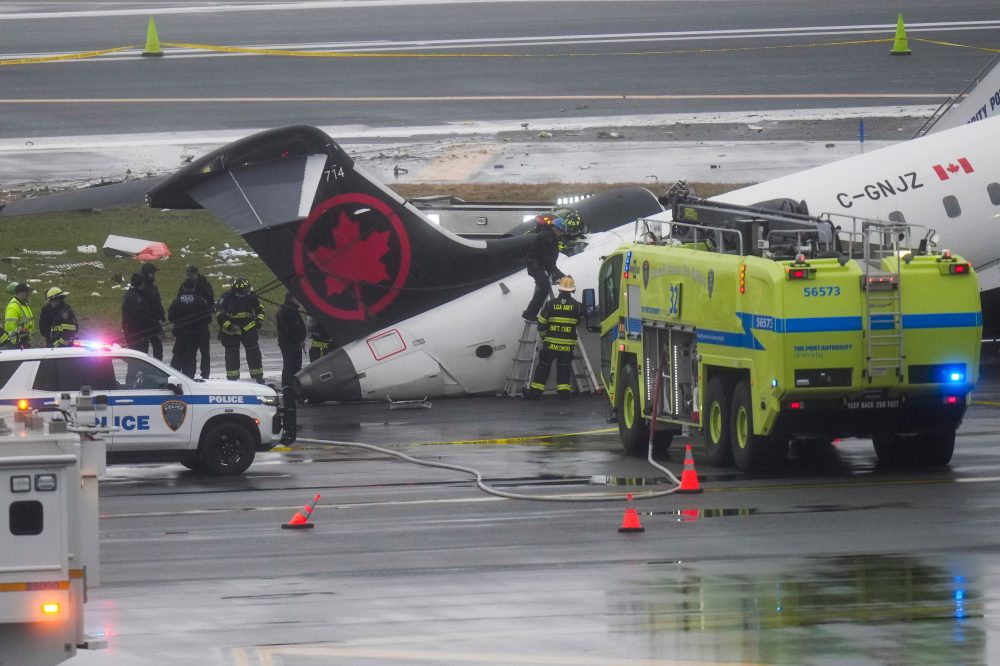

Federal safety officials released findings Thursday examining the fatal March collision at LaGuardia Airport that claimed two lives when an Air Canada regional aircraft struck a fire truck during landing operations.
The National Transportation Safety Board’s preliminary findings reveal multiple breakdowns that contributed to the tragedy, including the fire vehicle running a runway warning signal, missing safety equipment, and overwhelming air traffic conditions during the incident.
The March 22 accident involved Air Canada Express Flight 8646 arriving from Montreal carrying 76 passengers and crew. The aircraft collided with the emergency vehicle moments after touchdown, killing pilots Antoine Forest, 30, and Mackenzie Gunther, 24. Hospital treatment was required for 39 individuals, including the fire truck’s two occupants.
This marked LaGuardia’s first fatal aviation accident in more than three decades, prompting extensive investigation into the circumstances.
Airport operations faced unusual strain that evening, with arrival and departure activity more than doubling typical post-10 p.m. volumes due to earlier flight delays, according to aviation data company Cirium.
Two air traffic controllers managed the heightened workload while simultaneously coordinating an emergency response to a United Airlines aircraft reporting strong odors in the cabin. The fire truck that would later collide with the Air Canada flight was part of the emergency response convoy.
Controller responsibilities became divided when the senior operator focused on the United emergency, leaving the second controller to manage both ground vehicle movements and continued flight operations.
“These controllers were just way busy, just too busy,” explained aviation safety specialist Jeff Guzzetti.
LaGuardia operates an advanced collision prevention system called ASDE-X, which uses radar combined with transponder signals to track all aircraft and vehicles on airport surfaces. However, the fire trucks involved lacked the required transponders, preventing accurate tracking.
Without transponder data, the radar system struggled to maintain clear identification of the emergency vehicles, causing tracking signals to merge intermittently and preventing automatic collision warnings from activating.
Radio communications show the Air Canada flight received landing authorization at 11:35 p.m. Approximately two minutes afterward, with just 25 seconds remaining before impact, the fire crew requested runway crossing permission.
Controllers granted crossing clearance when the approaching aircraft was roughly 100 feet above ground level. At that moment, red warning lights designed to alert ground traffic remained illuminated on the runway.
The warning system continued operating until the truck reached the runway edge, shutting off only three seconds before collision as designed – the lights automatically extinguish moments before aircraft reach intersection points.
Former airline captain John Cox, who leads Safety Operating Systems, emphasized that ground vehicles must never proceed while warning lights remain active, regardless of controller clearance.
“That’s an automated system so even though the controller says you’re cleared to cross, the lights mean that there’s an airplane that is either on the runway or about to be,” Cox explained.
Guzzetti noted that darkness and wet pavement conditions may have made the warning lights difficult to observe before the collision occurred.
With nine seconds remaining before impact, the controller recognized the developing collision and issued urgent instructions: “Stop, stop, stop, stop. Truck 1. Stop, stop, stop, stop.”
Investigation interviews revealed the fire truck’s turret operator remembered hearing repeated “stop” commands but initially couldn’t determine the intended recipient until hearing “Truck 1” identification.
By then, the vehicle had already entered the runway. As the truck turned left, the operator reported seeing the aircraft’s lights on the runway ahead.
Cox acknowledged the confusion was understandable given the controller’s rapid succession of instructions to multiple vehicles, creating ambiguity about command recipients.
“Now we know who he’s talking to, but the first three stop, stop, stop there is ambiguity, if you were listening to it, who he’s talking to,” Cox noted.
However, Cox questioned whether immediate braking would have prevented the collision, given the truck’s 29 mph speed when entering the runway. Considering the vehicle’s momentum and weight, Cox observed the truck “isn’t going to stop on a dime.”