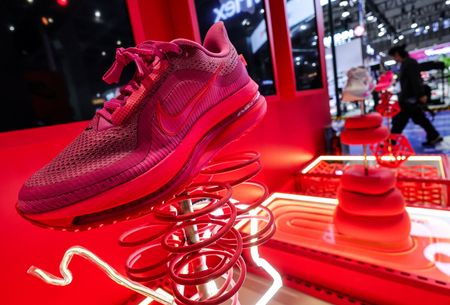

After enduring eight straight quarters of declining sales in China, Nike is making a bold move — stripping major retail partners of their ability to sell its products online in an effort to regain control over pricing and protect its brand.
Analysts say the measures announced this week by Nike’s Greater China general manager Cathy Sparks could go a long way toward curbing the widespread discounting that has been eating away at the brand’s reputation in its third-largest market. However, whether Nike can also convince Chinese consumers that its products are worth buying remains a much harder question to answer.
Sparks, who has 25 years of experience at Nike and took over the China operation earlier this year, announced Tuesday that beginning in January, major sportswear retailers in China will no longer be permitted to sell Nike clothing and shoes online. Going forward, Nike products will be available almost entirely through Nike’s own branded digital stores.
Wei Kan, founder of sports and lifestyle brand strategy consultancy Conduit Asia and a former brand director at Nike Greater China, welcomed the decision. “This is the right thing to do, especially at this moment,” he said. “Otherwise, the consumer will always expect the discounted Nike product.”
But any real benefit from these changes won’t come quickly. Mari Shor, a senior equities analyst at Columbia Threadneedle Investments — which holds Nike stock — said it could take as long as three years before the company sees meaningful results, given both broader economic headwinds and problems of Nike’s own making.
A Nike spokesperson said the company expects improvement in China to happen gradually, noting that Nike has already seen an increase in full-price online sales over the past two quarters after beginning to crack down on discounts.
Nike’s CEO Elliott Hill, who is nearly two years into leading the company, has been working to refocus the brand on sports, rebuild retail partnerships in North America, and roll out new products. Despite those efforts, Nike’s stock has dropped roughly 34% so far this year as investors grow frustrated with the pace of progress.
PRICING DESCRIBED AS ‘TOTAL CHAOS’
Nike’s struggles in China highlight just how competitive the sportswear market there has become. Domestic brands Anta and Li Ning have gained ground with flexible supply chains, rapid expansion, and products designed with Chinese consumers in mind. Meanwhile, international challengers such as Hoka — owned by Deckers — and On have intensified competition at the high end of the market.
In that environment, Nike’s comeback efforts have been dragged down by discounting, too much unsold inventory, and a growing difficulty justifying its premium price tags.
Ben Cavender, managing director at Shanghai-based China Market Research Group, said the sheer volume of Nike products moving through various company-owned and wholesale channels in recent years has created “total chaos” in online pricing. He said that confusion has made it very hard for Nike to reclaim the “coolness” it once had with Chinese shoppers.
Brian Fenn, who served as senior director of product for Nike Greater China from 2018 to 2022, said reining in “constant discounting and grey-market inventory” from outside distributors has been a long-standing goal for Nike. But he cautioned that the new restrictions won’t be painless.
“Cutting distributors like Topsports and Pou Sheng will pressure sales volume before it helps,” Fenn said. “They move a lot of product.”
Nike reported $5.85 billion in total China sales in fiscal year 2026.
BETTING ON LOCAL PRODUCTS
Sparks also announced that Nike has named its first-ever Greater China Vice President of Local Product Creation — an acknowledgment that the company has fallen behind competitors when it comes to designing products that appeal to Chinese tastes. As a first step, Nike plans to develop two lifestyle collections aimed at the holiday season.
However, the success of those efforts will hinge on how much freedom the local team is given to move quickly and at the scale needed to compete with faster-moving rivals.
“The times we won were when the local team could move fast,” Fenn said. “Anta and Li-Ning win as much on speed and reading the culture natively as they do on design.”
Ivan Su, an equity analyst at Morningstar, noted that Chinese shoppers are accustomed to hunting for bargains on major e-commerce platforms like Tmall and Douyin. Nike’s rivals — both domestic brands and foreign companies with locally tailored strategies — offer attractive products at lower price points.
“Consolidating into official storefronts only works if the product justifies the price,” Su said of Nike’s new online restrictions.