
HOUSTON (AP) — Two men who were riding in a van with Lorenzo Salgado Araujo on the morning he was shot and killed by an immigration officer are pushing back hard against the government’s version of events, telling a federal court this week that the officer was never at risk of being struck by the vehicle.
Following the July 7 shooting, the Department of Homeland Security stated that Salgado Araujo, who was 52 years old, had turned his van into a weapon in an attempt to run down an ICE law enforcement officer, and that the officer fired in self-defense.
However, the two men who were with him that day submitted written statements to the court telling a very different story. They say ICE officers were positioned only on the sides of the van — never in front of or behind it. One of the men flatly called the government’s account “a lie.”
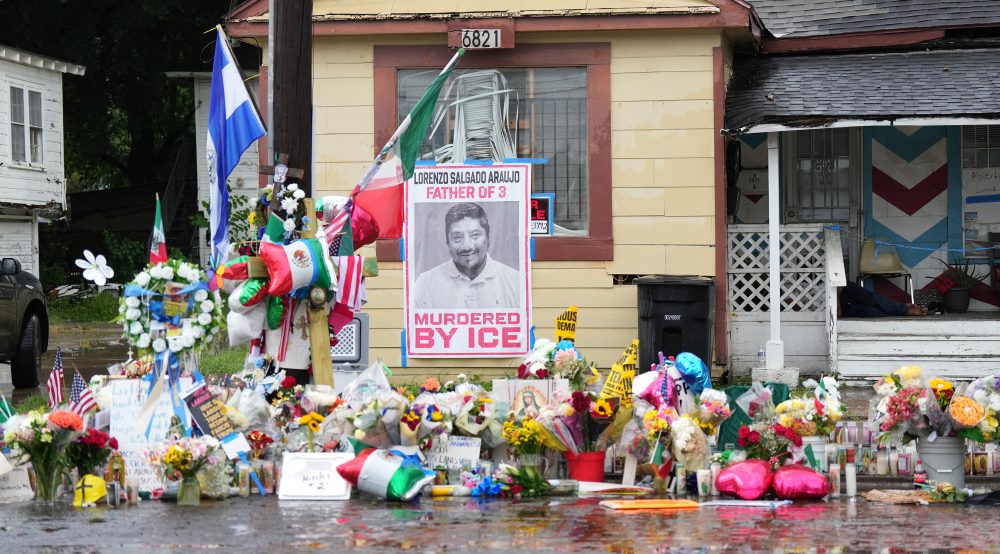
Salgado Araujo had been living in the United States without legal status for 35 years and operated a homebuilding business. He was killed that morning in front of his construction crew, which included his own brother. His family said he had no criminal record.
His death is one of at least 10 that have occurred during immigration enforcement operations since President Donald Trump’s mass deportation campaign began. The killing set off widespread protests across Houston and prompted demands for an independent and transparent investigation. Adding to the controversy, the officers involved were not wearing body cameras, and no photographs or video footage of the incident have emerged.
All three men who were present with Salgado Araujo that morning were taken into custody and are currently being held in immigration detention facilities. Each has filed a habeas corpus petition, arguing that their detention is unconstitutional and requesting that the court order their release.
Jose Trinidad Rojas Pliego and Daniel Tirado Pantoja included their personal accounts of the shooting with their petitions, a development first reported by the Texas Tribune. Both men stated they have lived in the United States for decades and have no criminal history. Victor Salgado, the brother of the man who was killed, has also petitioned for his release, but his attorney asked the court to seal his petition to protect his privacy, so his account of the events has not been made public.
Rojas Pliego, writing in Spanish, described how Salgado Araujo picked him up at 6:30 that morning as part of their normal daily routine. They then collected the other two men.
Tirado Pantoja recounted that a vehicle soon began following them, coming close enough that it nearly caused a collision with their van. He wrote that the group was frightened and ran over a curb while trying to turn around.
According to Rojas Pliego, the ICE vehicle pursued them until Salgado Araujo believed they had shaken the tail — but agents then suddenly had them surrounded with nowhere to go.
Tirado Pantoja wrote that the ICE vehicle struck them from behind, and then again on the driver’s side.
DHS, which oversees ICE, has offered the opposite account, alleging it was Salgado Araujo who rammed the ICE vehicles with his van. A federal prosecutor in Texas has said that ICE agents were actually targeting two Guatemalan men believed to be subject to deportation, who were driving a van similar to Salgado Araujo’s. DHS claims he ignored commands and attempted to run over the officer, prompting the officer to fire in self-defense.
Rojas Pliego rejected that account as “a lie” and “impossible,” writing: “there wasn’t a single officer behind or in front of us, they were only on the sides.”
Tirado Pantoja echoed that, writing that agents were never positioned in front of the van, and that Salgado Araujo had “put vehicle in park as the agents were shooting.”
Rojas Pliego wrote that after the shooting, officers pulled a wounded Salgado Araujo from the vehicle, placed him in handcuffs, and “threw him to the ground.”
Tirado Pantoja recalled that at some point, Salgado Araujo said “Ya me mataron” — meaning “they’ve already killed me.”
Rojas Pliego also wrote that the same officer who fired the shot then “dragged us out violently, throwing us to the ground while we were handcuffed and chained from head to toe.”
Aaron Reitz, the U.S. Attorney for the Southern District of Texas, released a statement last week pledging a thorough investigation involving his office, the FBI, DHS, and state and local law enforcement. “We are doing everything we can to seek the truth and do the right thing,” he wrote.
DHS confirmed in a statement Wednesday that its Office of Inspector General is also conducting an investigation. It also noted that the FBI’s Houston office “is leading an investigation into the potential assault on a federal law enforcement officer.”
On Monday, a judge barred the government from deporting Rojas Pliego or moving him out of the district without court approval. A separate judge overseeing Tirado Pantoja’s case ordered on Wednesday that the federal government must give the court at least five days’ notice before transferring him out of the district or deporting him.
Attorney Raed Gonzalez Olivieri, who represents both men, wrote in their petitions that the circumstances of their detentions “are exceptional: those who now administer his custody shot at him at close range.” He argued this places them at heightened risk of emotional and physical harm while they remain incarcerated.
Both men have applied for visas intended to protect immigrants who are victims of crimes and cooperate with law enforcement. Gonzalez Olivieri wrote that they survived “aggravated assault with a deadly weapon” and are material witnesses to the killing.