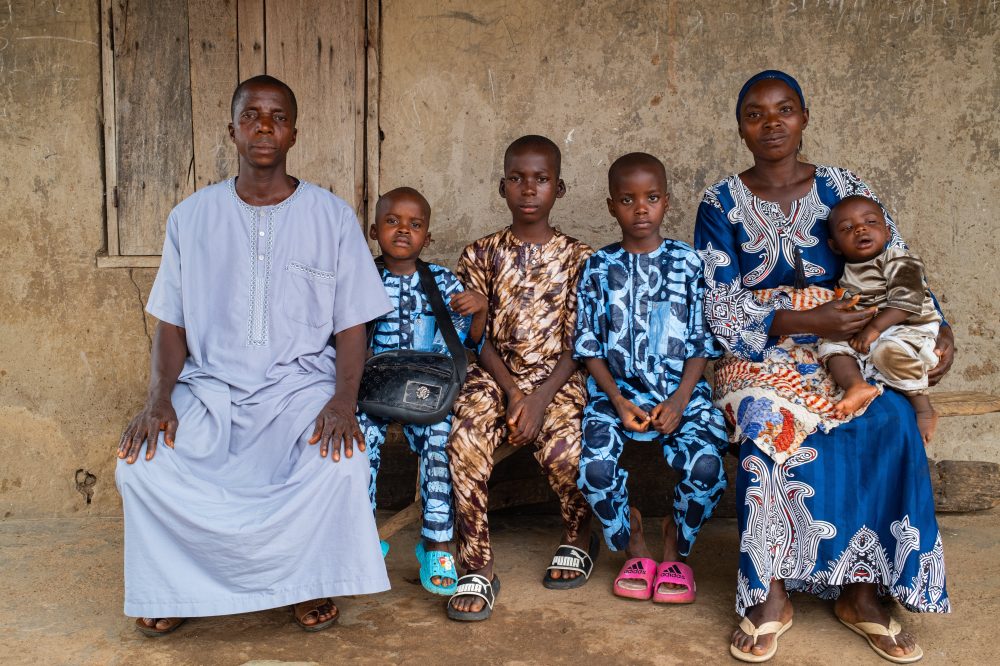

ESINELE, Nigeria — A Nigerian farmer spent nearly two months barely sleeping, haunted by the thought that he might never see his three young sons again. Al-Qaida-linked fighters had swept through his community and taken the boys — along with dozens of other children — in a mass abduction that shocked a part of Nigeria that had never before experienced such an attack.
His youngest son was only 5 years old at the time.
“The day they told us they had been rescued was the happiest day of my life,” said the farmer, Aliyu Saheed, speaking to The Associated Press as the children arrived back in their community on a Friday to celebrations filled with food, prayers, pastors, and Islamic clerics.
His three sons were among dozens of students taken from classrooms in the Oriire area of southwestern Oyo state on May 15. They were eventually freed on July 10.
The attackers seized children as young as 3 years old — an assault that has put much of Nigeria on alert about a threat steadily pushing southward through Africa’s most populated country over the past year. Armed groups, including jihadist factions, are expanding beyond the conflict-worn northern regions into areas that had largely been spared, driven by competition over territory and natural resources.
The armed men descended on the farming community and removed 39 children from three different schools, then marched them — along with their teachers — into a large nearby forest reserve. One teacher died during the abduction itself. According to local media reports, two more teachers were killed while in captivity.
That forest reserve is connected to the neighboring state of Kwara to the north, which borders Nigeria’s northern region — an area with a long and painful history of mass student kidnappings carried out by armed groups seeking ransom. Analysts note that children and schools are frequently chosen as targets because they generate more public attention and command higher ransom payments.
Nigerian President Bola Tinubu identified the attackers as Ansaru militants — a splinter group of the Boko Haram organization that claims to act in defense of Islam and has grown more active in recent years. Authorities reported that the rescue was a joint effort involving the military, the national intelligence agency, and police. Eight kidnappers were taken into custody, while others were killed during the operation.
The incident cast a spotlight on Nigeria’s poorly monitored forest reserves, which armed groups have been using as corridors and hideouts.
“The thing to learn is that the forested areas of the country must be much better surveilled because that is where those armed groups operate and keep their victims,” said Joachim MacEbong, a senior analyst at global risk consultancy firm Control Risks.
In conversations with the AP, both children and their parents described the brutal conditions they endured. Captors left the children outdoors without any shelter, exposed to both harsh sun and heavy rain.
Saheed’s oldest son, 9-year-old Shuaib, said he and his brothers coped by thinking about home and their mother’s food. They were given only boiled rice with palm oil to eat.
“I could not say anything for fear of getting beaten,” Shuaib said. “They flogged us with a cane all over the body, and they hit me in the back with the butt of their gun.”
Alamu Folawe, the head of one of the schools, told reporters that the militants actually beat the youngest children the hardest, and stuffed cloth into their mouths to keep their cries from being heard.
Families reported that some children came home with physical scars, and many are still working through the psychological damage.
Eight-year-old Kehinde Kaosarat, daughter of Aduke Balogun, was among the last children to be released from the hospital. Since returning home that Friday, she has not left her mother’s side.
While being held, the girl said she was unable to eat or sleep because “I kept imagining the worst things.”
Two siblings, Jacob and Mary, told their parents after being freed that they did not want to go back to school, according to their father, Gabriel Sunday. That reaction is not unusual following kidnappings in a country that already ranks among the highest in the world for the number of children not attending school.
“Sending them back to the school does not sound meaningful to me right now,” said Saheed, father of the three boys.
President Tinubu, who won election in 2023 on pledges to fix Nigeria’s security problems, has faced mounting criticism. The United States military has been providing support to Nigerian forces, though that assistance is largely limited to logistics and intelligence work concentrated in the more volatile northern regions.
While Tinubu claimed that the Ansaru militants’ informant network was broken up during the rescue operation, analysts caution that the root causes of instability — including corruption and weak governance — have not been addressed. Nigeria’s security forces, already stretched thin, are largely absent from remote communities.
James Barnett, a research fellow at the U.S.-based Hudson Institute who focuses on African security issues, said Ansaru has spent years quietly building networks in Nigeria’s southwestern region.
Experts warn that an attack perceived as successful could encourage further strikes.
The celebration welcoming the children home brought together both Christians and Muslims from the community for dancing and a shared meal of thanksgiving.
“We have all come here to thank God for protecting the children and their teachers and helping the military men who rescued them,” said Tajudeen Abioye, the village chief.
Many residents had fled the area after the kidnapping but have begun returning. Security forces remain deployed in the area, yet locals — particularly farmers whose fields border the forest reserve — are still living with fear.
“The rescue of the Oriire abductees is wonderful news and should inspire some confidence in Nigeria’s ability to better manage these threats. But it is not the end of insecurity in the southwest or Nigeria as a whole,” Barnett said.