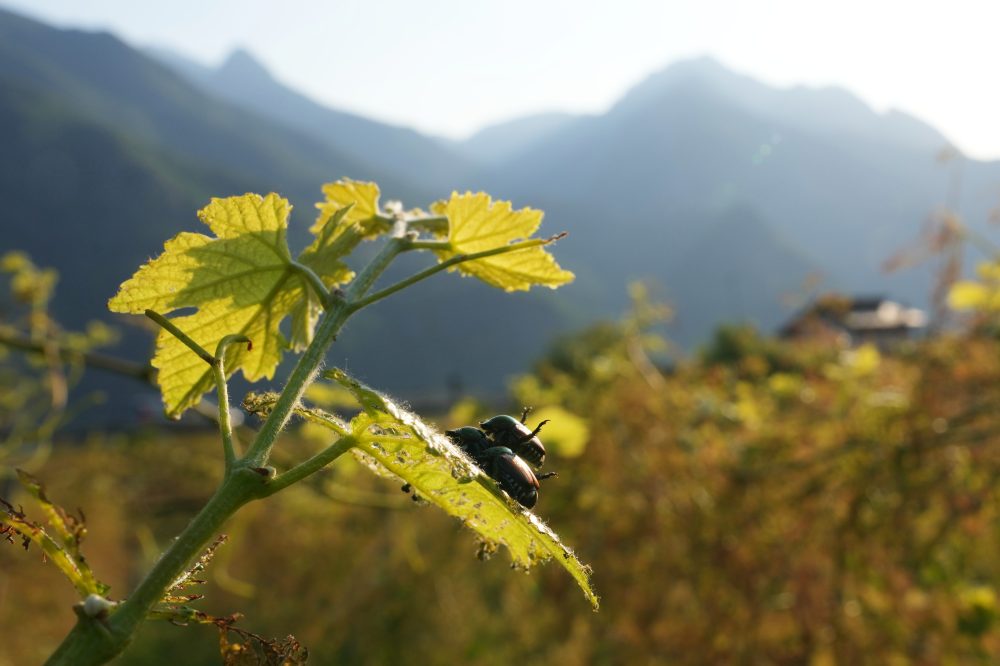

DONNAS, Italy — A shimmering green insect originally from Japan has become an increasingly serious threat to farmers across northern Italy, descending in swarms on orchards and vineyards and chewing distinctive lattice-like holes through leaves that weaken crops and cut into harvests.
Known scientifically as Popillia japonica, the Japanese beetle has been a well-established nuisance in the United States for over a hundred years. However, it is a much more recent arrival to Europe, first turning up near Milan’s Malpensa airport back in 2014. Since then, it has spread through the northeastern Italian regions of Lombardy, Piedmont, and Valle d’Aosta — including the terraced vineyards above the town of Donnas, where it was spotted for the first time last year.
Luciano Zoppo Ronzero, a winemaker who grows Nebbiolo grapes on those historic terraced slopes, described watching the infestation creep closer. “We’re seeing the popillia steadily advance from terrace to terrace across our historic vineyards,” he said. “We’re now about the 10th terrace and can already see the popillia attacks. This means they’re consuming and gradually moving up the mountain.”
The beetle has no natural predators in Europe and will feed on more than 300 different types of plants and trees. That voracious appetite has earned it a spot on the European Union’s list of priority pests, requiring active efforts to control and eliminate outbreaks wherever they occur.
Daniela Lupi, an entomologist at the University of Milan, explained that the beetle is now firmly established in Italy, Switzerland, and Germany — where the focus has shifted to managing its spread — while populations in France and Spain remain low enough that eradication may still be possible.
Adult beetles travel in large groups as they feed and are also known to hitch rides on trains, vehicles, and aircraft. After a summer of feeding, they mate and lay eggs, with the larvae then burrowing into the ground to feed on grass roots before emerging as adults to restart the cycle.
Italy’s Coldiretti agricultural lobby has warned that the pest poses a serious danger as it moves through the Po River Valley, the country’s primary agricultural region. Measuring the damage has proven difficult, however, because the beetle typically eats away the soft tissue of leaves rather than killing plants outright — weakening them and lowering their output without always causing visible destruction.
“In some areas, the beetle has destroyed the harvest,” said Lorenzo Bazzana, the head of economic affairs at Coldiretti. The beetle’s larvae also damage lawns, golf courses, and athletic fields by feeding on grass roots underground.
For Zoppo Ronzero, the concern goes beyond this season’s crop. His vineyards are carved into steep mountainsides and supported by centuries-old drystone walls. When the beetles strip the leaves from grapevines, the grape clusters are left exposed to direct sunlight while the plant’s ability to convert sunlight into energy is severely compromised.
“What scares me is the fact that in the end the grapes don’t ripen. If the grapes don’t ripen, it means we’re not bringing home a splendid harvest, as we had hoped, but something unusable,” he said.
According to Bazzana, the most promising approach to controlling the beetle is targeting the larvae before they mature. The pest was recently found near Verona’s Valerio Catullo airport, and researchers are now testing the release of a microscopic parasite in the surrounding area to attack the grubs in the soil.
Pheromone traps are also being deployed widely, while wine producers in Donnas have turned to pesticide treatments — though those come with limitations, as their effectiveness fades quickly and applying them on steep, terraced terrain is labor-intensive.
Lupi cautioned that inaction would allow the problem to grow. “If we don’t counter it, the population will continue to rise and so there will be strong damage to the fruit plants, to the grasses, to the ornamental plants,” she said. “There are no problems for the human population, because they are not so dangerous, but the production is really, really lowered.”