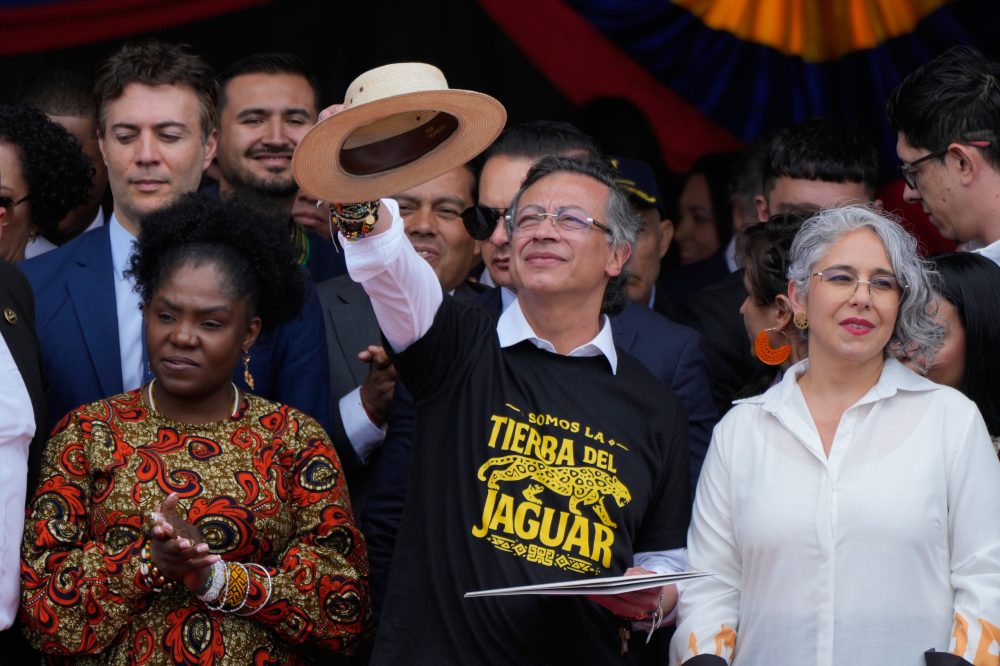

BOGOTÁ, Colombia — Colombia’s outgoing president, Gustavo Petro, took to the podium Monday to urge his supporters to stand firm in defense of his administration’s social and economic achievements and push back against any attempts by the incoming government to overhaul the country’s labor laws.
In what he described as his final address as the nation’s head of state — delivered on Colombia’s Independence Day — the left-wing leader also leveled accusations at Israel and the United States, claiming both nations interfered in Colombia’s recent presidential election.
President-elect Abelardo de la Espriella, a conservative lawyer who holds both U.S. and Colombian citizenship, has pledged to slash government spending by as much as 40% and rewrite labor laws to allow companies to bring on workers by the hour. He is scheduled to be inaugurated on August 7.
Petro renewed his claims of electoral fraud, telling the crowd he would soon release evidence showing that vote tallies were manipulated using software provided by Israel. Colombia’s electoral authorities have rejected those fraud allegations.
The outgoing president called on his supporters to mobilize “by the millions” and organize strikes if the new government moves to roll back labor protections — rules that increased overtime compensation and made short-term hiring more difficult for employers.
“We must exercise our opposition in the streets, and resist peacefully … but in an overwhelming manner,” Petro said.
Political tensions in Colombia have been running high since the June 21 presidential election, which de la Espriella won by a narrow margin of roughly 250,000 votes. Petro ally and losing candidate Iván Cepeda initially accepted the outcome but later declared he would not recognize de la Espriella as a legitimate head of state unless the president-elect renounces his American citizenship.
De la Espriella, a criminal defense attorney, stepped into politics last year after running a Florida-based law firm whose clients included former leaders of Colombian paramilitary organizations and individuals facing money laundering charges.
The incoming president has also vowed to end peace negotiations between Colombia’s government and rebel factions, and has promised a hardline approach to crime — including the construction of large-scale prisons modeled after the CECOT penitentiary in El Salvador.
De la Espriella has further indicated he wants to lower taxes on businesses so companies can afford to pay employees more. During Petro’s time in office, Colombia’s minimum wage was nearly doubled to approximately $550 per month.
U.S. President Donald Trump endorsed de la Espriella ahead of the election, a move that sparked accusations of foreign interference in Colombian affairs. Petro argued Monday that Trump’s backing of his rival should be grounds to invalidate the election results.
Colombia’s electoral authorities have certified de la Espriella’s win. The president-elect has said he intends to hold his inauguration ceremony at a military base as a show of solidarity with the country’s armed forces.
De la Espriella also announced Monday that rebel organizations — including the National Liberation Army and FARC splinter groups — have allegedly offered contract killers up to one million dollars to assassinate him. He has pledged an aggressive crackdown on these groups, which have grown increasingly powerful in rural regions where they profit from drug trafficking.
Bogotá-based political risk analyst Sergio Guzmán noted that de la Espriella will face significant obstacles in carrying out his agenda, including budget cuts and prison construction plans, because the conservative lawyer does not hold a majority in Congress.
Petro hinted Monday that he may remain active in politics by taking on the leadership of his political party, the Historical Pact. According to Guzmán, Petro’s aim now “is to prove that he is still influential” and that his administration’s priorities “will not fade away” but will continue as a lasting force in Colombian political life.