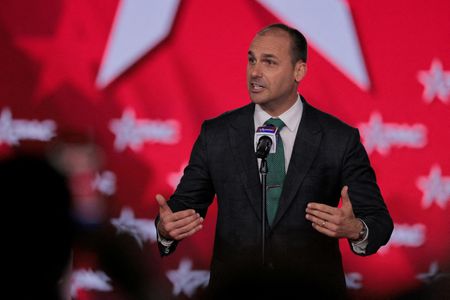

Eduardo Bolsonaro, a former Brazilian lawmaker and son of former President Jair Bolsonaro, confirmed to Reuters on Monday that he has been granted permanent residency in the United States — commonly known as a green card.
The younger Bolsonaro, who has resided in the U.S. since early 2025, said in a phone interview that his residency was approved under the EB-1A visa category. That classification is reserved for individuals who demonstrate extraordinary abilities in fields including science, the arts, business, and sports. He noted that the application process began roughly a year ago.
His time in the U.S. comes after he was sentenced to prison in Brazil. In June, a Brazilian court found him guilty of soliciting U.S. interference in his father’s legal proceedings and handed down a sentence of four years and two months behind bars. Eduardo Bolsonaro maintains that he relocated to the U.S. to shield himself from what he describes as unfair targeting by Brazil’s Supreme Court — not to intervene on his father’s behalf.
His father, former President Jair Bolsonaro, was sentenced to more than 27 years in prison for allegedly plotting a military coup. The elder Bolsonaro had previously been accused of attempting to reverse the outcome of Brazil’s 2022 presidential election, which he lost to President Luiz Inacio Lula da Silva.
Eduardo Bolsonaro has long cultivated relationships with U.S. conservative circles and the Trump administration. Political opponents have accused him and his brother, Senator Flavio Bolsonaro — a candidate for the Brazilian presidency — of working against Brazil’s interests while in the United States. Critics have suggested those efforts may have contributed to U.S. tariffs being placed on certain Brazilian goods.
A 25% tariff on select Brazilian imports is scheduled to go into effect Wednesday. Both brothers have denied playing any role in pushing the Trump administration to impose those tariffs on Brazilian exports.
Before receiving his green card, Eduardo Bolsonaro already held authorization to work in the United States. He made clear he has no plans to return to Brazil without a guarantee of amnesty.
“At least here I am free,” he said.