
MODESTO, Calif. — Teacher Nancy Barajas creates an energetic atmosphere before major assessments by dimming classroom lights, activating a disco ball, and playing upbeat music. Her sixth-grade students participate in this “pre-celebration” dance routine to build confidence before tackling their tests.
Recently, elementary schools in Modesto, California have found plenty of reasons for such celebrations, as both mathematics and reading performance has steadily improved over recent years.
However, the national picture tells a different story. Education experts are sounding alarms about what they’re calling a reading recession — a troubling downward trend that began well before COVID-19 disrupted classroom learning.
Academic researchers from Harvard, Stanford and Dartmouth examined standardized test results for grades three through eight across more than 5,000 school districts spanning 38 states, creating a comprehensive national Education Scorecard for comparison purposes.
Their findings paint a concerning picture: Between 2022 and 2025, only five states along with the District of Columbia demonstrated significant improvement in reading test performance. Across the nation, students continue to lag nearly half a grade level below their pre-pandemic reading abilities, with mathematics showing only marginal improvement.
Although educational institutions have concentrated efforts on helping students recover from COVID-19’s educational disruptions, reading assessment scores have actually been declining since 2013 for eighth graders and 2015 for fourth graders, based on National Assessment of Educational Progress data.
“The pandemic was the mudslide that had followed seven years of steady erosion in achievement,” said Thomas Kane, a Harvard professor who helped create the Education Scorecard.
Despite these challenges, certain states and school systems are demonstrating positive outcomes — primarily through adopting phonics-centered teaching methods and offering additional assistance to students experiencing reading difficulties.
Mathematics presents a more encouraging scenario.
Nearly all states included in the research showed mathematics test score improvements between 2022 and 2025. Student attendance rates also improved across most states. More than 400 U.S. school districts, including Modesto, achieved reading or mathematics progress that exceeded similar districts within their respective states.
Education researchers continue to examine potential causes behind the reading recession.
Experts suggest one contributing factor may be increased smartphone social media usage and related decreases in children’s leisure reading habits. States have also reduced strict accountability measures for schools whose students fail to demonstrate adequate progress on standardized assessments, Kane explained.
However, states achieving reading score improvements — particularly Louisiana, Maryland, Tennessee, Kentucky and Indiana — shared a common approach: mandating schools implement phonics-based instruction known as the “science of reading.”
For many years, educational institutions taught reading through methods that minimized phonics instruction and promoted strategies like using contextual clues to guess unfamiliar words. As reading performance declined over the past decade, parents, researchers and literacy supporters advocated for teaching approaches aligned with extensive research on children’s reading development — primarily through phonetic word recognition.
Beyond reforming instructional practices, states have also mandated schools conduct screenings for learning differences such as dyslexia and employ coaches to enhance teachers’ reading instruction capabilities.
Nevertheless, implementing “science of reading” reforms didn’t ensure universal success. Several states, including Florida, Arizona and Nebraska, modified portions of their reading curriculum but continued experiencing declining test scores.
Modesto transformed its reading instruction during the pandemic period, having previously updated mathematics curriculum several years earlier. The district established a specialized department supporting English language learners. Schools also enhanced teacher preparation, compensating educators $5,000 for completing comprehensive “science of reading” training called LETRS, or Language Essentials for Teachers of Reading and Spelling.
Modesto’s assessment results improved sufficiently to represent an additional 18 weeks of mathematics learning and 13 weeks of reading progress. However, the district acknowledges continued challenges: overall performance remains significantly below grade-level expectations.
Detroit has also seen score improvements through reading emphasis — combined with efforts to increase consistent school attendance. The large urban district previously struggled with inadequate facility conditions, resulting in a 2016 legal challenge where students claimed denial of their “right to read.”
The litigation concluded with a settlement exceeding $94 million, funding that contributed to meaningful progress. While the district continues performing below national averages, student assessment scores have improved more rapidly than comparable urban districts throughout Michigan.
“It took a lot to rebuild systems, and now kids are learning at higher levels, but I’m still not satisfied. And I think that’s the next challenge: continuing to motivate, inspire and change things,” said Detroit Superintendent Nikolai Vitti.
Settlement funds have enabled Munger Elementary-Middle School, situated in a predominantly Latino Detroit neighborhood, to employ 18 educators providing individualized small-group support. An attendance specialist contacts families of absent students and conducts home visits when necessary.
Just recently, explains first grade teacher Samantha Ciaffone, seven or eight daily absences from her classroom were typical. Currently, only one or two students are usually absent.
“It allows us to be better educators to see kids consistently in the seat instead of once or twice a week,” said Ciaffone. “It makes such a difference.”
Throughout the past decade, Southern states have emerged as educational reform leaders — challenging their historical position at the bottom of education rankings. These states quickly adopted research-supported teaching methodologies, with state governments funding teacher training and coaching programs.
These investments have produced results. Louisiana and Alabama were the only states achieving higher mathematics scores in 2025 compared to pre-pandemic levels. Louisiana also stands alone in exceeding pre-pandemic reading averages, with 87% of traditional public school students attending districts with higher scores than 2019.
Alabama achieved remarkable reading gains following the pandemic, driven by state legislation requiring all schools to implement phonics-based instruction. The Legislature modeled 2022 mathematics reforms after Alabama’s reading achievements. The state’s Numeracy Act standardized mathematics instruction, established regular assessment requirements and mandated intervention for students lacking sufficient mathematical skills.
Birmingham’s Oxmoor Valley Elementary hired a dedicated mathematics specialist this year to assist struggling students. The school, which appeared on the state’s “failing” designation in 2016, has consistently improved both mathematics and reading scores, though most students still test below proficiency in both areas.
“We can provide all of these supports, but at the same time, hold kids to high expectations,” Birmingham Superintendent Mark Sullivan said.
Researchers emphasize such advancement is achievable nationwide, citing historical precedent. Beginning in the 1990s, the country experienced decades of improved test scores and graduation rates while reducing racial achievement gaps. This progress continued through the mid-2010s.
“We made enormous progress as a country in terms of educational success from over a 30-year period. Test scores went up dramatically,” said Stanford professor Sean Reardon. “And so I think that says, as a country, we can improve education and educational opportunity.”
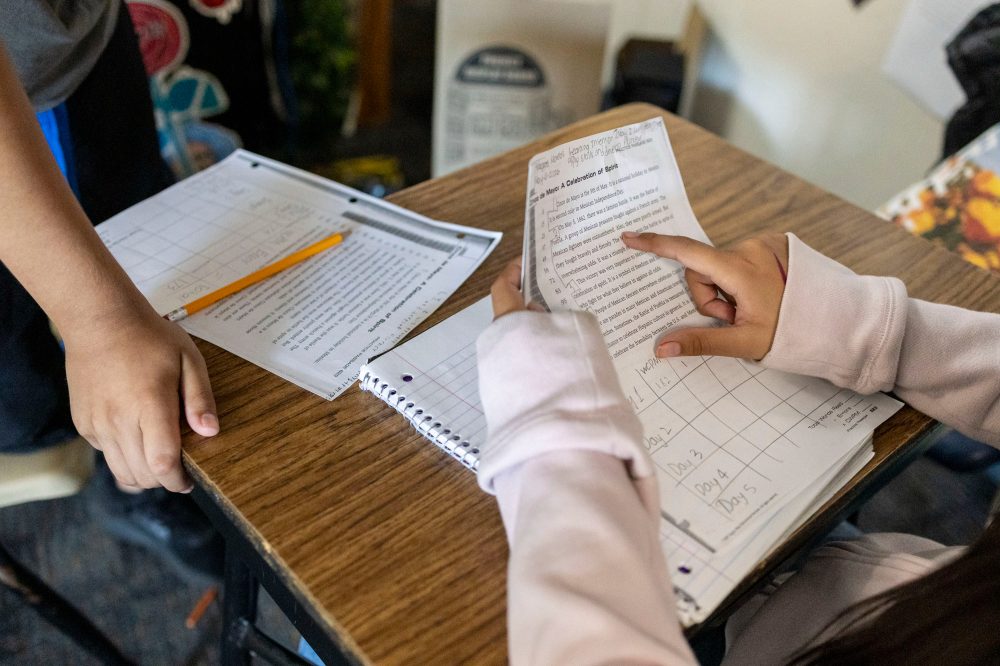
At Modesto’s Fairview Elementary, where Barajas teaches, students now practice reading speed and fluency daily. Following their dance break, the class reads a one-page passage together for one minute, then students work in pairs for additional practice. English language learners partner with native English speakers, and each student receives individual reading time with Barajas.
“Eventually, you get through the word like it’s water,” one boy said. “You just say it smooth.”