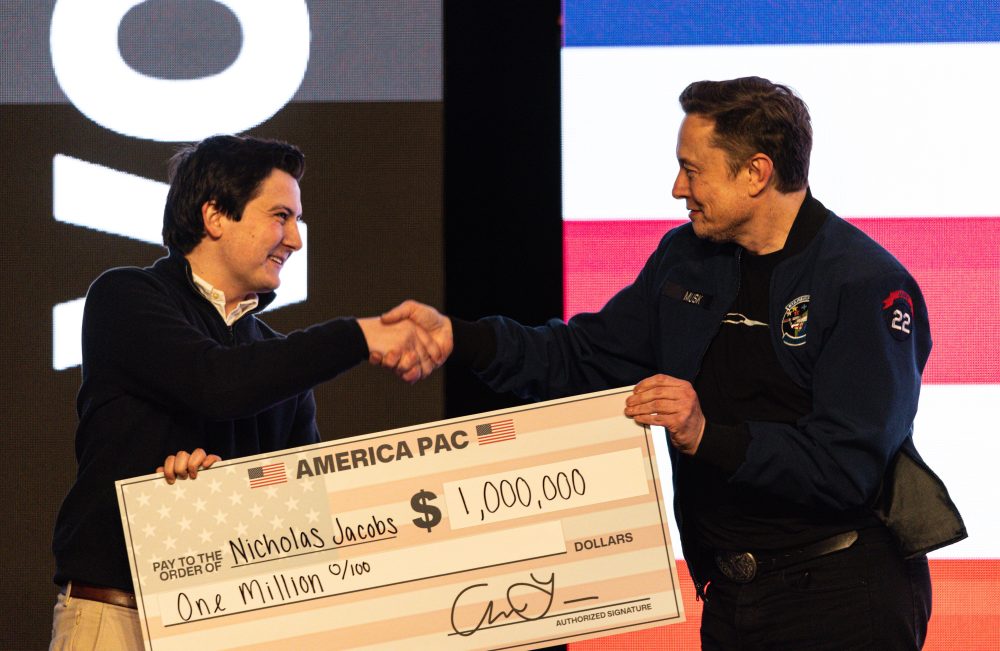

MADISON, Wis. — A bipartisan elections panel in Wisconsin has concluded that billionaire Elon Musk likely violated state law when he distributed $1 million checks to voters ahead of the 2025 Wisconsin Supreme Court election.
The Wisconsin Elections Commission voted 5-1 during a closed session last Thursday to forward two confidential complaints to the Brown County district attorney’s office. Under Wisconsin law, prosecutors have 40 days to report back to the commission on whether they will pursue criminal charges related to election bribery.
Musk, the founder of SpaceX and CEO of Tesla, poured significant resources into the effort to shift majority control of Wisconsin’s highest court. He and the groups he backed spent at least $20 million supporting Republican-backed candidate Brad Schimel — who ultimately lost by 10 percentage points to Democratic-backed candidate Susan Crawford.
Total spending in the race surpassed $100 million, making it the most expensive judicial election in American history. About a month after Schimel’s defeat, Musk announced he planned to significantly scale back his involvement in political campaigns going forward.
The complaints were filed by voters in Milwaukee and Green Bay. Green Bay, located in Brown County, was the site of a rally where Musk personally handed out checks to voters just days before the election.
Commission spokesperson Emilee Miklas confirmed the 5-1 vote, which included members from both parties on the six-person panel — three Democrats and three Republicans.
Brown County District Attorney David Lasee, a Republican, had not responded to a request for comment as of Tuesday.
According to the motion approved by the commission, members found probable cause that Musk broke Wisconsin law through a social media post in which he offered $1 million to people who had voted in the Supreme Court election, stating it was done “in order to induce them to vote in that election.”
Representatives for Musk did not respond to requests for comment on the matter.
In total, three Wisconsin voters received checks from Musk, including two who were handed them in person at the Green Bay event. Two weeks before election day, Musk’s political action committee, America PAC, also offered $100 to voters who either signed a petition opposing “activist judges” or referred others to sign it.
Crawford’s victory preserved liberal control of the Wisconsin Supreme Court. That majority has since grown to 5-2 following Democratic-backed candidate Chris Taylor’s win this year.
Musk’s involvement in the 2025 race has already triggered a separate lawsuit from the Wisconsin Democracy Campaign, a government watchdog group. That suit, filed in Brown County, seeks to permanently bar Musk from offering cash to voters in Wisconsin again. It also alleges that Musk and two organizations he funds violated bribery and unauthorized lottery laws and engaged in an unlawful conspiracy and public nuisance.
Wisconsin’s Democratic attorney general had previously attempted to block Musk from handing over checks to two voters, but state courts rejected that effort.
In legal filings from 2025, Musk’s attorneys argued the cash giveaways were an exercise of free speech rights, and that any restrictions would run afoul of both the Wisconsin and U.S. constitutions. They contended the payments were “intended to generate a grassroots movement in opposition to activist judges, not to expressly advocate for or against any candidate.”
This is not the first time Musk’s political action committee employed this approach. Before the 2024 presidential election, America PAC offered $1 million per day to voters in Wisconsin and six other battleground states who signed a petition in support of the First and Second Amendments. A Pennsylvania judge ultimately allowed that program to continue through Election Day after ruling that prosecutors had not demonstrated it constituted an illegal lottery.