
Recent military operations targeting Iran may influence North Korean leader Kim Jong Un to restart nuclear discussions with President Donald Trump, according to analysts and former government officials speaking from Seoul.
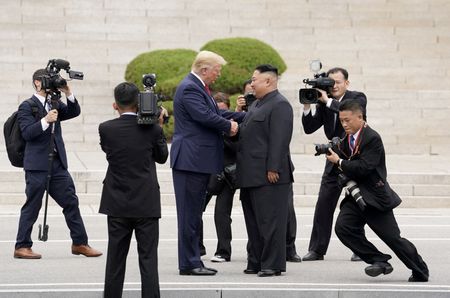
Previous diplomatic efforts aimed at addressing North Korea’s nuclear weapons program and missile development collapsed after high-level meetings between Kim and Trump during 2018 and 2019, despite initial optimism. However, the recent Iranian situation could change Pyongyang’s calculations.
The military action that resulted in the death of Iran’s Supreme Leader Ayatollah Ali Khamenei occurred two months following the capture of Venezuelan President Nicolas Maduro by American special operations forces under Trump’s direction.
“Kim must have thought Iran was attacked like that because it didn’t have nuclear weapons,” explained Song Seong-jong, who teaches at Daejeon University and previously worked for South Korea’s Defence Ministry.
North Korea’s foreign ministry described the military operation as unavoidable, characterizing the United States as “hegemonic and rogue” in a statement released through state-controlled media this past Sunday.
During a recent ruling party gathering, Kim announced plans to expand the country’s nuclear arsenal, though he suggested future discussions remained possible based on Washington’s approach.
“If the United States withdraws its policy of confrontation with North Korea by respecting our country’s current status … there is no reason why we cannot get along well with the U.S.,” Kim stated according to the KCNA news agency.
Trump has expressed interest in renewed discussions, leading to speculation about a potential meeting during his upcoming visit to China scheduled for March 31 through April 2.
“The lesson the Trump administration wants pariah states to take is clear; stop threatening America and its allies and make a deal before it is too late,” said Leif-Eric Easley, who teaches international studies at Ewha Womans University in Seoul.
Easley noted that North Korea has developed more sophisticated nuclear capabilities than Iran possessed, including advanced warhead technology and long-range missile systems.
North Korea formally adopted legislation in 2022 authorizing first-strike nuclear attacks, with Kim declaring this made the nation’s atomic status “irreversible.”
Sydney Seiler, currently a senior adviser at the Center for Strategic and International Studies and former U.S. representative in six-nation nuclear talks, believes renewed negotiations haven’t been Kim’s main focus.
“President Trump’s willingness to use military force and threats for negotiating leverage must make Kim nervous and less likely to hastily seek talks,” Seiler observed.
Some experts suggest Kim’s increased security concerns might actually encourage diplomatic engagement.
“Unlike Iran, it’s impossible to denuclearise North Korea,” said Cho Han-bum from the government-funded Korea Institute for National Unification, pointing to the widespread distribution of nuclear facilities throughout the isolated nation.
International estimates suggest North Korea has built approximately 50 nuclear warheads and maintains sufficient materials to construct up to 40 additional weapons, according to last year’s assessment by the Stockholm International Peace Research Institute.
Yang Moo-jin, a professor at Seoul’s University of North Korean Studies, sees potential for discussions if Kim attempts “to leverage his personal rapport with President Trump to explore Washington’s position on North Korea, while at the same time buying time to further advance the country’s nuclear capabilities.”
Nam Sung-wook, who teaches at Sookmyung Women’s University and formerly led a research organization connected to South Korea’s intelligence service, believes Kim might agree to conditional talks if America recognizes North Korea’s nuclear capabilities.
Nam also suggested the North Korean leader likely feels protected by relationships with China and Russia.
Kim traveled by armored train to Beijing last September, where he appeared alongside Chinese President Xi Jinping and Russian President Vladimir Putin at a significant military demonstration.
Despite these international partnerships, Ko Young-hwan, a former North Korean diplomat who defected and now advises the South Korean government, thinks Kim may want to reassure Trump about nuclear restraint.
“The incident in Iran must have made him think he should manage relations with the United States better,” Ko concluded.