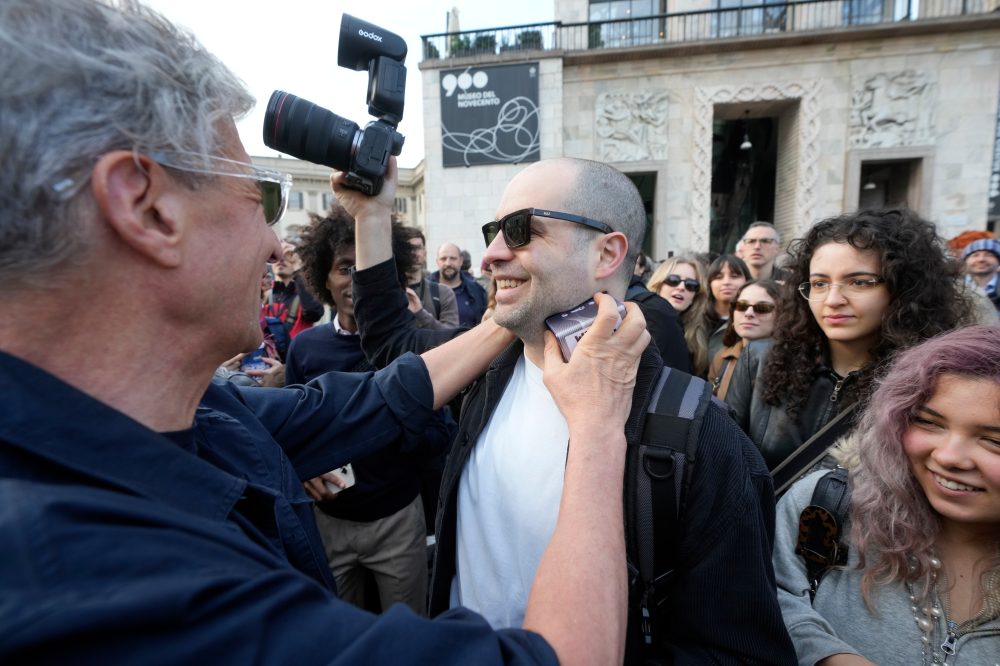

MILAN (AP) — Controversial artist Maurizio Cattelan, known for creating provocative pieces like a golden toilet called “America,” kicked off Milan Design Week by hosting an unconventional gathering at Milan’s iconic Duomo cathedral, where he marked participants with “White Trash” stamps on their necks and hands during an informal sharing of cherished items.
The atmosphere throughout Milan remained upbeat Monday evening as attendees traveled between cocktail receptions at some of the city’s most attractive locations before the Milan Furniture Fair officially began Tuesday, launching what’s considered the most diverse and dynamic collection of events on the international design scene.
Even with economic uncertainty and travel complications caused by conflicts in the Middle East, nearly 1,900 exhibitors representing 32 nations displayed their creations at Fiera Milano Rho, while countless additional events took place throughout the city during the widely anticipated Fuorisalone.
“This week of design is so deep — an experience for all of us. I think we are a big community around the world, and I think at the end, we are a little bit all dreamers,” said Spanish architect and designer Patricia Urquiola, one of Europe’s most celebrated luxury interior and furniture designers.
Among Urquiola’s projects was a collaboration featuring an installation at a Milan luxury hotel for German porcelain manufacturer Duravit, which included artistic totems constructed from toilets and bidets.
This year’s furniture fair introduced a new section called “Raritas” specifically for creators of limited-edition works, providing a counterbalance to the mass production that has traditionally dominated the event.
“We wanted to have antiques, high handcraft and, of course, contemporary collectibles with limited edition and unique pieces, so to have the entire wide range of design at the Salone,” curator Annalisa Rosso said.
Dutch creator Sabine Marcelis displayed a dynamic sculpture featuring air bubbles moving through a viscous liquid contained within a vertical polymer structure. Italian designer Francesco Faccin exhibited seemingly straightforward tables and chairs that looked like wooden planks but were actually bronze castings, drawing inspiration partially from Shaker design principles.
Saudi brand Zaza made its first appearance at Salone, proving that the Gulf kingdom serves not only as a market for international products but also as a source of creative innovation. The brand displayed curved sculptures crafted from colored stainless steel and a limited-edition chair befitting royalty.
“We are here to bring the Saudi story to the world,” designer and architect Abdulaziz Khalid Al Tayyash said. “We want to expand and tell a good story about how, from Saudi lifestyle and Saudi culture, we can bring something interesting to be in such a platform, like this one.”
Interior design has emerged as a significant focus for numerous luxury fashion brands including Armani and Dolce & Gabbana. Even fashion houses that haven’t entered the home goods market consider design week an essential event, complete with champagne receptions.
Gucci hosted visitors in a peaceful garden filled with wildflowers within a monastery setting. The courtyard featured tapestries chronicling the fashion house’s evolution, beginning with Guccio Gucci’s work as a London hotel employee that inspired him to create leather luggage in Florence, and following the brand’s artistic journey under designers Tom Ford, Frida Giannini, Alessandro Michele, Sabato Sarno and current creative director Demna.
Louis Vuitton presented its newest home goods and furniture line in an elegant palazzo, displaying historical pieces including travel trunks designed for traveling artists that connected to modern table arrangements, a wooden turntable stand resembling a drill bit, and an imaginative foosball table with mermaid figures and eyeball-shaped handles.
At the historic Palazzo Litta in the city center, Paris-based Lebanese designer Lina Ghotmeh constructed a bright pink wooden maze designed to encourage visitors to slow their pace, explore design publications, sit down and engage in conversation.
“As people move in this installation, you have this feeling of choreography and dance that is manifested, and you sit here and you’re just about watching people talk to each other. They become part of the setting and part of the theatricality of this place as well,” she said.
At Piazza Gae Aulenti, surrounded by Milan’s impressive skyscrapers, Andrea Olivari displayed sculptures representing the heart, stomach and brain with accompanying text: “Follow your heart, use your brain, trust your stomach.”
Italy’s design and furniture industries contribute 2.3% of the nation’s GDP and account for more than 4% of manufacturing output, establishing Italy as an innovation hub.
The combination of design week with the furniture fair has evolved into a leading global destination and essential platform for numerous small and medium enterprises to connect with purchasers and markets, according to Claudio Feltrin, president of FederlegnoArredo, Italy’s furniture industry association.
Highlighting the sector’s strategic significance, Italian Prime Minister Giorgia Meloni inaugurated the furniture fair, joined by Foreign Minister Antonio Tajani.
Italy’s furniture and design industry performed better than anticipated during U.S. tariff periods, achieving 1.4% growth last year with revenues reaching 52 billion euros ($60.8 billion), with 36% coming from international sales. However, uncertainty from Middle Eastern conflicts, which are increasing energy costs and disrupting transportation, is creating cautious projections for the current year.
International sales declined 9% to approximately 1.6 billion euros ($1.8 billion) during the year’s first two months, including a 20% decrease to the United States. Feltrin indicated the sector could rebound if conflicts conclude soon, similar to last year’s recovery from tariff impacts.