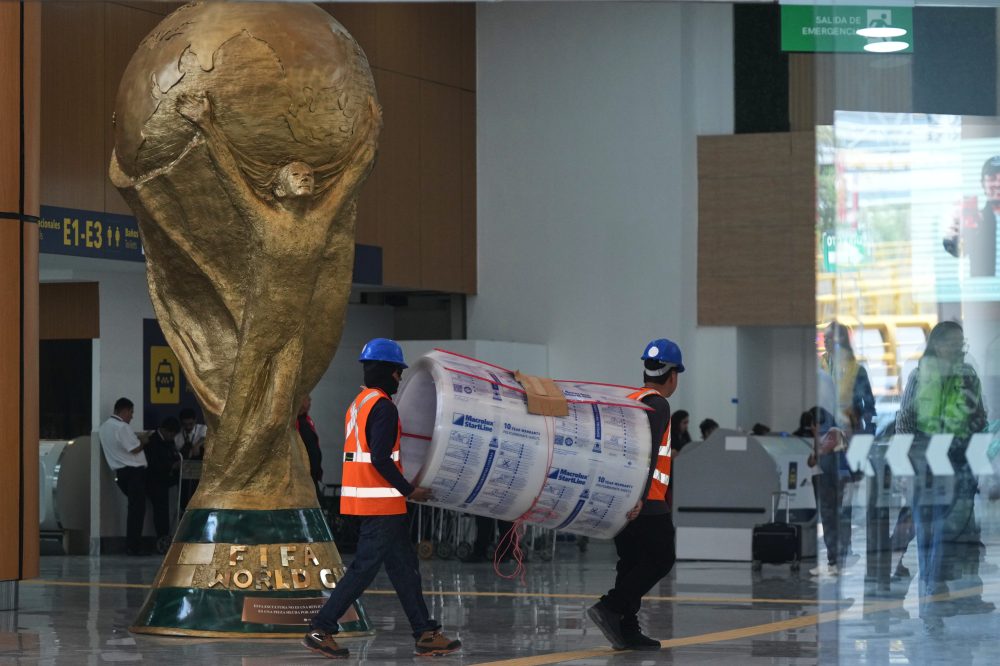

MEXICO CITY — As the 2026 FIFA World Cup approaches with less than 30 days remaining, travelers landing at Mexico City’s Benito Juárez International Airport find themselves walking through what looks like an active construction zone, complete with drilling sounds, scattered construction materials, and incomplete floors.
The ongoing construction work exists alongside numerous World Cup promotional displays, including oversized soccer ball replicas and trophy displays that serve as distractions from the renovation disruptions that have been ongoing for twelve months.
Sitting near one of six cranes still positioned at Terminal 1’s entrance, 28-year-old engineer Luis Ibarra expressed no frustration with the construction activity. He pointed out that the airport has long dealt with water damage, roof leaks, and serious overcrowding issues.
Airport officials informed The Associated Press that completing this major renovation at Mexico’s busiest airport requires more than 3,000 workers operating in 20-hour shifts daily.
The project has faced significant challenges.
After one full year of renovation work — with the initial phase now over 90% finished — difficulties have been “more than we expected,” Juan José Padilla, general director of the Benito Juárez International Airport, told the AP. He said the unforeseen obstacles resulted from infrastructure that’s five decades old and missing original construction plans for certain sections.
“We are facing years of neglect,” said Padilla, recognizing that prolonged underinvestment had impacted the terminals that process approximately 120,000 passengers each day.
Under these circumstances, work commenced in May 2025 on a $500 million modernization effort. The extensive project receives complete funding from the airport operations, which have been under Mexican Navy management since 2023.
Project coordinator Capt. Arturo Flores explained that the comprehensive upgrade encompasses new exterior terminal designs, updated bathroom facilities, improved baggage collection areas, and replacement of almost 100,000 square meters of flooring and lighting systems. Internal redesign efforts have also recovered 30,000 square meters of passenger waiting areas. The second phase will start in August — after the World Cup concludes — and continue until December.
The improvements also feature expanded security camera coverage — increasing from 2,200 to more than 4,000 units — which will utilize artificial intelligence technology to identify suspicious vehicles, baggage, or people.
Padilla mentioned that an anti-drone system is also planned for installation soon to handle any emergency situations.
This month, Mexico’s foreign ministry revealed an agreement with the U.S. Department of Transportation to implement the 2015 bilateral transportation agreement through additional new measures.
These measures involve increasing the number of slots — designated time periods for aircraft departures and arrivals — which Washington had sought for U.S. carriers. Under the former administration, available slots at the capital’s airport dropped from 61 to 43 hourly, before rising slightly to 44 last year.
Regarding this matter, Padilla announced that slot availability for both international and domestic carriers will soon expand to 46.
This current airport enhancement represents a significant project by President Claudia Sheinbaum, coming after a difficult period under her predecessor, Andrés Manuel López Obrador, who had tried to redirect capital aviation operations to a new, military-operated airport at a different site — a plan that never succeeded in gaining support.