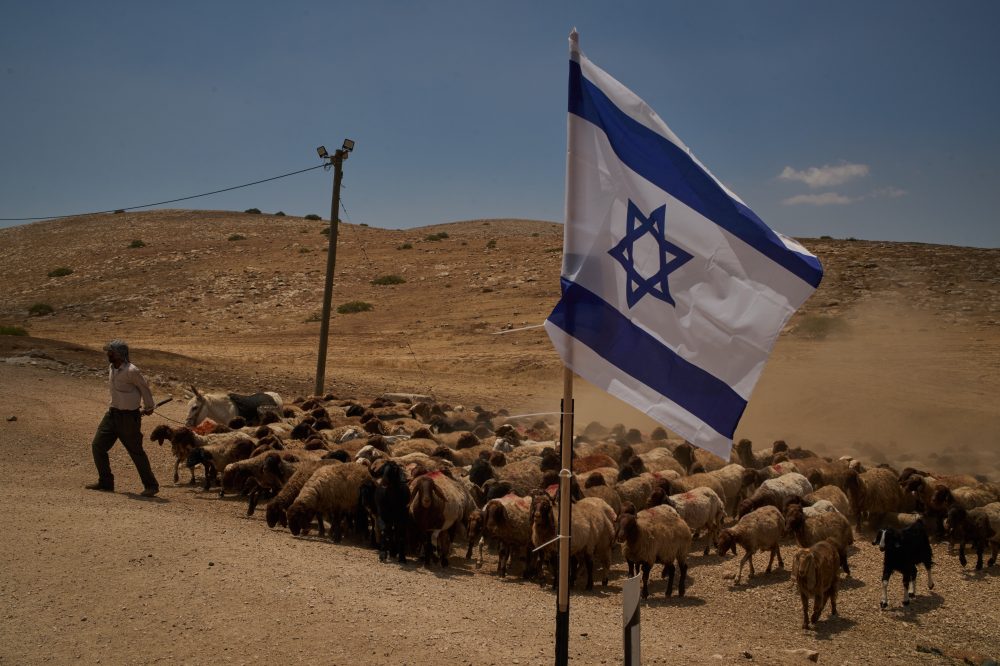

MASAFER YATTA, West Bank (AP) — Israeli flags in blue and white wave from hilltops and stretch along roads throughout the occupied West Bank, marking the steady growth of Israeli settlements and newly constructed outposts on Palestinian land.
For shepherds living in the Jordan Valley and in Masafer Yatta — a collection of villages in the southern West Bank — those flags and expanding settlements have become an unavoidable part of everyday life, a constant reminder of how restricted their existence has become.
Brothers Thiab and Ayman Draghme guided their flock across the parched hills of the Jordan Valley, making their way back to their community after searching for somewhere to graze their animals. Every step of their route is deliberate. Certain pastures are now considered too dangerous due to a rise in settler attacks. Others can only be accessed when Israeli activists accompany the shepherds, recording any encounters with settlers or Israeli troops and offering what they describe as a protective presence.
The practice of shepherding has changed little across generations. The dangers surrounding it have changed dramatically.
“We are people of generosity and hospitality,” said Thiab, a father of eight. “We want to live in peace.”
He described how his children have grown up amid Israeli demolitions, forced displacement, and constant uncertainty. “What kind of future is that for a child?” he asked.
Nearby, Youssef Moussa Shinaran, 52, says he has been unable to harvest olives from his land since the conflict between Israel and Hamas in Gaza erupted in October 2023. “You’re not allowed to move around. The house has become a prison,” said Shinaran, who lives near Susya in the southern West Bank.
The United Nations humanitarian agency reports that settler attacks surged sharply in 2026. From January through April, the agency documented 761 incidents tied to Israeli settlers, with close to 2,000 people displaced due to violence and restrictions on movement. Whole communities have grown increasingly cut off as new outposts spread across the hills around them.
The strain goes far beyond direct clashes between settlers and Palestinians.
On one occasion, a dispute over a brush fire drew settlers, Palestinians, soldiers, and police to a hillside. After settlers blamed Palestinians for starting the fire, one Palestinian and one Israeli activist were taken into custody, though both were released later that same day.
The ongoing settlement expansion and associated violence have pushed many Palestinian families to change how they live. Like the Draghme brothers, some shepherds no longer take their animals to places they once frequented. Others have given up entirely, selling off their flocks after deciding the dangers had grown too severe.
Near the village of Taybeh, northeast of Ramallah, the family of Shoma Kaabneh sold all of their sheep after an Israeli outpost was established close to their home. Her husband has since turned to construction work, bringing in far less income than the family once earned selling dairy products.
In another community in the northern Jordan Valley, one Palestinian family has left in place an Israeli flag that settlers planted near their sheep pen. They say taking it down risks provoking retaliation from settlers or soldiers.
As darkness settled over the Masafer Yatta area, men gathered outdoors to pray near their homes. Not far away, settlers rode quad bikes before heading back to a nearby outpost just a few hundred meters away.
Residents have organized nighttime watch rotations, taking turns staying up to alert neighbors if settlers approach.
Each morning unfolds much like the one before: sheep are led up into the hills, children play between tents and homes, and families tend to their animals, mend fences, and cook meals — all beneath a skyline increasingly shaped by Israeli construction aimed at pushing them out.
This is a documentary photo story curated by AP photo editors.