
Families of the 43 victims killed when Genoa’s Morandi highway bridge came crashing down nearly eight years ago are expected to fill a courtroom Thursday as verdicts are handed down in the trial of 57 defendants charged in connection with one of Italy’s deadliest infrastructure disasters.
Among those facing judgment are former top executives from highway operator Autostrade per L’Italia, specialists from its engineering subsidiary SPEA, and former government officials from Italy’s Infrastructure Ministry.
The majority of defendants are charged with negligent disaster and multiple counts of manslaughter, stemming from allegations that the bridge was not properly maintained. The structure served as a critical link between northern Italy and the French Riviera.
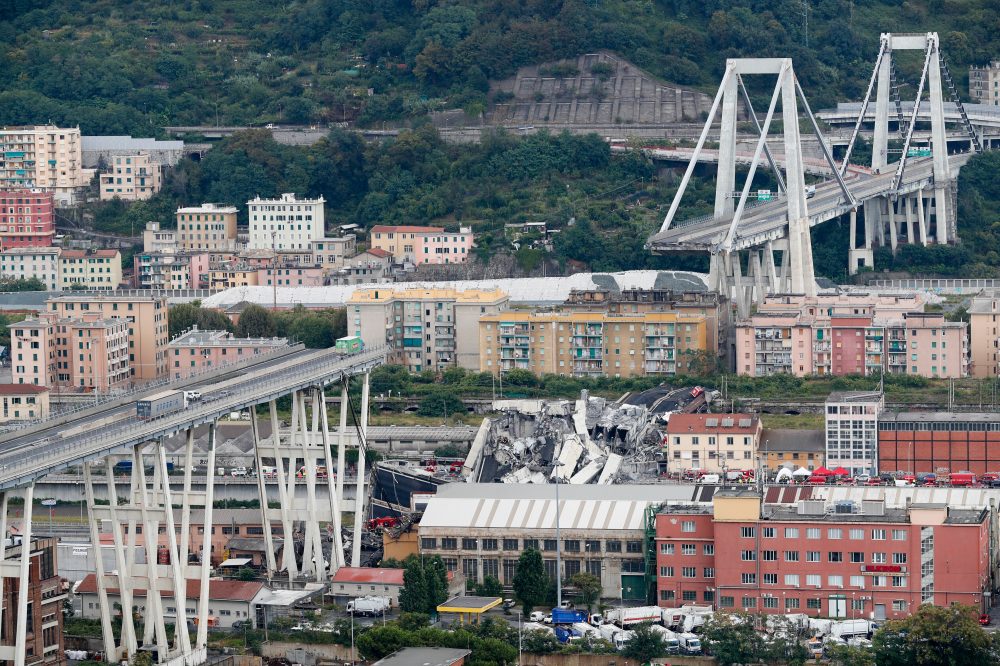
On the morning of August 14, 2018, a 200-meter, or roughly 650-foot, section of the bridge gave way during a rainstorm. Dozens of vehicles plunged to the ground below. The collapse unfolded on one of Italy’s most heavily traveled days, as millions of people were heading out to celebrate the traditional August 15 Ferragosto holiday, the height of the summer vacation season.
Footage and images of the destroyed bridge circulated around the world, leaving Italians stunned by the scale of the catastrophe.
Prosecutors contend that years of neglected maintenance ultimately caused the collapse and have called for combined prison sentences totaling nearly 400 years across all defendants. The accused deny any wrongdoing, arguing instead that a construction flaw was to blame.
With Thursday’s verdicts and sentencing, the proceedings will officially conclude after spanning more than 280 court hearings over four years.
Attorney Raffaele Caruso, who represents families of victims, expressed what many in the courtroom are hoping to hear. “Our expectation is to feel our pain recognized … and to have it acknowledged that this did not happen by chance, but because of serious failures in maintenance,” he said.
When the Morandi Bridge opened in 1967, it was celebrated as an engineering achievement, featuring three A-shaped concrete pylons and stay cables encased in concrete. Caruso, who represents the families of three of those killed, said the trial revealed that warning signs about structural problems in the pylon that eventually gave way had existed for decades. He pointed to maintenance work carried out on the other two pylons beginning in 1993 that was never applied to the third.
“From 1993 onward, the problem was known. We had three identical pylons. Two had already shown the same defect, and no one seriously asked whether the third one had it as well,” Caruso said.
On Thursday, Autostrade’s current chief executive, Arrigo Giana, issued a public apology through an open letter printed in major Italian newspapers. Giana, who took over as CEO last year, wrote: “The actions and decisions of some people left indelible scars. Offering today the apology that was not made then is, for us, a moral imperative that goes beyond establishing legal responsibility and the course of justice toward the truth.”
Autostrade and its subsidiary previously reached a corporate liability settlement during the proceedings, agreeing to pay roughly 30 million euros, or approximately $34 million, in financial penalties. That agreement allowed the companies to avoid standing trial as corporate defendants and potentially facing far steeper consequences, including being barred from public contracts. The settlements came after the companies put new compliance measures in place and after victims received compensation.
A replacement bridge, designed by Genoa-born architect Renzo Piano, opened in 2020. It spans a memorial dedicated to those who lost their lives in the Morandi Bridge collapse.