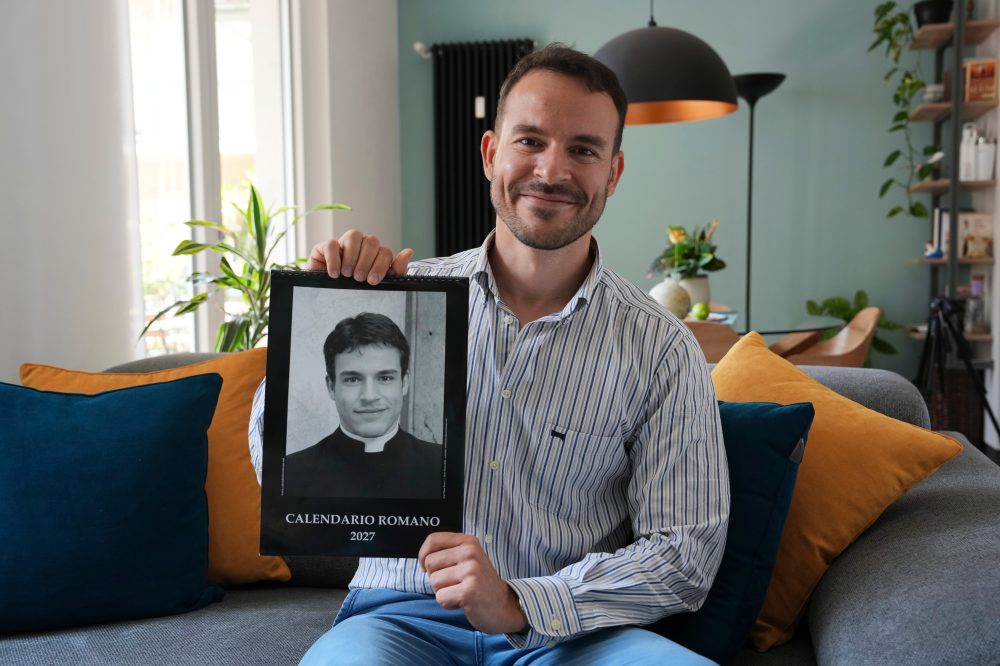

ROME — For more than two decades, tourists visiting Rome have purchased a calendar showcasing attractive young men dressed in clerical clothing, but a recent investigation reveals most of the subjects aren’t actually clergy members.
The main face of this so-called attractive priest calendar has been Giovanni Galizia, who has graced the cover for most of the past 23 years. The recurring image shows Galizia sporting clerical attire with a mysterious grin reminiscent of da Vinci’s famous masterpiece, photographed against a church’s stone exterior in his hometown of Palermo.
“It was the smile of an embarrassed kid, because I saw all my friends in front of me laughing out loud because I was dressed like I was a priest,” Galizia explained to The Associated Press during a Wednesday conversation at his Verona residence.
The photo session was simply a playful experience that had little impact on his existence until a Rome newspaper story this week exposed that the “sexy priest calendar” might be better described as “the fake priest calendar,” capturing national media attention.
The publication has no connection to the Vatican, which chose not to provide a statement.
Currently working as a 39-year-old cabin crew member for a Spanish carrier, Galizia was merely 17 when mutual acquaintances connected him with photographer Piero Pazzi, who has also produced a calendar showcasing Venetian boat operators and established feline history museums in Budapest and Montenegro.
Known formally as Calendario Romano, each yearly edition displays 12 monochrome portraits of men primarily wearing religious garments — many images reused annually. Galizia was familiar with only one other model, a French individual who also wasn’t ordained.
Pazzi informed the AP that approximately one-third of the men featured in the already published 2027 edition are genuine clergy members but offered no additional information.
Galizia mentioned he’s never been recognized publicly, although his relatives once presented the calendar to their grandmother as a present, “and they all died laughing.”
Galizia views the photographs showing priests as belonging to an artistic heritage, pointing out that television drama viewers don’t expect actual clergy to portray religious characters.
“Of course, it winks a bit at the dynamic between the sacred and the profane, because it is clear that seeing a world that is distant and in some ways so lofty as the ecclesiastical world, with such a fresh-faced young man, creates a kind of dissonance,” he explained.
However, he also expressed confusion about why the monochrome close-up images have been viewed as attractive. Pazzi similarly stated that wasn’t the intention.
“There’s a tendency to confuse what is beautiful with what is sensual, because nowadays, especially in today’s world, which is quite sexualized, beauty is expressed only through sensuality,” Galizia observed.
“That said, I appreciate the observation and take it as a compliment — because managing to be sexy in a priest’s collar is no small feat.”
Pazzi refuses to disclose sales figures for the Roman calendars but estimates thousands are purchased annually. While Pazzi collects royalties, Galizia, who signed authorization paperwork during the shoot, stated he’s never pursued compensation.
The publication retails for approximately 8 euros (roughly $9.30) in stores surrounding the Vatican and throughout Rome’s historical district. Store employee Hassam Mohammad reported selling several copies daily.
Pazzi incorporates Vatican information within the calendar, though its creation remains separate from and unconnected to the Holy See.
A South Korean priest walking near the Vatican recently noted the calendar’s popularity in his homeland, particularly among younger generations who find it amusing.
“They often think priests are stiff and distant,” explained the priest, who gave his name informally as Father Domenico. “But looking at this calendar, they think priests are more familiar, and priests can be funny. I think in Korea this calendar is very famous, and it is OK.”