
SHUSHA, Azerbaijan — A top Azerbaijani official says his country and neighboring Armenia are experiencing what he calls “real peace” and are rebuilding economic ties after decades of conflict — but a formal peace treaty won’t be signed until Armenia makes changes to its constitution.
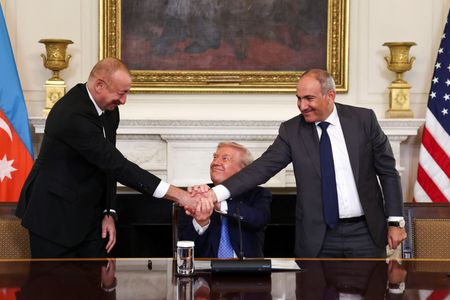
The two South Caucasus nations spent much of the time since the late 1980s in intermittent warfare, primarily over the mountainous Nagorno-Karabakh region. That conflict reached a turning point last August when a preliminary peace agreement, brokered by the United States, was reached between the two sides.
However, Azerbaijan continues to take issue with language in the preamble of Armenia’s constitution. That preamble references a Soviet-era document calling for the unification of Armenia with Nagorno-Karabakh, which was once an autonomous region within Soviet Azerbaijan. Azerbaijan seized full control of the territory in a swift military operation in 2023, prompting most of its roughly 100,000 residents — the majority of whom were ethnically Armenian — to flee into Armenia.
Hikmet Hajiyev, who serves as assistant to Azerbaijan’s president and heads the president’s foreign policy department, spoke with reporters this week on the sidelines of a forum held in the city of Shusha. He highlighted the progress both countries have made, pointing to growing direct contacts and increasing bilateral trade, including expanded Azerbaijani oil product shipments to Armenia.
“We are living in conditions of real peace. For Azerbaijan and Armenia, peace is not just something written on paper or contained in a declaration — it is a reality,” Hajiyev said.
Even so, he made clear that Baku’s position on Armenia’s constitution has not softened.
“The form of constitutional changes is Armenia’s internal matter,” Hajiyev said. “What is important for Azerbaijan is that the provisions we regard as territorial claims against our country are formally removed, whether through the adoption of a new constitution or another legal mechanism.”
“Once that issue is resolved, we believe there will be no obstacles to signing the final peace agreement,” he added.
Armenian Prime Minister Nikol Pashinyan has indicated he wants to put a new constitution to a public referendum and plans to release a draft of the updated document before the end of this year. However, his Civil Contract party does not hold the parliamentary supermajority required to call such a referendum, and it remains uncertain whether opposition groups — many of which are aligned with pro-Russian interests — will lend their support.
Hajiyev stated that simply publishing a draft constitution would not be enough to move forward with signing a peace deal.
On a separate but related matter, Hajiyev said Azerbaijan has received “serious and positive signals” from the United States suggesting that construction on a planned regional transport corridor could get underway this autumn. The proposed route, dubbed the “Trump Route for International Peace and Prosperity” or TRIPP, would span roughly 43 kilometers (about 27 miles) through Armenian territory, giving Azerbaijan a direct land connection to its exclave of Nakhchivan and to its close ally Turkey.
The corridor is seen as a way to better link Asia and Europe, particularly as Washington seeks to reduce reliance on Russian trade and energy routes in the wake of the war in Ukraine.
“Our position is that this should be implemented as soon as possible,” Hajiyev said of the TRIPP corridor.
He also noted that infrastructure work in Azerbaijan’s southwestern Zangilan region is expected to be largely finished by the end of 2026, after which it could be linked to planned construction in Armenia and Turkey.
A lasting peace between the two nations could reopen trade and transport routes across the South Caucasus, with broader implications for the regional influence of Russia, Turkey, and Iran.