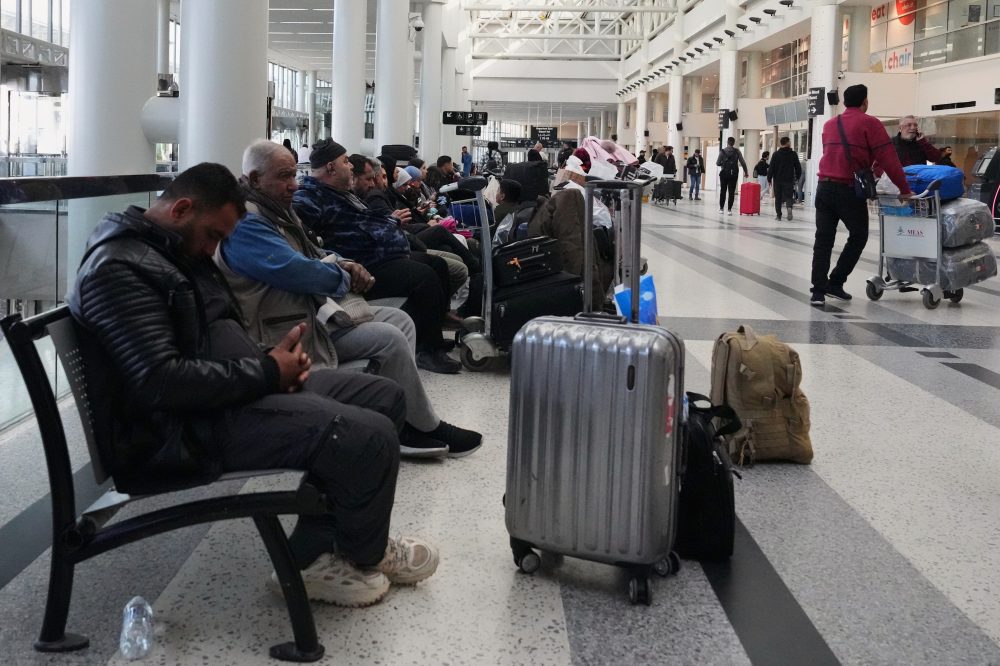

LONDON — Military strikes targeting Iran have created widespread travel chaos throughout the Middle East, forcing the closure of major airports and leaving tens of thousands of passengers stranded worldwide as the conflict entered its second day Sunday.
Major transportation hubs across the region remained shuttered Sunday following the joint U.S.-Israeli operation. Emirates Airlines halted all Dubai operations until at least Sunday afternoon, while Qatar Airways announced its airport would stay closed through Monday morning. Israeli airspace also continued its closure Sunday.
The widespread airspace restrictions have affected hundreds of thousands of travelers globally.
On Saturday, massive travel disruptions began when Israel, Qatar, Syria, Iran, Iraq, Kuwait and Bahrain all sealed their airspace to civilian aircraft. The United Arab Emirates implemented what officials called a “temporary and partial closure” of its airspace, effectively grounding all flight operations, according to flight monitoring service FlightRadar24.
The closures shuttered critical aviation hubs in Dubai, Abu Dhabi and Doha, resulting in more than 1,800 flight cancellations by major Middle Eastern carriers. The three primary airlines serving these airports — Emirates, Qatar Airways and Etihad — normally handle approximately 90,000 daily passengers through their hubs, plus countless additional travelers bound for Middle Eastern destinations, aviation data company Cirium reports.
UAE authorities reported direct impacts at two of their airports, condemning what they described as a “blatant attack involving Iranian ballistic missiles” on Saturday.
Dubai International Airport — the UAE’s largest facility and among the world’s busiest — confirmed four people sustained injuries, while Abu Dhabi’s Zayed International Airport reported one fatality and seven injuries from a drone attack. Kuwait International Airport also experienced strikes.
While Iran has not officially acknowledged responsibility, the retaliatory strikes that Gulf states blame on Iran went beyond the American military installations Iran had previously threatened to target.
“For travelers, there’s no way to sugarcoat this,” stated Henry Harteveldt, airline industry analyst and president of Atmosphere Research Group. “You should prepare for delays or cancellations for the next few days as these attacks evolve and hopefully end.”
Airlines operating Middle Eastern routes must now redirect flights around the conflict zone, with many aircraft routing south through Saudi Arabian airspace. These longer flight paths will add hours to journey times and increase fuel consumption, raising operational costs that airlines must absorb. Extended conflicts could drive ticket prices higher.
The increased air traffic will strain Saudi Arabia’s air traffic control systems, potentially requiring slower traffic flow to maintain safety standards. Meanwhile, countries with closed airspace will lose revenue from overflight fees that airlines typically pay.
However, Mike McCormick, former Federal Aviation Administration air traffic control overseer and current Embry-Riddle Aeronautical University professor, believes partial airspace reopening may occur within days once American and Israeli officials share military flight information and Iran’s remaining missile capabilities with airlines.
“Those countries then will be able to go through and say, okay, we can reopen this portion of our space but we’ll keep this portion of our airspace closed,” McCormick explained. “So I think what we’ll see in the next 24 to 36 hours how the use of airspace evolves as the kinetic activity gets more well defined and as the capability of Iran to actually shoot missiles and create additional risk is diminished due to the attacks.”
The duration of flight operation disruptions remains uncertain. For reference, the Israeli and U.S. military action against Iran in June 2025 continued for 12 days.
Rapidly changing conditions prompted airlines to advise passengers to verify flight status online before traveling to airports.
Several carriers have issued travel waivers allowing affected passengers to reschedule flights without additional fees or fare increases.
Jonathan Escott and his fiancé discovered their situation firsthand Saturday when they reached Newcastle, England’s airport only to learn their direct Emirates flight to Dubai had been canceled, stranding all passengers.
Escott returned to family accommodations an hour from the airport but remains uncertain about future travel plans.
“No one knows,” Escott said. “No one really knows what’s going on with the conflict, really. Not Emirates, Emirates don’t have a clue. No one has a clue.”
Flight tracking service FlightAware recorded at least 145 aircraft diverted to alternate airports in Athens, Istanbul, and Rome after being rerouted from destinations like Tel Aviv and Dubai early Saturday. Other flights returned to their departure points, including one aircraft that spent nearly 15 hours airborne after leaving Philadelphia, reaching Spain before turning back to its starting location.
Multiple airlines suspended weekend international service to Dubai as India’s civil aviation authority classified much of the Middle East — including airspace over Jordan, Saudi Arabia and Lebanon — as high-security risk zones at all flight levels.
Air India canceled all Middle Eastern flights. Turkish Airlines suspended service to Lebanon, Syria, Iraq, Iran and Jordan until Monday, while also halting flights to Qatar, Kuwait, Bahrain, the United Arab Emirates and Oman.
The carrier warned of potential additional cancellations, joining numerous other airlines suspending regional service through the weekend.
American carriers Delta Air Lines and United Airlines paused Tel Aviv flights at least through the weekend. Dutch carrier KLM had already announced earlier this week its suspension of Tel Aviv service.
Lufthansa, Air France, Transavia and Pegasus eliminated all Lebanon flights, while American Airlines suspended Philadelphia-to-Doha service.
Virgin Atlantic announced it would avoid Iraqi airspace, potentially extending flight times to and from India, the Maldives and Riyadh. The airline, already avoiding Iranian airspace, said all flights would carry extra fuel for potential short-notice rerouting.
British Airways suspended Tel Aviv and Bahrain flights until next week, while canceling Saturday’s Amman, Jordan service.
“Travelers should anticipate that there will be a lot of disruptions,” Harteveldt warned. “To be honest, if you haven’t left home, chances are you won’t be leaving home if you’re supposed to travel to or through these destinations for at least several days, if not longer. And if you are returning home, you will have to be very creative about how you get home.”