
Maryland’s Natural Resources Police unveiled their latest patrol vessel Wednesday, christening it the Harry L. George to commemorate a former deputy commander who lost his life while serving in 1978.
The ceremonial unveiling took place at Sandy Point State Park in Annapolis, where Lieutenant Colonel George’s children joined Department of Natural Resources Secretary Josh Kurtz and NRP Superintendent Col. Orlando Lilly for the dedication. The naming represents a return to the agency’s historical practice of honoring fallen officers through vessel designations.
“The dedication of our newest patrol boat not only honors the sacrifice and service of Lieutenant Colonel Harry L. George, but also ensures his legacy will never be forgotten,” said Col. Lilly. “We are proud to continue this esteemed tradition of commemorating the fallen heroes who gave their lives in service to Maryland’s parks, waterways, and communities. The George family has been deeply supportive of this effort, and it is a privilege to resume this practice in his honor.”
This marks the first time since 1951 that the Natural Resources Police have named a patrol boat after a deceased officer. The previous vessel honored Gordon G. Barnes, who died on duty in 1945.
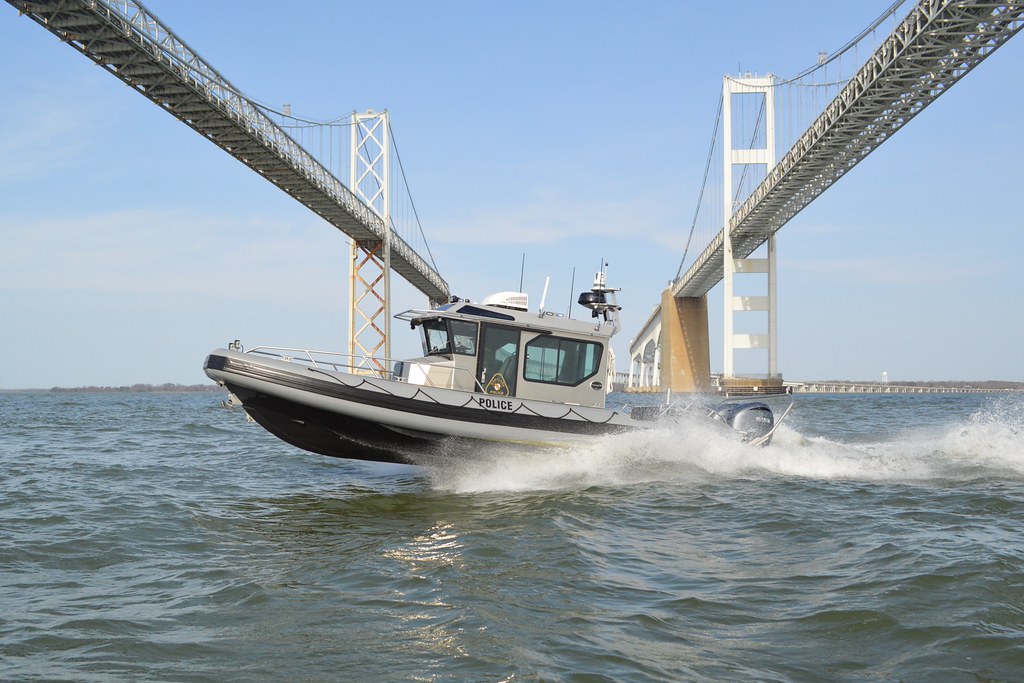
Known by its designation NRP 130, the Harry L. George is a 31-foot LifeProof rigid-hull inflatable vessel manufactured in Bremerton, Washington and delivered to Maryland this spring. The craft accommodates six to nine passengers while requiring a minimal operating crew.
The new addition joins NRP’s existing fleet of 21- and 25-foot LifeProof boats currently deployed on the Choptank, South, Potomac, and Wicomico rivers.
Equipped with three 300-horsepower Yamaha four-stroke outboard motors, the vessel provides the speed and capability needed to patrol Chesapeake Bay’s open waters amid growing numbers of high-performance recreational boats. Its 260-gallon fuel tank allows for extended operations without refueling stops, crucial during lengthy search-and-rescue missions.
The boat features cutting-edge technology and law enforcement equipment, including shock-absorbing seats, an enclosed climate-controlled cabin, radar and thermal imaging systems, and sophisticated electronics.
Officials will base the Harry L. George in Rock Hall, where it will handle multiple response duties, supporting routine patrols and dramatically improving search and rescue capabilities, especially during rough weather when smaller vessels could endanger officer safety or hamper emergency responses.
Boaters throughout the Chesapeake Bay and waters around Kent and Queen Anne’s counties will benefit from enhanced police response to maritime emergencies and service calls, as the modern vessel replaces NRP 109, a diesel-powered 36-foot aluminum boat from 1990 that has been decommissioned as part of the agency’s fleet modernization initiative.
Lieutenant Colonel George perished following an aircraft accident on August 8, 1978. That day, George, Sergeant Joseph Robey, and DNR personnel deputy director William Jones took off from Lee Airport in Edgewater for a surveillance flight over the lower Chesapeake Bay. Their aircraft crashed in woods near Maryland Route 214 shortly after departure. While Robey and Jones survived with injuries requiring treatment, George died from his injuries on October 24, 1978. George began his career with the Tidewater Fisheries Commission in 1953 and became head of the Natural Resources Police Marine Division in 1975.