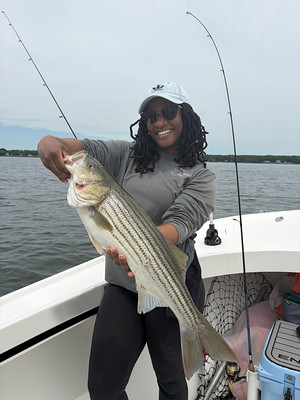

This weekend marks the 250th anniversary of the United States, and for many families, that celebration will include a fishing trip. July 4 is a license-free fishing day throughout Maryland, meaning anyone can wet a line without a fishing license — a great opportunity to bring along a friend or family member who hasn’t tried fishing before.
Forecast Summary: July 1–7
Surface water temperatures in the main Bay and at river mouths have climbed to 80 degrees and are expected to keep rising through the week. Smaller rivers and streams are running in the upper 70s to low 80s. As water warms, oxygen levels near the bottom are declining. Most Bay bottom waters still have adequate oxygen, with the exception of the Potomac River between Indian Head and the Wicomico River, and the Bay from the Sassafras River down to the Bay Bridge area.
Most Maryland rivers and streams are running below average flow levels. Water clarity throughout the Bay and its rivers is expected to be near average. Strong tidal currents are expected through Sunday due to the full moon on June 29.
Upper Chesapeake Bay
The lower Susquehanna River and Conowingo Dam pool remain popular destinations, drawing anglers targeting striped bass, Chesapeake Channa, and blue, flathead, and channel catfish. Striped bass fishing is best during the early morning and late evening in the dam pool and along the edges of the Susquehanna Flats. Casting lures and drifting cut bait in the dam pool are popular techniques. Chesapeake Channa can be found in the dam pool and in the grass beds of the Susquehanna Flats, where paddletail lures and noisy topwater lures work best.
Elsewhere in the upper Bay, striped bass are turning up along channel edges at around 30 feet deep. The channels leading into the Northeast River and Elk River are worth checking. Anglers are also finding fish around the lumps near Pooles Island, the Tolchester Channel, Swan Point, and Love Point. Live-lining spot and drifting cut bait are popular methods, along with jigging and trolling. As temperatures rise, anglers are urged to release striped bass outside the slot size without removing them from the water to improve their survival. Safe catch-and-release guidance is available on the Maryland DNR website.
Tidal rivers in the region are producing Chesapeake Channa, blue and channel catfish, and white perch. Chesapeake Channa — also known as snakeheads — favor thick grass in the middle to upper sections of tidal rivers. Buzzbaits, chatterbaits, and soft frogs work well in the grass, while white paddletails are effective along the open-water edges.
Blue and channel catfish are active throughout the tidal rivers. Larger female blue catfish appear to have finished spawning and are now feeding aggressively to rebuild their energy. Channel edges are productive during the day, while shoal edges along channels are good spots in the evenings.
White perch fishing in tidal rivers and creeks offers a more relaxed, often secluded experience. Grass shrimp, pieces of peeler crab, or bloodworms fished near oyster beds, hard bottom, and dock pilings are reliable choices. Spin jigs, spinners, and small spinnerbaits cast along shorelines during early morning and evening can target larger fish. Spot have been found at the mouth of the Magothy River, the Chester River, and near Sandy Point State Park.
Middle Bay
The Bay Bridge remains a productive fishing destination, with striped bass gathering around the pier bases and rock piles. The 30-foot edge on the east side of the bridge is a favored spot for live-lining spot or drifting soft crab and cut baits back toward the pier bases.
Anglers are encouraged to fish responsibly as water temperatures climb. When temperatures exceed 80 degrees and air temperatures are high, survival rates for caught-and-released striped bass drop significantly. Ethical anglers should limit their fishing during these conditions, avoid removing fish from the water that will be released, and reduce catch-and-release activity overall.
Most daytime anglers in the middle Bay are working channel edges at 30 feet or deeper. The steep channel edges off Kent Island, south of Bloody Point to Stone Rock, the Clay Banks, and below the mouth of the Choptank and Thomas Point are all worth exploring. Depth finders are helpful for locating striped bass suspended along these edges.
Middle Bay water temperatures are around 79 degrees and are expected to cross 80 degrees by the end of the week. High salinity levels resulting from dry conditions are making the area more hospitable for bluefish. Trolling drone spoons and surge tube lures can target them, as can jigging or casting soft plastic jigs and paddletails to breaking fish. Cownose rays have been a nuisance for anglers across the Bay, snagging lines and stirring up shallow waters when they move through an area.
Shallow-water striped bass fishing is shifting to early morning and late evening windows due to warm water and intense sunlight. Topwater lures such as poppers and Zara Spooks are exciting choices over grass, while paddletails and jerkbaits offer good alternatives.
Spot and croaker fishing in the middle Bay is offering some enjoyable action. Many of the spot are large enough to keep, and a fair number of croaker are clearing the 9-inch minimum size. Good locations include Whitehall Bay, Holland Point, Eastern Bay, Bar Neck Point, inside of Black Walnut Point, and the mouth of the Little Choptank.
Tidal rivers and creeks offer accessible light-tackle opportunities. Fishing with grass shrimp, peeler crab, or bloodworms on a simple bottom rig near deep-water docks and oyster reefs is a good option. Drifting along shorelines and casting spin jigs and spinnerbaits during morning and evening hours is always a pleasant outing.
Lower Bay
Warmer water temperatures are pushing striped bass to channel edges in 30 feet of water or deeper. Shallow-water opportunities still exist but are largely limited to early morning and late evening.
Productive spots for striped bass include the steep 30-foot channel edges of the lower Potomac River near St. Georges Island, Piney Point, and Cornfield Point, as well as Cedar Point and Cove Point, and the Patuxent River below the Route 4 Bridge. Live-lining spot and jigging with soft plastics are popular methods. Action is also being reported on the eastern side of the Bay near the HS Buoy and the Target Ship area.
Bluefish numbers are picking up this week, offering additional fishing opportunities. Anglers are encountering breaking fish at times, and bluefish are also being caught while chumming for cobia, jigging, or trolling. When breaking fish are spotted, large red drum, striped bass, and cobia may also be holding near the bottom beneath the surface action.
Large red drum are providing catch-and-release action near the mouth of the Potomac River, the Middle Grounds, and the Target Ship area. Schools can be spotted by breaking fish activity, slicks, and depth finders. Jigging with large soft plastics is producing good results, as are soft crab baits and trolling with large chrome spoons. Trolling spreads in the lower Bay can be rigged with drone spoons for bluefish, surgical tube lures for cobia, and chrome spoons for large red drum.
Cobia chumming has been active near the Target Ship, Smith Point, and Point Lookout, with most anglers drifting live eels into their chum slicks. While waiting for cobia, drifting cut bait can produce bluefish and the occasional striped bass. Most cobia being caught are falling just short of the 43-inch minimum. On calm days, sight fishing and casting soft plastic jigs or live eels to cobia is also an option.
Spot and croaker fishing is delighting anglers of all ages this week. Many spot are table-fare size, and while the throwback rate on croaker is high, a solid percentage are meeting the 9-inch minimum. Good locations include Cob Island, the mouth of the Wicomico River, Cornfield Harbor, the lower Patuxent, waters near Hoopers Island, and Tangier Sound.
White perch can be found in tidal rivers and creeks, sometimes alongside spot and croaker. Spin jigs and small spinnerbaits along shorelines offer fun light-tackle fishing. In the evenings, chartreuse Clouser flies with crystal flash are an exciting fly-fishing option for white perch along shorelines.
Blue Crabs
It has been a tough week for recreational crabbers. The crabs being caught in deeper water are large — often 8 inches — but supplies are thinning out quickly as they get harvested. A couple of molting cycles will likely be needed before crabbing improves to the level crabbers are hoping for. The lower Bay tends to have the best catches. Those using razor clams as bait are dealing with cownose rays chewing through clam bags. For recreational crabbers hoping to fill a bushel in time for July 4 celebrations, good luck is in order.
Freshwater Fishing
Fish and anglers alike are adjusting to summer heat. In the central and parts of the western regions, trout are seeking cool, shady pools to wait out the midday sun, feeding mostly at night. Catch-and-release trout anglers are encouraged to minimize handling to reduce stress on the fish.
Western Maryland’s reservoirs offer excellent fishing for a wide range of species. Deep Creek Lake is among the most well-known and draws heavy summer vacation traffic. Lake Habeeb at Rocky Gap State Park is another popular destination. Nestled between them in Garrett County is Piney Reservoir, which holds a unique population of saugeye — a hybrid of walleye and sauger — that were stocked to help manage yellow perch numbers in the lake. Angler Herb Floyd made a trip from the Eastern Shore to fish for saugeye at Piney Reservoir and was surprised to land and release a massive tiger musky instead.
Largemouth and smallmouth bass are most active at night, so early morning and evening hours offer the best chances to find them feeding. Topwater lures and spinnerbaits work well near shallow structure and grass. Wacky-rigged stick worms and soft plastics are good choices when fishing through floating grass mats and shaded areas where bass may be resting during the heat of the day.
Chesapeake Channa are wrapping up their spawning activities this month and will be actively feeding. Large grass beds and small backwater ditches in the tidal waters are prime locations. Soft frogs, buzzbaits, and chatterbaits are effective in the grass, while white paddletails work well along open-water grass edges.
Summer is prime time for sunfish, offering easy and enjoyable light-tackle fishing. Small lures and natural baits will attract them, and it’s also a great opportunity for fly fishing with a lightweight rod, floating fly line, and small rubber-legged poppers or floating ant patterns. Bluegill and pumpkinseed sunfish are found in nearly every freshwater pond in Maryland, while redbreast sunfish are more common in western parts of the state.
Atlantic Ocean and Coastal Bays
Ocean City is in full summer swing, and both the beaches and waterways are packed with vacationers. Anglers should use extra caution on the water. The beaches of Assateague offer more elbow room for those with overland beach permits. Surf anglers are catching and releasing some impressive large red drum on cut mullet or menhaden baits, with the head of the menhaden holding up best against clearnose skates. Sandbar and blacktip sharks are also being encountered. Bluefish are showing up in the surf, with finger mullet on a finger mullet rig being a popular setup. Kingfish are available to those fishing small bloodworm baits or artificial alternatives. A few spot and croaker are also being reported in the surf. Casting jigs tipped with squid strips is a productive way to target flounder.
In the inlet during early morning and late evening, striped bass and bluefish are being taken on bucktails and soft plastic jigs. Striped bass are also showing up at the bridge piers of the Verrazano and Route 90 bridges during morning and evening hours, with drifted bait working well at night. Sheepshead are being caught on sand fleas along the jetty rocks and pier structure. Flounder are consistently available in the inlet. Drifting for flounder in back bay channels near the inlet is productive, but anglers should exercise caution in that area due to heavy boat traffic.
Black sea bass fishing has been solid at offshore wreck and reef sites. Limit catches are uncommon, but most anglers are coming home with a respectable haul. Triggerfish and flounder are also part of the catch. Some anglers specifically targeting flounder near humps and reef sites are landing some impressive fish.
Offshore canyon trips are being rewarded with a solid run of yellowfin tuna. Some boats have reached limits, and most anglers are bringing home at least one or two hefty yellowfins. Deep-drop fishing is producing golden and blueline tilefish. Anglers and boat captains are reminded that tilefish catches must be reported electronically — details are available on the NOAA website. A few bluefin tuna have also been reported from the canyons.