
Financial markets experienced significant gains Wednesday following reports that the United States has proposed a temporary halt to hostilities and delivered a comprehensive peace proposal to Iran, sparking investor optimism about reduced regional tensions.
Futures for the S&P 500 climbed 0.9% during Asian trading hours, while European market futures advanced 1.2%. Meanwhile, Brent crude oil prices tumbled approximately 6% to $98.30 per barrel as traders anticipated potential resumption of Persian Gulf oil shipments.
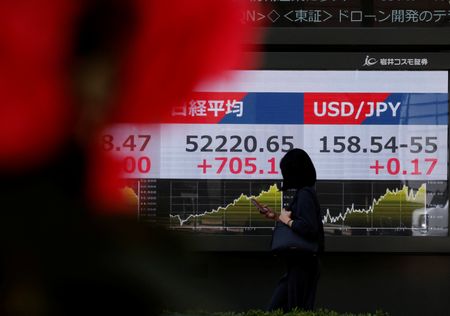
Asian equity markets showed strong performance, with exchanges in Australia, South Korea and Japan posting roughly 2% gains during morning sessions. Gold prices also increased 1.6% as investor sentiment shifted.
“The market is trading the headlines at the moment,” explained Kerry Craig, global market strategist at J.P. Morgan Asset Management in Melbourne. “So there’s a positive tone. The difficulty is now…there are still unknowns about where this actually goes from here and whether there’s anything material in terms of a ceasefire.”
President Donald Trump indicated Tuesday that negotiations were advancing toward ending the conflict, mentioning an important concession obtained from Tehran. Sources confirmed Washington had delivered a 15-point settlement framework to Iranian officials.
According to Israel’s Channel 12, citing three sources, American officials are pursuing a month-long cessation of hostilities to facilitate discussions around the 15-point proposal. However, Tehran has disputed claims that direct negotiations have occurred.
Market reactions have been positive yet measured since Monday’s initial reports of American efforts to conclude hostilities, though uncertainty remains about when the Strait of Hormuz might reopen for oil transport.
Currency markets showed the dollar weakening slightly throughout the week, trading at 158.8 yen and $1.1620 per euro Wednesday morning.
Despite the recent decline, Brent crude remains elevated 35% since conflict began, hovering near $100 per barrel – a level already creating economic strain for Asian buyers purchasing jet fuel and diesel.
Interest rate markets continue anticipating aggressive central bank responses, with pricing indicating upcoming rate increases across Europe, Britain, Japan and Australia to combat inflation, while no additional U.S. rate reductions are expected.
Treasury bond yields declined during Tokyo trading, with benchmark 10-year yields dropping approximately five basis points to 4.34% and two-year yields falling similarly to 3.875%.
“For now, it feels like a market that is reacting rather than anticipating, and until there is clearer alignment from both sides, I would expect price action to remain fragile,” stated Marc Velan, head of investments at Lucerne Asset Management in Singapore. “People are reluctant to chase moves that are entirely headline-driven and can reverse quickly.”
Despite diplomatic developments, military operations continue on the ground, with U.S., Israeli and Iranian strikes ongoing. Sources indicate Washington is preparing additional troop deployments to the region.
Two individuals familiar with the situation told Reuters Tuesday that thousands of soldiers from the Army’s elite 82nd Airborne Division are expected to deploy to the Middle East.
The Australian dollar remained steady around 70 U.S. cents following February inflation data that came in slightly below expectations, recorded before the current conflict began.
War concerns have also overshadowed growing credit market anxieties, where private credit stress indicators are emerging. Ares Management became the latest asset manager Tuesday to restrict withdrawals from a private debt fund, unsettling investors.
Ares shares, representing approximately $623 billion in managed assets at the end of 2025, declined 1% Tuesday and are down 36% year-to-date.