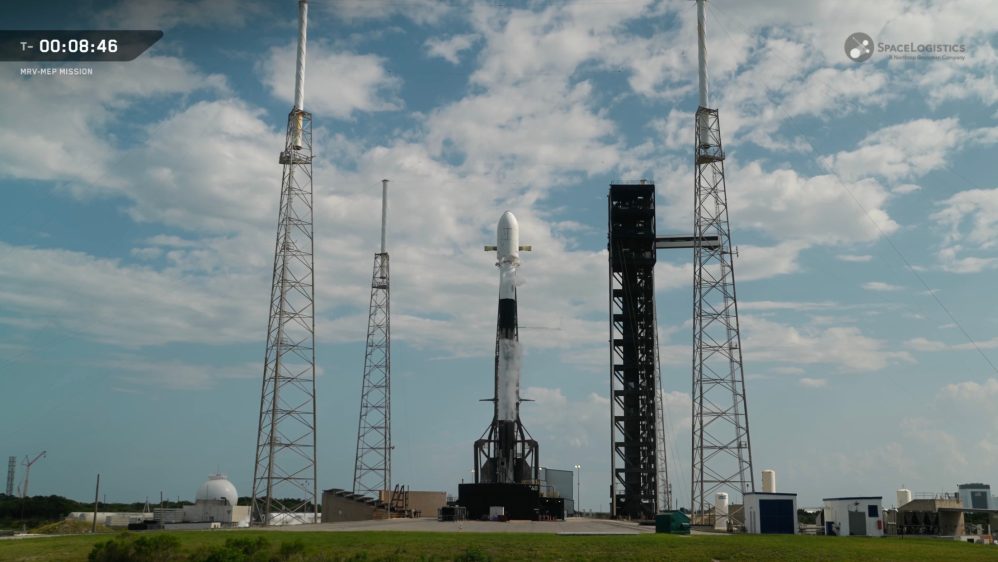

A two-armed robotic spacecraft took flight Tuesday afternoon on a private salvage mission aimed at breathing new life into aging communication satellites that are nearly out of fuel — orbiting tens of thousands of miles above our planet.
This marks the second satellite-rescue mission to launch in July alone, reflecting a rapidly growing industry push to keep older spacecraft operational as long as possible rather than replacing them at enormous expense. Earlier this month, on July 3, a separate company’s three-armed spacecraft headed to orbit with the goal of boosting NASA’s Swift Observatory to prevent it from falling back to Earth this fall.
Northrop Grumman’s robotic vehicle — known as MRV — was carried into space aboard a SpaceX rocket. Over the next year, the MRV and its accompanying jetpacks will maneuver into a specific orbit sitting 22,300 miles above Earth. This so-called geosynchronous orbit is home to hundreds of satellites that travel at the same speed as Earth’s rotation, allowing them to hover over the same portion of the planet continuously.
Once the minivan-sized spacecraft reaches its destination, it will use its 10-foot arms to attach a jetpack to an aging communication satellite before moving on to service two additional satellites.
For this inaugural flight, the spacecraft carried three electrically powered jetpacks that were designed to separate from the rocket after liftoff and independently navigate to the target orbit using their own xenon gas thrusters — just like the MRV itself. The robot will then retrieve the jetpacks one by one and connect them to satellites in need.
Each jetpack is roughly the size of a washing machine and will supply enough propulsion to keep a fuel-depleted satellite functioning for several additional years rather than forcing it into early retirement. If successful, the mission will be a major win for satellite operators SES, based in Luxembourg, and Optus, based in Australia — potentially saving them millions of dollars they would otherwise spend on replacement satellites.
This latest venture is part of Northrop Grumman’s ongoing work in the satellite-servicing field. Back in 2019 and 2020, the company launched two spacecraft that docked with struggling communication satellites and took over their steering functions, extending their operational lives.
Northrop Grumman designed this newer robotic system to be even more capable. The company envisions future versions of the technology being used to repair and reposition active satellites, and even to grab decommissioned satellites and remove them from crowded orbital zones. The company is working alongside the U.S. Naval Research Laboratory and the Defense Advanced Research Projects Agency on these efforts.
Meanwhile, Katalyst Space Technologies is still putting its Link satellite helper through its paces in orbit before it rushes to assist the Swift Observatory. Flight controllers ran into early troubles with communication and pointing systems on the Link spacecraft, and had to transmit software fixes to resolve the issues.
NASA’s Swift telescope, which launched in 2004, has been losing altitude more quickly than expected due to heightened solar activity in recent months. A boost from the Link spacecraft in the coming weeks could extend the life of the nearly $400 million gamma ray observatory — which studies some of the most powerful explosions ever recorded in the universe — by many more years.
NASA has contracted with Katalyst for $30 million to raise Swift back to its original operating altitude of 373 miles. Northrop Grumman provided the rocket that carried Link to orbit, using a Pegasus rocket launched from an aircraft.