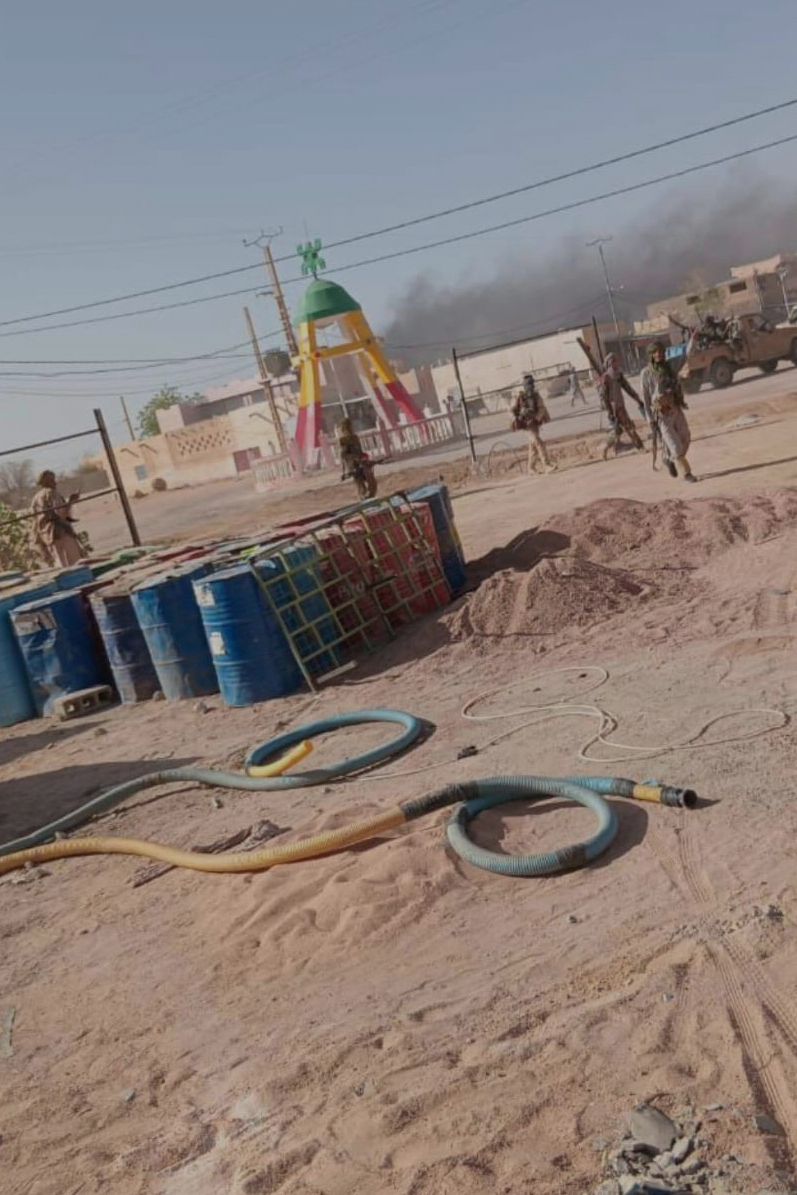

DAKAR, Senegal — A devastating series of coordinated strikes by extremist militants and separatist forces has rocked Mali in what security experts are calling the most extensive terrorist operation the West African nation has witnessed in more than ten years.
The weekend offensive presents a significant test for Russia’s expanding influence in the region, as Mali’s military leadership has increasingly relied on Moscow for security assistance while severing ties with traditional Western partners including France.
Security analysts described Monday how the scope of the weekend violence was extraordinary, both in terms of the number of simultaneous targets and their strategic importance, though government officials have yet to provide official casualty figures.
The coordinated strikes hit multiple locations simultaneously throughout Mali — targeting Bamako’s main airport, the military stronghold of Kati nearby, and several key cities in the country’s northern and central regions including Kidal and Sevare. A car bombing near the capital claimed the life of Mali’s defense minister at his residence.
According to the separatist Azawad Liberation Front, fighters have successfully seized control of Kidal, the strategically important northern city whose previous capture by similar rebel alliances more than a decade ago triggered the current security crisis.
Mali sits within the Sahel region, an expansive territory below the Sahara Desert that has emerged as the global epicenter for extremist violence in recent years.
Data from the Institute for Economics and Peace’s Global Terrorism Index shows this region now represents 51% of all violent extremism fatalities worldwide, a dramatic increase from just 1% two decades earlier. Since 2019, deaths from extremist attacks have surged nearly ten times over.
For more than a decade, Mali has struggled with militants connected to al-Qaeda and the Islamic State, alongside a persistent separatist insurgency in its northern territories.
This marks the second time Tuareg separatists and jihadist organizations have joined forces. Their previous collaboration in 2012 resulted in the capture of much of northern Mali, leading to governmental collapse and ultimately requiring French military intervention.
The al-Qaeda affiliate JNIM, known formally as Jama’at Nusrat al-Islam wal-Muslimin, has significantly expanded its operations recently, capturing extensive territory and implementing a fuel blockade around Mali’s capital. The group maintains active operations in neighboring Burkina Faso and Niger, while extending its reach into coastal nations including Benin, Ivory Coast and Togo.
JNIM approached the weekend offensive with substantial financial resources. The organization generates revenue through local taxation, cattle theft, and control over natural resources like gold mining operations, while using siege tactics, kidnappings and explosives to dominate transportation corridors.
According to Ulf Laessing, who heads the Sahel program at the Konrad Adenauer Foundation, the group possessed a “full war chest” before launching the attacks, reportedly after collecting at least $50 million in ransom payments for releasing an Emirati member of Dubai’s royal family and two business associates who were kidnapped near Bamako last year.
In Mali’s northern region, Tuareg-led separatist movements have maintained a long-running campaign to establish an independent nation called Azawad. These groups consolidated in 2024 to form the Azawad Liberation Front, or FLA, which collaborated with JNIM during the weekend assault.
Despite fundamental ideological disagreements, JNIM and the FLA share common objectives in forcing Mali’s military from territories they control in the north and center, while also seeking to expel Russian fighters supporting Mali’s security operations, explained Rida Lyammouri, a senior fellow at Morocco’s Policy Center for the New South.
Military leaders who seized power through coups now govern Mali, Niger and Burkina Faso, having promised citizens improved security while condemning previous democratic governments as corrupt and overly dependent on France.
Even with years of French military deployment and U.N. peacekeeping efforts, terrorist incidents had increased since 2014, government territorial control had eroded, and civilian casualties had mounted, creating the public frustration that enabled military takeovers.
These nations have pivoted toward Russia for security partnerships while expelling traditional allies including U.S. forces and U.N. peacekeeping missions, establishing their own regional security arrangement called the Alliance of Sahel States.
Mali’s primary security partner is now the Africa Corps, a newly established Russian military formation answering directly to Moscow’s defense ministry. Security analysts estimate approximately 2,000 Russian troops are currently deployed in the country.
However, the Sahel’s security situation has deteriorated since military governments assumed power beginning with Mali in 2020, with analysts reporting record numbers of attacks and civilian deaths from both Islamic militants and government forces.
Laessing noted that French forces and U.N. peacekeepers had effectively compensated for the largely absent state presence, especially in central and northern Mali. Their departure reduced employment opportunities for locals, making them more vulnerable to jihadist recruitment efforts.
Russian assistance has proven insufficient to address this gap, with their forces now retreating. On Monday, Africa Corps announced via Telegram that its fighters had withdrawn from Kidal, just two days after an FLA spokesperson declared their forces had assumed control.
Kidal remains central to Mali’s ongoing security crisis. In 2012, Tuareg separatists and jihadist groups captured the city along with most of northern Mali. When Malian government forces and Russian Wagner group mercenaries retook the city in 2023, it represented a major victory.
The FLA announced Saturday it had negotiated an agreement permitting Africa Corps forces and the Malian army to withdraw from Kidal, with a convoy departing under rebel protection from the former U.N. peacekeeping facility.
In recent months, JNIM has systematically targeted fuel tankers traveling from Senegal and Ivory Coast, creating a crisis in Bamako even before Middle East conflicts tightened global fuel markets.
Fuel shortages resulted in extensive lines at gas stations, while the Malian military began escorting some fuel convoys to the capital for limited relief.
A temporary ceasefire was established in late March but subsequently failed. Attacks on supply routes resumed before the weekend offensive.
Analysts believe JNIM’s strategy involves using the blockade to pressure businesses and residents to withdraw support from Mali’s military leadership, weakening the government’s credibility and control. However, experts suggest the militants do not appear interested in assuming power themselves.