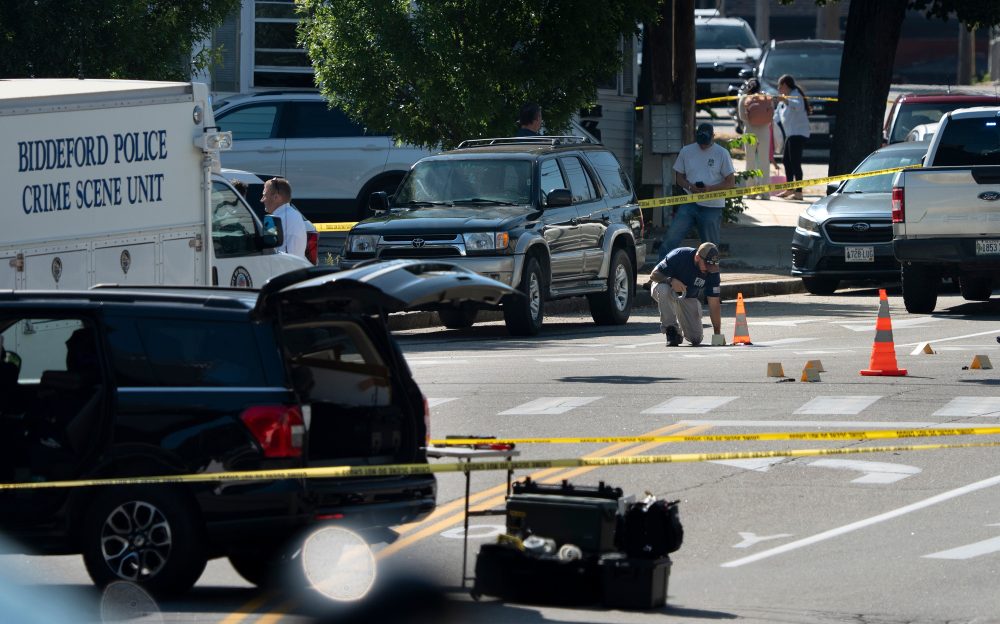

BIDDEFORD, Maine — Within moments of an immigration officer pulling the trigger in a small coastal city in southern Maine, a pattern that has become all too recognizable began to repeat itself: a man had been shot and killed inside a moving vehicle during an immigration enforcement operation.
The Department of Homeland Security later stated that the officer discharged his weapon after the man being pursued attempted to escape, posing a threat to “public safety.”
This scenario has played out repeatedly since the Trump administration launched its immigration crackdown, with federal officers confronting drivers and then claiming they fired their weapons because the vehicles posed a threat. That justification comes despite decades of warnings from law enforcement experts that firing into moving cars is itself dangerous and should almost always be avoided.
The Embassy of Colombia identified the man killed Monday in Biddeford — located roughly 15 miles southwest of Portland — as Johan Sebastián Durán Guerrero, a 26-year-old Colombian national. Some of his friends, neighbors, and an advocacy group have spelled his first name “Joan.”
He is the ninth person to die during immigration enforcement operations since the Trump administration’s mass deportation effort began. At least four of those deaths involved individuals inside vehicles, including one last week in Houston. The trend has become so alarming that U.S. Sen. Susan Collins said Tuesday she urged DHS Secretary Markwayne Mullin “to cease all non-urgent vehicle stops.”
A source with knowledge of the situation told the Associated Press on Tuesday that administration officials have instructed immigration officers to suspend most vehicle stops. Some law enforcement experts argue that Immigration and Customs Enforcement should never have been conducting traffic stops in the first place.
“They’re saying that all these cases are justified because the officers were in danger,” said John Sandweg, who served as acting director of ICE during the Obama administration. “But then why the hell are we putting the officer in danger by asking them to execute traffic stops?”
Sandweg, who estimates approximately 18 traffic-stop shootings have occurred during the immigration crackdown, pointed out that arrests can be made in many other settings, including homes and workplaces.
“It becomes a much more risky and dangerous situation once you start to pursue someone,” said John Gihon, an immigration attorney who worked at ICE from 2008 to 2014. “That’s going to escalate.”
Gihon said that during his time at ICE, he regularly trained deportation officers on vehicle stop policies. He explained that officers were told they have the option of whether to pull someone over during an arrest attempt — but if that person refuses to exit the vehicle and drives away, the guidance was to stand down and find another opportunity to make the arrest.
“If they refuse, you are not pulling them out of the vehicle, you are not putting yourself in front of their car,” he said. “This policy is for everyone’s safety.”
Yet deadly vehicle stops have continued to occur under the current administration.
Among those killed was Ruben Ray Martinez, a 23-year-old U.S. citizen shot during a late-night traffic stop in South Texas in March 2025, and Renee Good, a mother of three shot and killed in January as she drove through a residential neighborhood in Minneapolis amid growing protests against the crackdown.
Just last week, Lorenzo Salgado Araujo, a Mexican construction worker, was shot and killed as he drove his crew to a job site in Houston, a city where he had lived and worked for decades.
In each case, officials maintained that federal officers fired because they believed their lives or the lives of others were in danger from the vehicles.
“Many of you have been told this law enforcement officer wasn’t hit by a car, wasn’t being harassed, and murdered an innocent woman,” Vice President JD Vance wrote on X following Good’s death. “The reality is that his life was endangered and he fired in self defense.”
That shooting was recorded on multiple bystander videos that contradicted the administration’s account and sparked widespread outrage and protests over the use of deadly force.
Details surrounding the other shootings remain largely unknown. Officers involved in both the Salgado Araujo and Durán Guerrero killings were not wearing body cameras — even though DHS announced months ago that it planned to equip all officers with cameras.
Geoffrey P. Alpert, a policing expert at the University of South Carolina, said that without video footage, investigators are forced to depend on witness accounts.
“There’s certainly a pattern, a practice, a trend that is disturbing,” Alpert said. He added that law enforcement agencies decades ago began prohibiting officers from shooting at moving vehicles because an injured or killed driver can lose control, turning the car into “an unguided missile” that threatens anyone nearby.
“Every bullet needs to be understood: why was it fired. Every time an officer pulls the trigger, we need to know why,” Alpert said. “We talked about that last time, and we’ll talk about that the next time.”
Questions are already mounting about the official version of events surrounding the fatal shooting of 52-year-old Salgado Araujo in Houston. DHS said in a statement that he ignored commands, attempted to evade arrest, and then tried to ram his vehicle into an officer, who fired in self-defense.
Rep. Sylvia Garcia said she visited the detention facility where the men who had been riding with Salgado Araujo are being held and spoke separately with two of them, raising “many alarming questions” about the administration’s account.
“Here’s the deal. I visited with them separately, and their stories were consistent, and paint a totally, totally conflicting version of the events,” Garcia said. The men told her that ICE officers were never positioned in front of the vehicle — instead, they were on the passenger side and fired through the open passenger window. The window was down because the vehicle’s air conditioning was not working.
The full circumstances of the Maine shooting also remain unclear. DHS said officers were in Biddeford conducting surveillance on an address associated with a person under a final order of removal, and then attempted to stop a vehicle driven by someone leaving that address.
Maine U.S. Sen. Angus King said DHS Secretary Mullin told him the officer fired after the man attempted to use his vehicle as a weapon against officers.
However, nearly 12 hours after Durán Guerrero’s death, that account changed: DHS released a statement saying the “vehicle attempted to flee the scene and, fearing for public safety, an officer discharged his weapon.”
When questioned about the conflicting statements, Sen. King told CNN that an investigation would determine the truth.
Maine’s Office of the Attorney General announced it would investigate the shooting in coordination with federal authorities, pledged transparency, and asked any witnesses to come forward.
On Tuesday, hundreds of demonstrators gathered near an ICE facility in Scarborough, Maine, holding a large banner that read “No more ICE killings” along with signs saying “stop the murder” and “end this terror.”
“We need to never see this happen in the streets of Biddeford, Maine, and in this country,” said Democratic state Sen. Mattie Daughtry during the protest. “Never forget the human toll of what has happened here in Maine, in Minnesota, in Texas.”