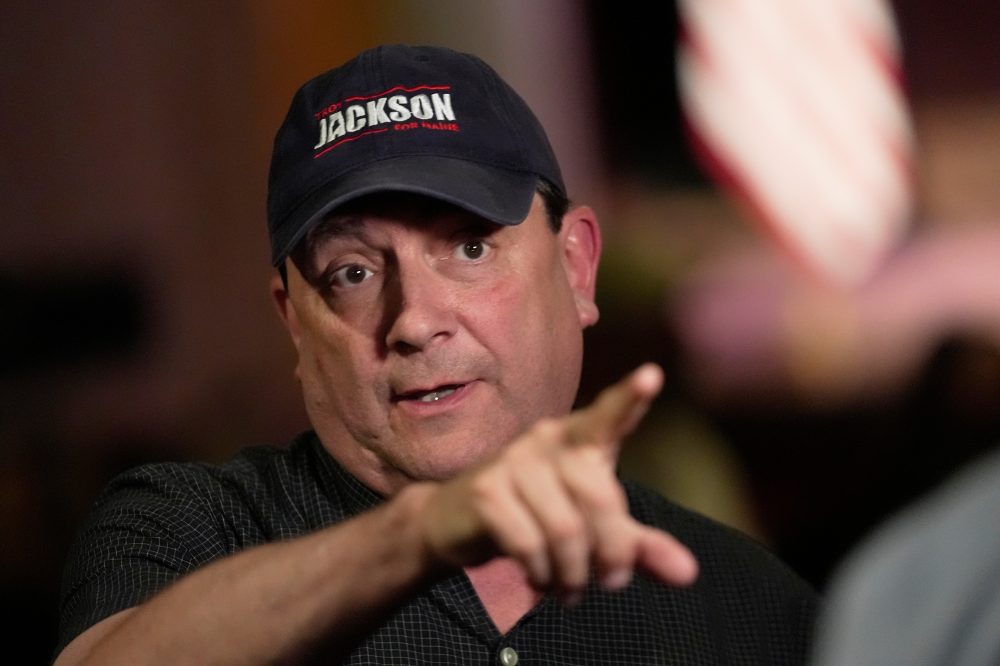

Maine Democrats, scrambling to find a new candidate for a critical U.S. Senate race, are poised to select Troy Jackson as their nominee at a last-minute convention scheduled for this weekend in Bangor.
Jackson is a progressive Democrat who previously served as president of Maine’s Democratic-controlled state Senate. He is also a fifth-generation logger with deep roots in a rural, heavily Republican region in the northern part of the state.
The special nominating convention comes after the collapse of primary winner Graham Platner’s campaign. If Jackson secures the nomination Saturday as expected, he will have fewer than four months to mount a campaign against Collins, who has represented Maine in the U.S. Senate for three decades.
Here is a closer look at who Troy Jackson is:
Jackson has been a familiar face in Maine politics for many years, though his positions and party affiliation have shifted considerably over time. He ran for the Democratic nomination for Maine governor this year but was defeated in the primary.
His political journey began more than 25 years ago when he made his first bid for office as a Republican. He was later elected to the Maine House of Representatives in 2002 as an independent, then joined the Democratic Party in 2004 and went on to serve three terms in the House.
Jackson subsequently won election to the Maine Senate and eventually rose to lead that chamber, serving as its president from 2018 to 2024.
His path into politics was shaped by his labor background. In the late 1990s, he led a weeklong blockade by loggers along Maine’s border with Quebec to protest the hiring of Canadian workers who were coming into the state and pushing wages down. The standoff ended when police escorted Jackson away from the scene. He later used his position as a state lawmaker to push for stronger protections for loggers and wood haulers.
Early in his career, Jackson held conservative views on abortion and same-sex marriage — stances he has since abandoned. Today he is regarded as one of Maine’s leading progressive voices.
In 2016, Jackson led independent Vermont Sen. Bernie Sanders’ presidential campaign effort in Maine, helping Sanders claim victory in the state’s caucus. The two remain political allies.
Like Sanders, Jackson is a vocal advocate for “Medicare for All.” He has also called for the elimination of U.S. Immigration and Customs Enforcement, a position that has drawn attention in Maine following the killing of a driver in Biddeford.
Jackson has long championed union rights and workers’ protections, making those issues a centerpiece of his gubernatorial campaign.
Both Jackson and Collins hail from Aroostook County, the northernmost county in Maine, known for its potato farming and thinly spread population. The county — referred to by locals simply as “the County” — leans heavily Republican, and its voters have backed Trump in each of the last three presidential elections.
With Jackson on the verge of securing the nomination, both candidates are already in full campaign mode.
Collins told the Associated Press this week that she has watched Jackson transform into what she called “a Bernie bro.” She pointed to his “lengthy record” in politics and said his positions are “clearly” aligned with socialism.
Collins holds a substantial fundraising edge, with federal filings showing she has brought in more than $16 million. Jackson’s campaign reports raising more than $1 million.
Jackson has opened his campaign by drawing a connection between Collins and Trump, including what he referred to as Trump’s unpopular war in Iran.
“When the stakes are at the absolute highest, too often she stood with Donald Trump, Mitch McConnell and the other big corporations that already have all the power,” Jackson said at a recent campaign event.
Maine Republicans have also wasted no time in targeting Jackson.
“While promising a fair nomination process and rejecting any notion that Graham Platner would influence it, Maine Democrats still managed to pick the candidate Platner endorsed in the gubernatorial race, who is also a well-established Augusta insider,” said Jim Deyermond, chair of the Maine GOP.
Democrats were thrown into crisis when Platner stepped down as their nominee earlier this month. Jackson had appeared alongside Platner during Platner’s own run for the governor nomination.
Platner announced his withdrawal after a former girlfriend accused him of sexual assault, an allegation he has denied.
To select a new nominee, Maine Democrats are using a process that has never been employed before — gathering more than 600 delegates in Bangor who were chosen at county party meetings the previous weekend.
Jackson’s campaign reports that more than 480 of the 601 delegates participating in Saturday’s convention have pledged their support to him.
Democrats face a narrow road to reclaiming control of the Senate in November, and strategists say a win in Maine is considered essential to that effort. The party also needs victories in competitive races in North Carolina, Alaska, and Ohio, while defending seats in Michigan and Minnesota, where current Democratic incumbents are not seeking re-election.