
BEIRUT (AP) — Israeli military forces have been systematically destroying residential buildings in southern Lebanese territories they’ve controlled since establishing a ceasefire with Hezbollah last week, claiming these structures served as militant strongholds for the Iran-supported organization.
However, the scale of destruction has grown so extensive that local residents, government officials from Lebanon, and United Nations peacekeeping forces are expressing mounting concern that thousands of displaced civilians may find no homes to return to should the delicate peace agreement survive.
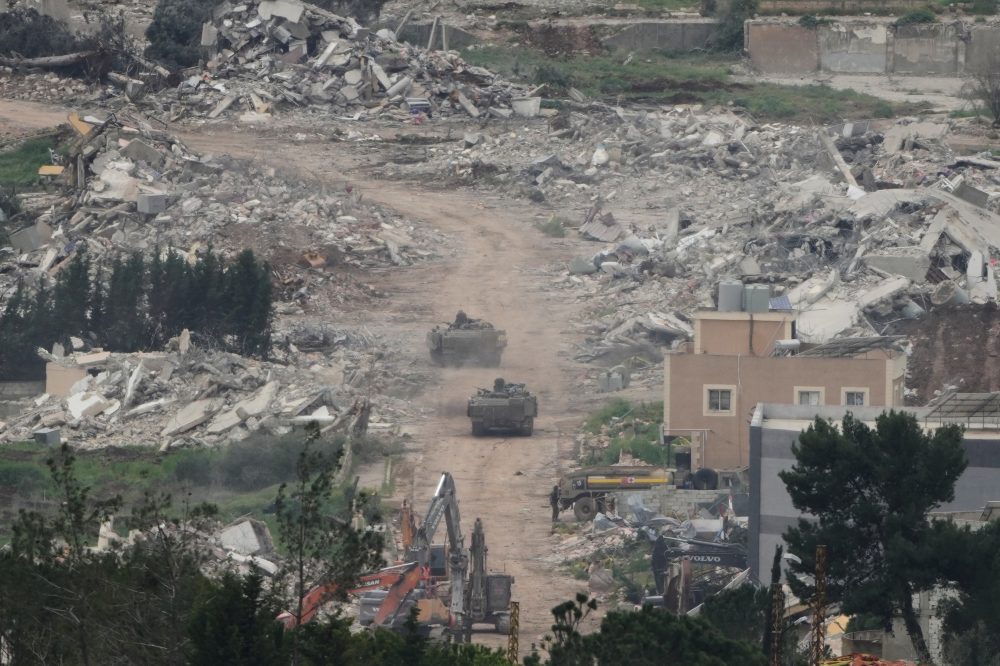
Associated Press reporters observing from an elevated position above Beit Lif — located approximately 4 kilometers (2.5 miles) north of the Israeli-Lebanese border — witnessed the near-complete destruction of the village that previously housed several thousand inhabitants.
“They were demolishing it gradually until they reached the main square and now, as you can see, there are no more houses,” said Hassan Sweidan, a resident of a neighboring village.
Lebanese government representatives intend to address the extensive demolition activities on Thursday during ceasefire discussions with Israeli officials in Washington — marking the first direct diplomatic engagement between the nations in several decades.
Due to safety risks and restricted access, neither UN peacekeeping personnel nor Lebanese authorities have managed to complete comprehensive assessments of the communities experiencing demolitions. However, witnesses have reported the systematic destruction of complete residential areas across multiple villages.
On March 2, two days after the U.S. and Israel launched the war with Iran, Hezbollah entered the fray by firing missiles into northern Israel. The group had been under pressure by the Lebanese government to disarm following its previous war with Israel in 2024, but refused to do so.
Israel retaliated with a massive aerial bombardment and ground offensive into Lebanon, forcing hundreds of thousands of residents to evacuate the country’s southern regions. The conflict resulted in approximately 2,300 Lebanese casualties, including numerous women and children.
A 10-day ceasefire that commenced Friday largely ended the hostilities. However, both parties have conducted strikes since the truce began. Hezbollah has defended its attacks partly by citing the Israeli military’s destruction of residential properties.
Israeli leadership has announced intentions to maintain control over portions of southern Lebanon, with military officials publishing maps showing a “forward defense line” extending several miles into Lebanese territory and covering numerous villages whose inhabitants remain barred from returning.
Following the ceasefire announcement, Israeli Defense Minister Israel Katz stated this region had been “cleared of terrorists and weapons and is empty of citizens, and will continue to be cleared of terrorists’ infrastructure, including the destruction of houses in Lebanese villages that border (Israel) and have become terrorists outposts in every sense.”
When the ceasefire took effect, Sweidan traveled back to inspect his residence in the southern Lebanese community of Yater. His home remains undamaged.
Since Sweidan’s community provides a view of adjacent Beit Lif, he has witnessed Israeli military activities in that area. Although the village sustained damage from Israeli airstrikes during combat, most of Beit Lif remained standing when the ceasefire began, according to his account.
However, on the following day, Israeli troops arrived with bulldozers, jackhammers and tanks.
“We would come each day to see how much of the village was demolished,” he said.
Tilak Pokharel, a spokesperson for the U.S. peacekeeping force in southern Lebanon known as UNIFIL, confirmed that peacekeepers “have observed demolitions taking place in several areas” since the truce.
The Israeli military released a statement declaring that the demolition operations target Hezbollah, not Lebanon or its civilians, and that it “operates in accordance with international law and does not destroy civilian property unless required by imperative military necessity.”
Extensive damage already existed in border regions following the previous Israel-Hezbollah conflict in 2024. While some property owners managed to fund repairs, no large-scale rebuilding occurred.
Destruction also occurred during the most recent conflict. Images captured on April 12 by AP from the Israeli northern towns of Menara and Misgav Am show excavators and bulldozers demolishing Lebanese homes across the border.
Lebanon’s government-operated National News Agency reported Wednesday that Israeli bulldozers were destroying neighborhoods, roads and infrastructure in Khiam, a combat zone during the Israel-Hezbollah fighting, “in a scene that suggests an attempt to completely erase the town’s identity.”
The agency also documented “systematic bombing operations” Wednesday targeting residential areas in Bint Jbeil — another conflict hotspot — and in the communities of Beit Lif, Shamaa, Tair Harfa and Hanine.
Hezbollah announced Tuesday it had conducted drone and rocket strikes, the first since the ceasefire, responding to Israeli “attacks on civilians and the destruction of their homes and villages in southern Lebanon.”
While Lebanese authorities work to preserve the ceasefire, President Joseph Aoun declared in a statement that “halting Israel’s demolition operations in southern villages and towns” would be an issue Lebanese ambassadors in the United States will discuss with their Israeli counterparts during Thursday’s ceasefire negotiations.
The discussions were anticipated to address a possible extension of the 10-day truce and developing a structure for future negotiations aimed at achieving lasting peace between the two nations.