
What began as a small family business operating out of an apartment near Moscow has grown into Russia’s dominant online shopping platform — and now, Wildberries has become a target in Ukraine’s widening campaign of drone strikes inside Russian territory.
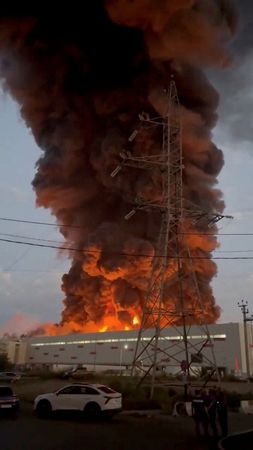
Over the course of the past week, Ukraine carried out attacks on four Wildberries warehouse facilities, escalating a drone offensive aimed at a company that sits at the center of Russia’s consumer marketplace. The strikes have brought the reality of the war home to millions of ordinary Russians who depend on the platform for everyday purchases.
Wildberries and its chief competitor, Ozon, have become a fixture in communities throughout Russia, with package pick-up locations appearing in towns across the country. Wildberries alone claims to handle 20 million orders each day through a vast network of warehouses totaling 3 million square metres of floor space.
The company’s co-founder, Tatyana Kim, has amassed a fortune of $7 billion, making her Russia’s wealthiest woman according to Forbes magazine.
The drone strikes pose a significant financial threat to the many small businesses that sell their goods through Wildberries, and could disrupt access for consumers who use the platform to purchase clothing, appliances, medications, cosmetics, and countless other products.
Russia has itself targeted Ukrainian infrastructure, supply chains, and businesses throughout the now four-and-a-half-year war. Ukraine maintains that its long-range strikes deep inside Russia are intended to weaken Moscow’s military capacity and push toward an end to the fighting. Russia, meanwhile, claims the recent attacks on refineries and storage facilities are designed to sow disorder among the Russian public.
Taken together with smaller competitors, Wildberries and Ozon account for goods and services equivalent to 8.5% of Russia’s entire gross domestic product and provide employment for 4 million workers — more than 5% of the national workforce.
The Kremlin has branded this sector the “platform economy,” a digital marketplace connecting consumers with sellers, delivery workers, warehouse staff, and pick-up point operators. President Vladimir Putin’s top economic adviser, Maxim Oreshkin, has been personally assigned to oversee this sector’s development. Oreshkin has characterized platforms like Wildberries and Ozon as a modern form of planned economy — one guided by algorithms rather than the government-run institutions of the Soviet era.
Kim’s personal story has made her a celebrated figure in Russian business circles. Born in the Chechen capital of Grozny in 1975 to a family of ethnic Korean heritage, she worked as an English teacher before co-founding Wildberries with her then-husband, Vladislav Bakalchuk, in 2004 — a rise from modest beginnings that has drawn comparisons to Alibaba founder Jack Ma.
The couple launched the business from their apartment in the Moscow region and rode the e-commerce surge of the 2010s to build the country’s largest online retail operation. Kim, a mother of seven, has cultivated an image as a self-made entrepreneur who credits her instincts for her success, and she has become a role model for aspiring businesswomen across Russia.
Their partnership ended in a turbulent divorce two years ago, triggered in part by Kim’s surprise decision to merge Wildberries with a much smaller outdoor advertising company, a move she said was aimed at building a global e-commerce platform. The deal had the Kremlin’s approval, but Bakalchuk contested it, calling it an unlawful seizure of assets. The dispute turned violent in 2024 when an attack on a Wildberries office in central Moscow left two security guards dead.
More recently, Wildberries has deepened its financial ties with VTB, Russia’s second-largest bank, which acquired a 5% stake in WB Bank — Wildberries’ banking subsidiary — with the option to expand its ownership stake further.
The company is also constructing a new 400-metre-tall headquarters in Moscow’s City business district, set to become the tallest building in the capital upon its projected completion in 2030. The tower will rise alongside the offices of some of Russia’s most powerful corporations.
Ukrainian President Volodymyr Zelenskiy described the targeted facilities as logistics hubs used to supply Russian forces with drone parts and other military equipment. Kim, for her part, said the attacks were directed at ordinary working people.