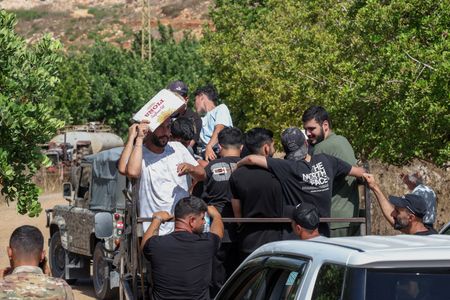

Residents of the southern Lebanese town of Zawtar al-Gharbiyeh took their first steps back into their community on Friday, picking through rubble-strewn streets and checking on damaged homes following an Israeli military withdrawal and the deployment of Lebanese army forces under a deal brokered by the United States.
The situation remains fragile. Mayor Abed Ezzeddin says more than half of the town has been leveled, and many of the buildings still standing have sustained serious damage.
Residents made their way through debris-covered roads, pausing in front of homes that had been badly damaged or destroyed.
“We’ve been waiting for this moment for almost five months,” said resident Mohammed Darwish. “We want to go in and check. We’re happy that we’re going in today.”
Darwish expressed hope that he would be able to stay in the town, though he noted that residents had not yet been told whether overnight stays would be permitted.
For others, even total destruction has not shaken their resolve to return. “My house is destroyed, and my children’s house is destroyed. Everything is destroyed,” said resident Abu Ali Ezzeddin. “I’m planning to stay in (Zawtar al-Gharbiyeh) because my livelihood is here.”
The Lebanese army began moving into Zawtar al-Gharbiyeh on Tuesday following the Israeli withdrawal, marking the first real-world test of a U.S.-brokered framework that Lebanon and Israel agreed to through direct negotiations.
Under the plan, the Lebanese army is tasked with seizing weapons from the Iran-aligned Hezbollah group in designated zones, while Israeli forces are to pull back in stages to allow Lebanese troops to take their place. The Israeli military has identified Zawtar al-Gharbiyeh as one of three towns or villages included in an initial pilot phase of the program.
Despite the partial withdrawal, Israeli troops continue to occupy a stretch of territory roughly 10 kilometers, or about six miles, into southern Lebanon, where entire villages have been razed. Tens of thousands of Lebanese who were displaced when the latest conflict between Hezbollah and Israel broke out on March 2 are still unable to go home.
Israeli forces also continued conducting controlled explosions this week in towns they still hold near Zawtar al-Gharbiyeh.
Lebanese army units have been combing the town for landmines and unexploded devices. On Thursday, ambulances entered to recover the bodies of Hezbollah fighters who were killed during combat in the area.
A senior Lebanese military official told Reuters this week that significant work still needs to be done before the town can be declared safe for residents.
Also on Thursday, Hezbollah’s parliamentary bloc publicly dismissed the Lebanese army’s deployment as little more than a symbolic gesture.