
Under normal circumstances, Lilian Jamaan would be busy purchasing new outfits for her daughter and stocking up on meat and sweets to celebrate Eid al-Fitr, the Islamic festival that concludes the holy month of Ramadan.
Instead, speaking from a converted school shelter in Sidon, Lebanon, where her family has taken refuge, Jamaan expressed her despair: “there’s no joy for Eid or for Ramadan or for anything.”
“Everything is difficult,” she added.
While Muslims around the globe prepare for what is traditionally a celebration filled with happiness, Lebanon has reached a devastating threshold. More than 1 million residents have been forced from their homes due to Israeli military strikes, Lebanese officials report.
According to Lebanon’s health ministry, 968 individuals have lost their lives in Israeli attacks since fighting resumed between Israel and Hezbollah, the Lebanese militant organization.
The Iranian-supported Hezbollah joined the broader regional conflict by launching rocket attacks against Israel, prompting intense Israeli bombardment of southern Lebanon and Beirut’s southern districts, forcing countless families to abandon their residences.
“A lot of the kids that I at least spoke to, their biggest wish was to just spend Eid at home,” explained Basma Alloush, who speaks for the International Rescue Committee. “Eid is a time where all families come together, people celebrate with their relatives, and it usually brings a lot of peace and joy to families. … It could be that many of them just spend Eid in shelters, in displacement.”
The crisis has unfolded throughout Ramadan, with images of families fleeing their residences and resorting to sleeping in street tents or vehicles. While some found space in schools converted to shelters or stayed with family members, many others struggled to secure temporary arrangements. Approximately 130,000 people are currently housed in official shelters.
For Jamaan, the difficult displacement conditions prevented her from maintaining many Ramadan observances—typically a period of fasting, enhanced prayer, and festive community meals with family.
At her home, she explained, she would fast, pray, and study the Quran, Islam’s sacred text.
Currently, she has discontinued fasting and plans to compensate for missed days upon returning home. “Some people fast and some are unable to fast; there’s psychological stress and we’re not sleeping well. … Food is the last thing on my mind, but the circumstances are difficult.”
She described how she and her daughter share sleeping space with others in the school building while her husband sleeps in their car. “There’s no stability.”
She yearns for her family and her usual Ramadan practices. “We would break our fast, pray, make and drink coffee and I would go to the neighbors or they would come over after iftar,” she remembered, referring to the evening meal that breaks the daily fast.
Asmahan Taleb, another displaced person in Sidon, said the approach of Eid has been overshadowed by suffering.
“How can we celebrate Eid when we’re displaced from our homes and our land? Where is the Eid? Where is the happiness?” she questioned. “It will be Eid when we can return to our homes.”
This displacement marks a repeated experience for Jamaan and many others. Her daughter was born during a previous displacement period from earlier fighting that ended with a fragile ceasefire in November 2024. Israel has continued conducting almost daily strikes in Lebanon after the ceasefire, claiming these target Hezbollah’s rebuilding efforts.
“Lebanon for us is really now the epicenter of the more immediate humanitarian fallout of this broader regional crisis,” stated Carl Skau, deputy executive director and chief operating officer of the U.N. World Food Program. “People here have endured crisis after crisis. They’ve been displaced before. But that doesn’t make it any easier.”
He noted that people he encountered appeared exhausted and hadn’t recovered from previous displacements.
“There was this real sense of uncertainty this time. How is this gonna end? When is it gonna end?”
Current conditions present additional challenges beyond previous crises.
“My concern is that the funding is not coming forward like it did last time,” he told The Associated Press. “We know there is less money available. We know there is also competing priorities. … We will need to make an effort that really donors step up.”
The World Food Program has served over half a million hot meals to displaced individuals in Lebanese shelters since March 2 as part of its relief efforts.
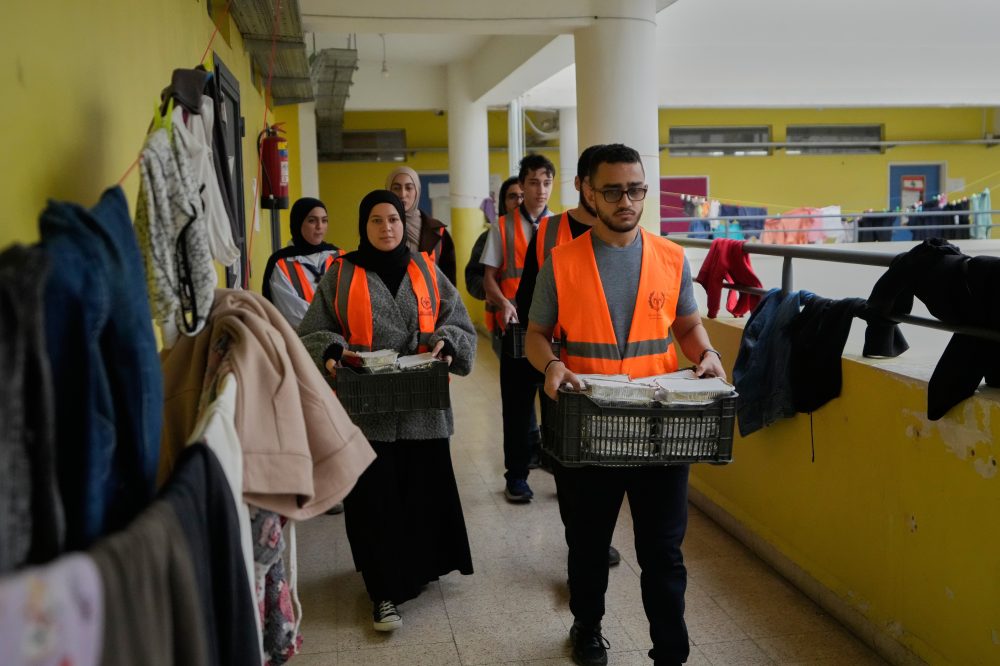
Various volunteers, organizations, and businesses have launched online initiatives to prepare, package, and distribute iftar meals while donating essential items including blankets, clothing, baby formula, and medications.
The requirements are extensive and diverse.
“There is a dire need for shelter,” Alloush noted. “There was a massive thunderstorm. We’re just thinking about the people that were sleeping outside, sleeping in tents that are not waterproof, sleeping on the mud.”
The International Rescue Committee has been providing mattresses, pillows, blankets, and coloring books for children.
“People don’t have enough clothes. Children fled with no toys or no activities to kind of get their minds off of the war.”
Eman Abo Khadra, who owns a hair salon in Sidon, attempted to bring some Eid happiness to displaced children through her skills by offering free haircuts.
“It’s a morale thing. What does a child know about war or no war. … It’s just about planting some joy in their hearts.”
Despite her efforts, she recognized the impact of ongoing tensions on young people.
“I was telling them, ‘Come on, clap; be happy; laugh,’ but … tensions are high,” she observed. “People are tired.”
Taking shelter in Sidon, Alia Ismail said maintaining proper Ramadan observance or finding Eid joy has become nearly impossible.
“We no longer can fast or buy anything for Ramadan,” she stated.
Regarding Eid preparations, her children ask for “We want clothes; we want to go out; we want sweets,” she said. “I tell them, ‘I can’t get you that. There’s no money.’”
Under typical circumstances, she would be cleaning her house and purchasing clothing, meat, and sweets for the holiday.
“Can you imagine that we are staying in a school corridor?” she asked during a phone conversation, explaining that she uses clothing as a pillow since none are available.
At a Beirut school housing hundreds of displaced people, some families attempted to recreate Ramadan traditions and remember their former lives. Corridor walls displayed holiday decorations, and one family arranged desks together to hold a small gas burner and charity meal packages.
Shaker Araqa, staying at the school, mourned how his extended family has been scattered. “We used to gather. We were in one building. Now, everyone is at a different place.”
Nabila Hijazi mentioned that her children ask about Eid, and she promised to purchase clothing for them.
“They want to live their lives,” she said. “We tell them ‘God Willing, Eid comes and we return to our homes.’”
She has managed to observe Ramadan normally at the school and acknowledges her situation is better than many others’.
Back in Sidon, Jamaan said she prays “for God to stop the war, for us to return to our homes and for there to be peace.”