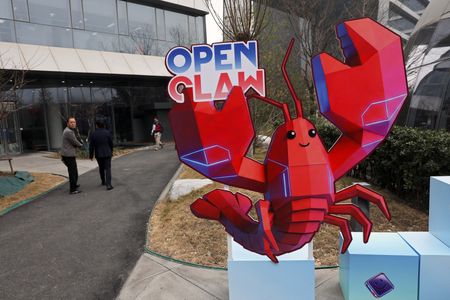

A wave of artificial intelligence excitement is sweeping across China as millions embrace a new AI tool they’ve affectionately dubbed the ‘lobster.’
Fan Xinquan, a 60-year-old former electronics technician from Beijing, recently began nurturing his own digital ‘lobster’ – an AI agent called OpenClaw that he believes can organize his technical expertise more effectively than traditional chatbots like DeepSeek.
“OpenClaw can actually help you accomplish many practical things,” Fan explained during a training session hosted by AI company Zhipu, where participants learn to use and develop the viral technology that has earned its crustacean nickname throughout China.
Over the past month, OpenClaw has captivated Chinese users ranging from retired workers seeking additional income to major tech companies exploring fresh revenue opportunities. Unlike standard chatbots, this AI agent can link multiple hardware and software systems while learning from generated data with minimal human guidance.
Since its debut last November, the platform has achieved record-breaking growth on GitHub, the world’s leading AI development platform. The open-source agent, developed by Austrian programmer Peter Steinberger, demonstrates how emerging technologies can rapidly transform China’s economy through widespread public adoption.
“If DeepSeek marked a milestone for open-source large language models, then OpenClaw represents a similar turning point for open-source agents,” noted Wei Sun, Counterpoint Research’s chief AI analyst.
The technology gained additional momentum when Nvidia CEO Jensen Huang declared OpenClaw “the next ChatGPT” this week. Growing excitement has driven Chinese technology stocks up as much as 22% recently as companies launch OpenClaw-based products.
The phenomenon has reached unexpected corners of Chinese society. Huang Rongsheng, chief architect at Baidu’s smart device division Xiaodu, revealed that parent chat groups for his daughter’s elementary school have become flooded with OpenClaw conversations.
“My daughter came to me and asked: Dad, I see you raising a lobster every day,” Huang shared. “Can I have one too?”
Bai Yiyun, attending the Zhipu training event, expressed hopes of launching a retirement side business using the agent.
“Some people use it to buy lottery tickets or for stock picking, others use it to create money-making apps or open e-commerce shops, but I don’t know if it brings them any real profits,” she observed.
Beyond quick-money schemes, many users seek significant productivity improvements. Some regional governments now provide subsidies reaching 20 million yuan ($2.8 million) annually for qualifying single-person enterprises.
“The OpenClaw frenzy directly coincides with what the Chinese government wants when it comes to the AI Plus initiative,” explained Lian Jye Su, chief analyst at technology research firm Omdia, referencing a national strategy to integrate AI throughout the economy.
However, initial enthusiasm may diminish as operational costs mount and regulators highlight security vulnerabilities. Zhipu recently increased token prices for its OpenClaw-optimized AI model by 20%.
“Output is extremely low: ordinary people spend tens or hundreds of yuan, burning through a bunch of tokens and in the end, they might only get a pile of useless data,” complained one social media post titled “Goodbye OpenClaw” on the Rednote platform.
“This is not ’embracing the future,’ it’s ‘being harvested by the future,’” the post continued.
The widespread enthusiasm has also concerned Beijing authorities, with increasing numbers of Chinese organizations – including government departments, financial firms, and universities – prohibiting employees from installing OpenClaw following regulatory warnings.
The state-controlled People’s Daily, serving as the Communist Party’s official voice, published commentary last week urging officials to “firmly maintain the safety bottom line to ensure that innovation does not deviate or derail” regarding OpenClaw.
“Beijing clearly sees AI as strategically important and wants Chinese firms to commercialize quickly,” said Rui Ma, founder of the Tech Buzz China newsletter.
“But it also wants deployment to stay legible, secure and politically manageable … the concern is utterly uncontrolled and chaotic diffusion that could cause harm.”
Li Hongxue, a data security specialist at a financial company, described the tension between central government warnings and local government actions as “contradictory.”
“Its development is still unstoppable, but the security capabilities also need to keep up so in that sense, this may also be an opportunity for (my) field,” she added.
Technical challenges also persist regarding the agent’s ability to function seamlessly across applications and devices controlled by various, sometimes competing companies.
During Tuesday’s Baidu demonstration, an employee used voice commands through a Xiaodu smart device to order coffee via McDonald’s app, powered by an OpenClaw agent.
Nearly two minutes elapsed before the order reached the payment stage.
“As you can see, I only gave a simple command, but to complete the whole delivery there is actually a lot of work being done in the background by Xiaodu and the lobster,” the Baidu representative explained.