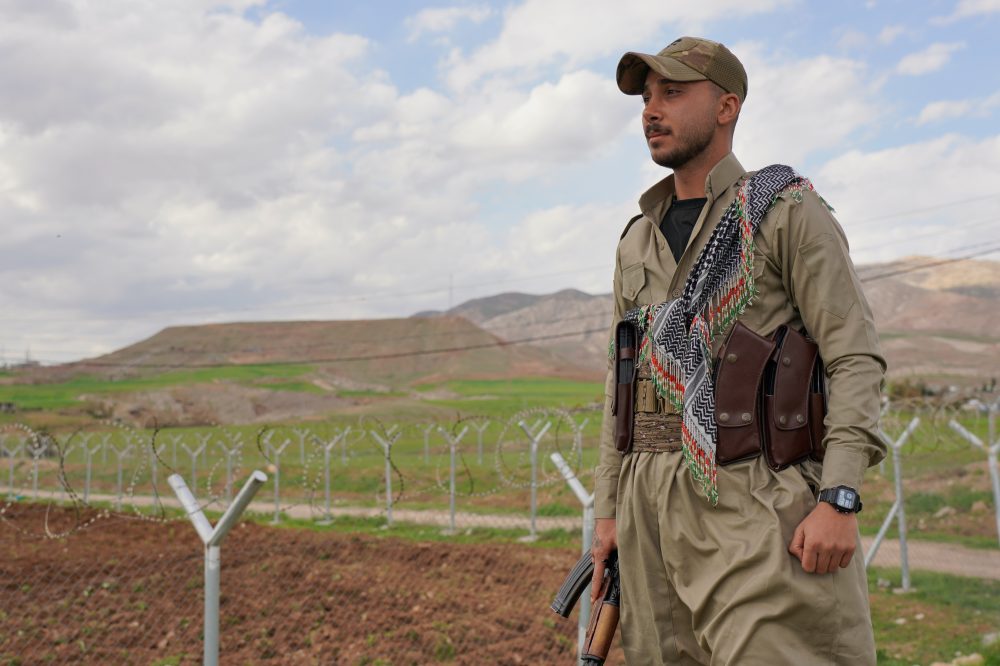

BRUSSELS (AP) — Kurdish officials have revealed to The Associated Press that thousands of experienced Kurdish fighters in northern Iraq are making preparations for possible cross-border military operations against Iran, with support from the United States.
Three Kurdish officials, speaking anonymously due to lack of authorization for public statements, confirmed that President Donald Trump met with leaders from Iraq’s two primary Kurdish political parties on Sunday to discuss the developing situation.
The involvement of armed Kurdish forces at this time, while Israel and the United States maintain their strikes against Iran, could pose a serious challenge to Iranian military defenses. However, it also threatens to draw Iraq — where several Iranian Kurdish organizations maintain operational bases — further into the expanding conflict.
Here’s an examination of the Kurdish people and their complex Middle Eastern relationships:
The Kurdish population represents one of the world’s most significant stateless ethnic communities, with approximately 30 million people living as minority populations across Turkey, Iraq, Iran and Syria. They maintain their distinct language with multiple regional dialects, and the majority practice Sunni Islam.
While Kurds have never achieved independent statehood, they maintain semi-autonomous governance in northern Iraq and previously controlled much of northeastern Syria for several years. Many Kurdish groups have conducted insurgency operations aimed at creating an independent nation they call Kurdistan.
Iran hosts approximately 9 million Kurds, primarily concentrated along the nation’s western boundaries with Iraq and Turkey. This population has maintained longstanding grievances and has staged multiple rebellions against both the current Islamic Republic government and the previous monarchical system.
Prior to the current conflict, Amnesty International documented that Iranian Kurds experience “systemic discrimination” and noted that in previous years “security forces killed or injured many unarmed Kurdish cross-border couriers (kulbars) with impunity.”
Multiple Kurdish opposition organizations have engaged in armed resistance against Iranian government forces throughout recent decades.
Several of these groups established operational headquarters in Iraq, creating diplomatic tensions between Tehran and Baghdad’s central government until 2023, when both nations reached an accord to disarm the Iranian Kurdish organizations.
Leading up to the current warfare, five Iranian Kurdish organizations formed an alliance committed to toppling the Islamic Republic and securing Kurdish self-determination rights. On Thursday, a sixth organization joined this coalition.
“For the first time, all major Kurdish parties have come together as one in a new coalition — a historic step toward shaping a new future for Kurds and a democratic Iran,” said Abdullah Mohtadi, secretary general of the Komala Party of Iranian Kurdistan.
However, coordinating with other Iranian opposition movements to remove Tehran’s leadership may present significant challenges.
Kurdish groups have historically faced disappointment in their dealings with American presidents.
In 1975, President Gerald Ford failed to shield Kurdish forces from defeat by Iraqi military units.
In 1988, President Ronald Reagan took no action to prevent Iraqi forces from deploying chemical weapons against Kurdish populations.
In 1990, President George Bush urged Kurdish uprising against Saddam Hussein following his Kuwait invasion but provided no support when Iraqi forces violently suppressed the rebellion.
More recently in January, Trump permitted Syrian forces to capture Kurdish-controlled territory that had been secured during the Syrian civil war and through costly battles against Islamic State militants.
Turkey, a crucial NATO member and potential refuge destination for war displaced persons, would likely oppose Western arms transfers to Kurdish fighters, regardless of their Iranian targets.
Since 1984, Turkey has conducted an intensive military campaign against armed Kurdish insurgents, resulting in tens of thousands of casualties and extending into Iraq and Syria.
On Thursday, Turkey expressed opposition to potential Iranian Kurdish dissident participation in the Iranian conflict, cautioning about increased regional instability.
Turkish authorities classify the primary Kurdish dissident organization, PJAK, as a terrorist entity with connections to separatist movements fighting Turkey. Turkey’s defense ministry stated Thursday that PJAK’s operations “negatively affect not only Iran’s security but also the overall peace and stability of the region.”
Combat has already broken out throughout Kurdish territories spanning the Iran-Iraq border region.
While Israel and the United States have conducted strikes throughout Iran, Iranian military forces and their Iraqi allies have launched missile and drone attacks against U.S. military installations and the U.S. Consulate in Irbil, as well as Iranian Kurdish group facilities.
Khalil Nadiri, representing the Kurdistan Freedom Party operating from northern Iraq’s semi-autonomous Kurdish territory, confirmed Wednesday that some of their personnel had relocated to positions near the Iranian border in Sulaymaniyah province and remained on alert status.
In January, the organization claimed responsibility for conducting operations inside Iran during extensive protest suppression efforts. Iranian state media subsequently designated them “terrorists” without providing supporting evidence, a classification that carries capital punishment in Iran.
Representatives from Iraq’s Kurdish regional government and Iraqi Kurdish political organizations have stated their opposition to launching attacks against Iran from their territory, citing concerns about severe retaliation.
Peshawa Hawramani, spokesperson for the Kurdistan Regional Government, declared in an official statement that “allegations claiming that we are part of a plan to arm and send Kurdish opposition parties into Iranian territory are completely unfounded” and emphasized that Iraqi Kurdish parties do not wish to “expand the war and tensions in the region.”