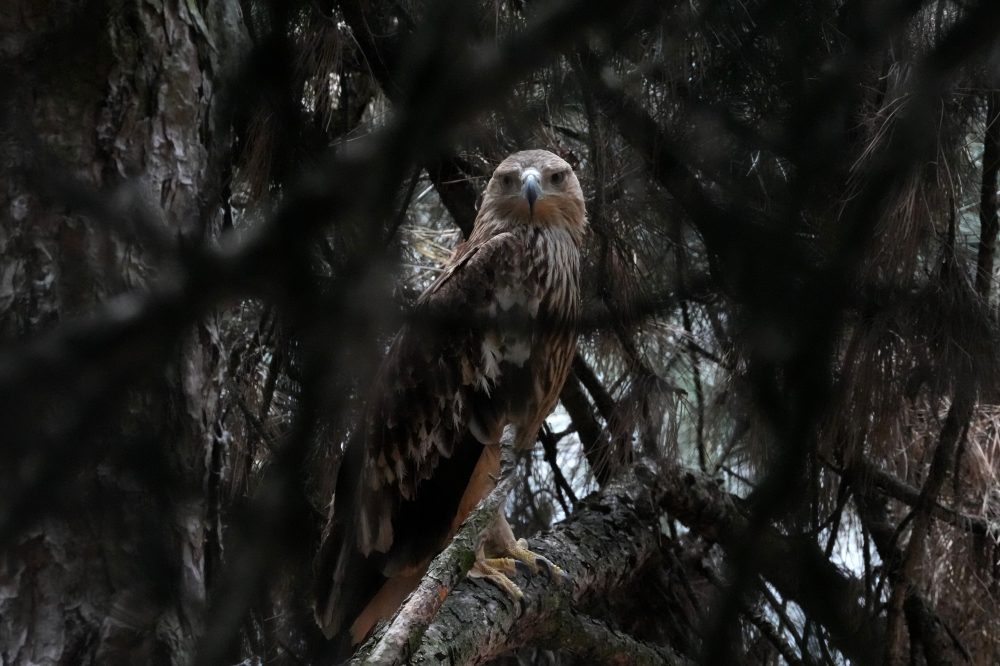

BELGRADE, Serbia — The story of Feliks the eagle reads more like a Hollywood thriller than a nature documentary — complete with poachers, illegal smugglers, and dangerous border crossings under cover of darkness.
The one-year-old eastern imperial eagle, native to Serbia, took his first migratory flight in August, heading toward the Middle East. What followed was a harrowing journey that ended with his capture by poachers, his sale on the illegal wildlife market, and an extraordinary rescue mission to bring him back home.
Feliks made it back to Serbia safely last week, but his ordeal has cast a harsh spotlight on the booming illegal animal trade and the relentless efforts of wildlife advocates fighting against it.
“It’s getting worse year after year, season after season, day after day,” said Michel Sawan, the head of the Lebanese Association for Migratory Birds, who was central to Feliks’s rescue. “We can actually barely believe … the mission was done successfully.”
The eastern imperial eagle is a striking bird of prey, capable of reaching a wingspan of up to 2 meters — roughly 6 feet. The species is protected in Serbia, where the population had fallen to just a single breeding pair in 2017 before recovering through the dedicated efforts of the Bird Protection and Study Society of Serbia, known as BPSSS.
As a prized member of the eagle population’s new generation, Feliks was fitted with a leg ring and a small backpack-style transmitter before departing last August, according to Uros Stojiljkovic of the BPSSS.
“Everything seemed normal,” Stojiljkovic said. “We didn’t dream all this would happen.”
Feliks flew southeast from Serbia, crossing through North Macedonia, Greece, and Turkey. His tracking signal went dark in late October somewhere over Syria.
“We hoped this was because there was a problem with the transmitter or something,” Stojiljkovic said.
Weeks later, Sawan delivered troubling news: Feliks had been caught by poachers who use various methods to trap migratory birds, including placing water in the desert as bait, shooting them, using nets, or even chasing them down with motorcycles.
“When Feliks was caught at first, it was posted on many WhatsApp groups for selling wild birds illegally trapped in Syria,” Sawan said. “I started my phone calls with people I know in Syria and we were able to reach out for Feliks.”
Paying smugglers for his return was never an option, but Sawan refused to abandon the effort. Feliks was sold to a buyer in Lebanon, then resold back into Syria, before Sawan was able to secure him through a network of trusted contacts. Getting the eagle across the border into Lebanon proved difficult due to ongoing fighting in the region and bad weather conditions.
Ultimately, a group of refugees carried Feliks across the Nahr al-Kabir river — the northern border between Syria and Lebanon — hidden inside a potato sack. “It was crazy,” Sawan said.
Once safely housed at Sawan’s bird sanctuary in Beirut, the challenge of getting Feliks back to Serbia remained. That task became nearly impossible after fighting broke out in Iran in February, leading to three failed attempts to transport him home.
The breakthrough came when the Serbian military stepped in, using troops already deployed in Lebanon as part of a United Nations peacekeeping mission. On June 22, Feliks finally touched down in Serbia aboard a military transport plane.
He is currently being held at a zoo in northern Serbia, where he must undergo a 21-day quarantine. BPSSS experts say he will be fitted with a new transmitter before being released back into the wild.
Over the past decade, the BPSSS has worked extensively to plant trees and install nesting platforms across the flat agricultural landscape of northern Serbia. In 2017, volunteers organized around-the-clock watches over the last remaining nesting pair to ensure their survival. A European Union-supported conservation project later helped grow the population to its current 29 breeding pairs.
Threats to the species remain significant, including accidental poisoning and collisions with electrical cables, Stojiljkovic noted.
“Feliks went full circle and came back to where he had set off,” Stojiljkovic said. “Let’s hope he won’t be bored here.”