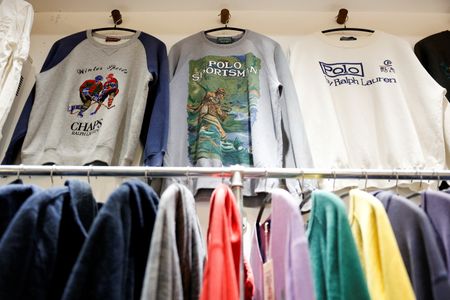

SHANGHAI — A 23-year-old collector named Xiao Neng says he has poured at least $1 million into Ralph Lauren clothing over the last four to five years, amassing such an enormous wardrobe that he now moves pieces of it through two vintage shops he opened in downtown Shanghai.
Neng is among a rising wave of devoted Chinese customers who are helping drive a remarkable comeback for the American fashion label. The company posted a 50% increase in China sales last quarter — a striking figure given that the wider luxury market there continues to struggle under weak consumer confidence, a prolonged slump in the property sector, and ongoing worries about employment and income.
Research firm Bain notes that China’s luxury sector is “slowly recovering” in 2026 following several years of declining and stagnant sales.
For Neng, the brand’s appeal goes beyond fashion. “Ralph Lauren, through clothing, provides people with a way to achieve this American Dream,” he said. “What he makes is clothing with an American Dream feel to it.” He emphasized that the American Dream concept isn’t limited to people born in the United States — it represents an aspirational way of living that resonates with consumers in China as well.
Company executives and market analysts say the brand’s strong footing in China — where it operates roughly 250 stores — is the product of a lengthy strategic overhaul, not simply a short-term bounce. The company’s chief executive said during a post-earnings call last month that the results were “not a one-off,” crediting years of effort to sharpen the brand’s identity and make it more relevant to local consumers.
“We’re in China not just to win this year, but we’re in China trying to win for the next 10 and 20 years and really make sure we’re building the right foundations for the long term,” the CEO added. The company declined to offer additional comment for this report.
A SWEET SPOT ON PRICE
Ralph Lauren’s brand-building push has aligned well with a notable shift in how Chinese shoppers are spending. Many have moved away from the most expensive luxury names in favor of labels they feel deliver stronger value for the money.
The brand sits at a lower price point than most European luxury houses, many of which have aggressively raised prices in recent years. According to data from Bernstein, luxury brands collectively hiked prices by 36% between 2020 and 2023, with top-tier names leading the charge.
In China, Ralph Lauren boutique dresses typically run a few thousand yuan, with shirts often priced under 2,000 yuan — roughly $294. By comparison, dresses at brands like Dior can exceed 20,000 yuan, with shirts topping 6,000 yuan.
“Another advantage is that they offer great value,” Neng said. “The brand’s positioning and style are very high-end, meaning you’re getting a high-class item for a smaller price.”
Jacques Roizen, co-founder of Shanghai-based consulting firm Foresight Performance Partners, said a large segment of Chinese luxury buyers has pulled back from the priciest labels as their economic confidence has softened.
“She looks at Hermès and the like, and she says this is above my needs,” Roizen said. “The value proposition doesn’t match my current confidence in the economy. And you’ve seen brands like Coach and Ralph Lauren do very, very well as a result.”
Roizen was clear that Ralph Lauren’s performance isn’t just about being in the right place at the right time. “You don’t overperform the market by 50% because you got lucky,” he said. “They’ve done a lot of things right.”
One of those changes involved stepping back from heavy reliance on discounts. “They’ve walked away from being, first and foremost, a brand that generated revenue on discounts during shopping festivals and all that stuff,” Roizen added.
The company has also poured resources into upgrading its stores and marketing efforts. According to Yann Bozec, a former Asia-Pacific president at the parent company of Coach and founder of consultancy YB Stratis, Ralph Lauren has adopted a city-focused strategy — concentrating its efforts on key urban centers like Shanghai, Beijing, and Chengdu rather than spreading itself thin across the entire country.
“When it comes to media spend, stores, events, targeted digital marketing, they will do it in those cities,” Bozec said. “It is a sound strategy to be very focused on some cities where they can achieve the reach and the frequency that they need in order to create impressions.”