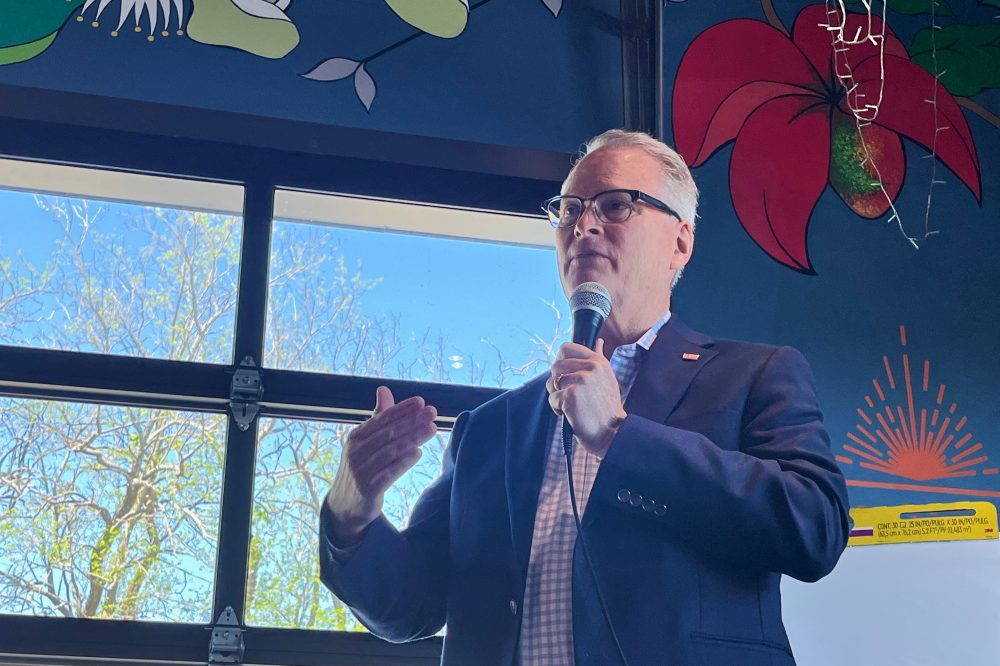

LENEXA, Kan. — A prominent religious leader who oversees the country’s biggest United Methodist congregation announced Thursday his bid for the Democratic U.S. Senate nomination in Kansas, dramatically reshaping the political landscape in a traditionally red state where the GOP’s narrow congressional control appears increasingly vulnerable.
Rev. Adam Hamilton joins the contest as a potentially powerful contender, though questions remain about whether any of the eight other lesser-known Democratic hopefuls will exit the August 4th primary race. The Democratic nominee will challenge sitting Republican Senator Roger Marshall, who closely allied himself with former President Donald Trump during his initial 2020 Senate campaign.
At 61 years old, Hamilton commands a nationwide audience among mainstream Protestant denominations and has grown his Church of the Resurrection congregation to approximately 22,000 members over three and a half decades in the Kansas City region — providing him with an established network for recruiting campaign workers and financial supporters.
Hamilton initially contemplated an independent campaign, informing his parishioners he could help heal partisan rifts during these deeply divided political times, though many Democratic leaders worried such a move would divide opposition votes against Marshall and boost the Republican’s chances for reelection.
“Every week, it seemed there was another news story in the last year where I would find myself shaking my head and thinking, we have to do better,” the minister, who describes himself as a fifth-generation Kansas native, shared with his congregation.
Although Democrats and Republicans have alternated control of the Kansas governor’s mansion over six decades, Republicans have maintained an unbroken streak in U.S. Senate contests dating back to 1932. Despite a competitive Democratic challenge in 2020, Marshall secured victory by more than 11 points, even while Democrat Joe Biden defeated Trump nationally and Democrats gained congressional majorities.
Hamilton’s campaign bears similarities to Texas Democratic candidate James Talarico, a Presbyterian seminary student who frequently discusses how his religious beliefs shape his policy positions, though Hamilton brings significantly more life experience at a generation older.
Among other Democratic candidates, state Senator Patrick Schmidt stands out as the most recognizable name, having mounted an unsuccessful congressional campaign in 2022.
Hamilton, a resident of Stillwell near the Kansas City metropolitan area, has consistently demonstrated an ability to build large followings. After completing his education at Oral Roberts University in Tulsa and Southern Methodist University in Dallas, his denomination selected the 25-year-old to establish a new church in suburban Kansas City specifically targeting non-churchgoers.
The congregation began meeting in a modest funeral home chapel and has since expanded to nine locations. The primary campus spans 76 acres in an upscale suburb and resembles a small college campus. Their annual Christmas Eve collection, dedicated to missionary activities, sometimes exceeds $2 million.
“I’ve raised a lot money over the years and I’m not afraid to do that,” Hamilton stated before his official announcement.
Hamilton has authored numerous published works and his video-based educational content is widely used in Sunday school programs nationwide. In 2013, he delivered remarks at the National Prayer Service.
His campaign launch occurs during what appears to be a difficult midterm election cycle for Republicans. Public opinion surveys indicate most Americans believe U.S. military actions against Iran have been excessive and voters express growing concern about Trump’s inability to tackle cost-of-living challenges.
Hamilton’s Johnson County home base represents the state’s most populated area, housing 643,000 residents — more than 20% of all Kansans. Previously a Republican stronghold, the county has shifted toward Democratic candidates, rejecting Trump in both recent presidential elections.
This demographic change explains how a state with a heavily Republican legislature maintains a Democratic governor.
Hamilton’s political positioning remains crucial, as he must attract disenchanted Republicans and independent voters — the same coalition that powered Democrat Laura Kelly’s 2018 gubernatorial victory and narrow 2022 reelection.
His congregation includes roughly equal numbers of Republicans, Democrats and Independents, and Hamilton characterizes himself as “a liberal conservative and a conservative liberal.”
While Hamilton lacks elected office experience, his extensive record of sermons, podcasts and social media content provides insight into his viewpoints.
During increased federal law enforcement activity in Minneapolis, Hamilton referenced Old Testament scripture instructing Israelites to treat foreigners with love and justice.
Regarding abortion rights, the father of two who married his high school girlfriend revealed during a recent listening tour that he opposed a state constitutional amendment that would have enabled stricter abortion limitations or complete bans in Kansas.
“I didn’t think that our state legislators should be the ethicists and the spiritual guides for all of the women of the state of Kansas,” he explained while emotionally recounting his counseling of sexual assault survivors and his mother’s consideration of abortion when she became pregnant with him as a teenager. “I feel both of these things at the same time.”
His church also exerted financial influence before the United Methodist Church conference overturned long-standing anti-LGBTQ policies. “We’ve lost a thousand people over the years because this was our commitment, and so I want to say that I will take that commitment with me to Washington D.C.,” he declared during his listening tour.
Hamilton indicated that if elected, he would continue his pastoral duties while reducing his preaching schedule to approximately 12 to 18 services annually.
“Can you imagine a future,” he asked, “where Republicans and Democrats and Independents work together to actually solve problems?”