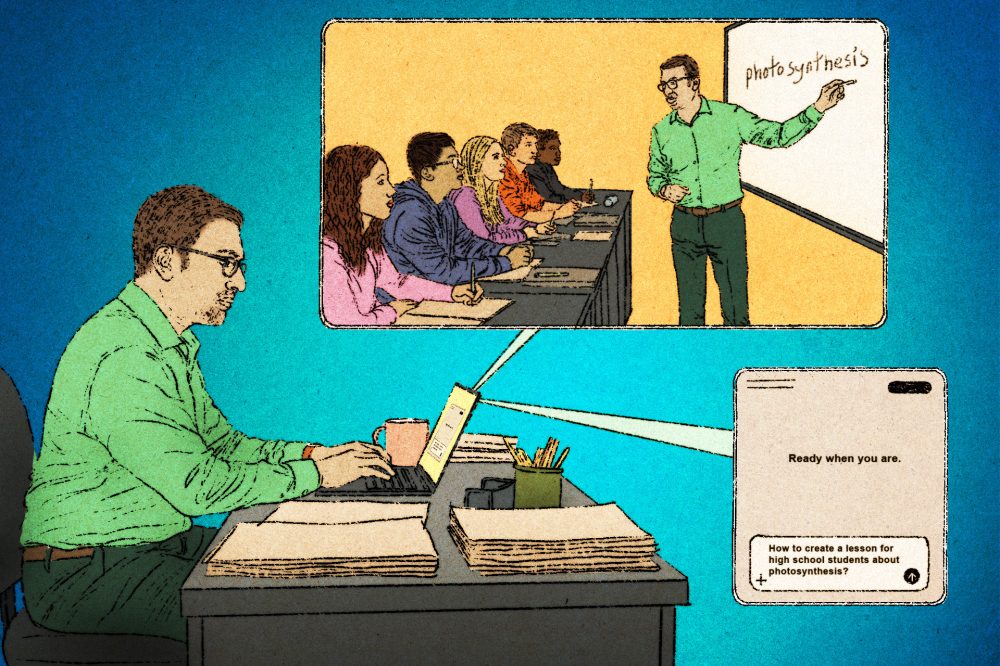

NEW YORK (AP) — The workplace landscape is experiencing a dramatic shift as artificial intelligence technology becomes deeply integrated into daily professional routines across numerous industries.
Educators are utilizing these digital tools to develop curriculum materials and evaluate student work. Sales and marketing teams are deploying AI to network effectively and analyze potential customer requirements. Meanwhile, project coordinators are turning to artificial intelligence as a translator when complex technical discussions become difficult to follow during workplace meetings.
While many professionals embrace these technological advances, some express worry that widespread adoption might diminish analytical reasoning abilities, particularly in younger generations. These users emphasize the importance of carefully reviewing AI-generated work, noting that these systems can produce errors or fabricated information.
Below are examples of how various professionals incorporate artificial intelligence into their work routines to increase efficiency and spark innovation.
Kristin Moore, who works as a technical product manager at PERQ, a digital marketing platform serving property management firms, has discovered an innovative application for AI in workplace communication. When attending meetings where engineers discuss complex topics beyond her technical background, she records these conversations and processes them through Claude, Anthropic’s AI assistant, requesting simplified summaries of her required follow-up actions.
“It picks up on all of that terminology that I don’t understand, and it can simplify it into something that I can consume,” Moore said.
Additionally, she employs the AI system to analyze emails, customer service requests, recorded discussions, and client communications to identify development priorities for her organization.
“It’s definitely freed up hours and hours of my week,” Moore said.
Kyle Weimar works as an elementary educator with Charter Schools USA while coordinating his Florida school’s multi-tiered support program, focusing on creating intervention strategies for students in the lowest-performing 20% academically.
In this capacity, he inputs academic assessments, progress reports, and medical data into his district’s artificial intelligence platform. Prior to student support meetings, he requests brainstorming assistance to develop targeted help strategies for individual children.
Weimar has also implemented AI for assignment evaluation. He can process 100 student papers through an AI system, provide scoring criteria, and receive graded work with immediate student feedback. “I can do that in 30 minutes, whereas it would have taken me a week before,” he said.
Given that educators face overwhelming workloads, “so any tools that we can use to make that a little bit more viable, we’re really excited about using,” Weimar said.
Ashley Smith serves as marketing director for HireQuest, a staffing and recruitment firm operating approximately 400 franchise locations. She utilized Claude to construct an analytical dashboard that examines web traffic information and social media patterns. This system identifies content that resonates with HireQuest’s audience versus material that receives little engagement, helping Smith advise franchise owners on business development strategies.
During a recent major manufacturing industry conference attended by her sales staff, she instructed them to photograph companies they wanted to target. She then uploaded these images to an AI platform, requesting a comprehensive list containing company names and projections about their potential staffing requirements over the following 18 to 24 months, based on public announcements and financial documents.
The time Smith conserved by delegating this research to AI allowed her to increase direct consultation time with franchise partners.
“AI has not replaced anything. It’s only expanded what we’re able to offer to our franchisees,” Smith said. “It allows us to do things that, candidly, we just weren’t able to deliver even as short as two years ago.”
Andrew Markle, a design executive at Georgia Pacific, the manufacturing company behind Dixie cups, Quilted Northern toilet paper, and various household products, employs AI for rapid visual concept development. During brainstorming sessions for modernizing the Brawny paper towel brand, his team used AI to visualize different appearances for the mascot character on their product packaging, including variations in facial hair length.
This AI assistance accelerated the team’s idea evaluation process while providing predictions about target customer reactions, Markle explained.
“It’s not replacing the creative eye of what’s good and what’s appropriate for our business,” Markle said. “Ultimately, we knew we were going to partner with our ad agency. We have an illustrator that’s going to do the final vision.”
Kenneth Lynch works as a special education instructor in Tulsa, Oklahoma, teaching life skills to developmentally disabled students to promote independent living. He uses AI to create educational assessments and study materials. When working with a student interested in automotive careers, Lynch uploaded mechanical training manuals to an AI system that produced chapter-specific quizzes.
However, he exercises caution when seeking AI guidance on psychological conditions. “When I look up different types of diagnosis and try to connect comorbid diagnoses together, it really struggles with understanding how those fit together,” Lynch said.
Ravi Pendse, serving as chief information officer at the University of Michigan, employs AI for meeting preparation by requesting predictions about potential questions he might face.
“It has made me a lot more efficient,” Pendse said. “It gives me more time to focus on my own mental health and wellness.”
The University of Michigan has also developed an AI tutoring system that faculty members can customize to provide students with round-the-clock academic support. Despite these benefits, Pendse emphasizes responsible implementation.
“We all should be thinking about how we ensure that AI does not erode our critical thinking skills, especially those of our children,” Pendse said. “As we grew up, we learned from our mistakes. We wrote bad papers, and we got better.”
Bob Jones, the university’s assistant vice president for emerging technology and support services, utilizes AI to refine his email communications for specific audiences.
“If I’m communicating about a particularly sticky topic, I want to make sure that I’m neutral and thoughtful,” Jones said. “So the idea of really assessing how I’m presenting myself, AI is really good at that.”
Natalie Blythe, marketing director at SumnerOne, a company providing printing equipment, copying machines, and IT solutions, requests AI assistance for developing email marketing campaigns, social media content, and presentation materials. She also leverages the technology to better understand her target customers.
When targeting printing services to higher education institutions, she asked ChatGPT, OpenAI’s AI platform, to develop a demographic profile for a typical university admissions director. She then requested predictions about this professional’s primary challenges and ways her company’s offerings could address these issues.
“When it first started up, I was in the camp of, ‘Oh my God, this is the end for us,’” Blythe said about AI’s early development. Rather than simply fearing the technology, she committed to learning its applications.
“The efficiencies gained out of it have been tremendous,” she said.