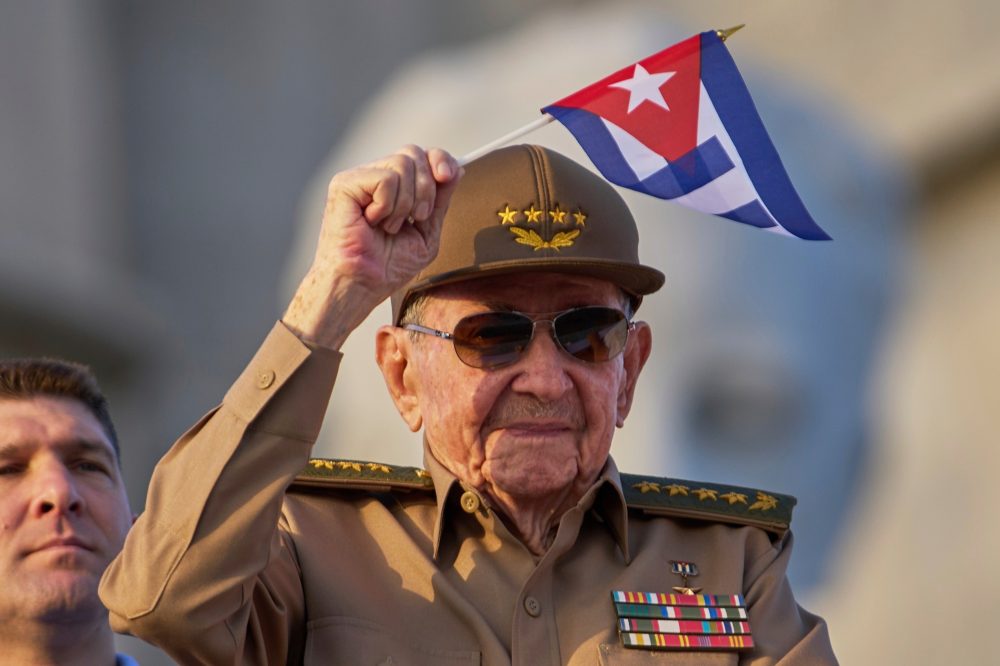

MIAMI (AP) — Federal prosecutors were set to reveal criminal charges Wednesday targeting former Cuban President Raúl Castro, as the current administration intensifies its pressure campaign against Cuba’s socialist leadership, sources with knowledge of the situation reported.
Miami-based federal prosecutors have been developing an indictment connected to Castro’s suspected involvement in the 1996 destruction of two aircraft flown by Brothers to the Rescue, a Miami-headquartered exile organization. The 94-year-old Castro served as Cuba’s defense minister during that period.
The anticipated charges encompass murder and aircraft destruction, according to one source briefed on the matter. These individuals requested anonymity since they lacked authorization to speak publicly before the official announcement.
Acting Attorney General Todd Blanche along with other senior Justice Department leadership were scheduled to attend a Miami ceremony Wednesday commemorating the victims of the aircraft attack.
President Donald Trump has been issuing military threats against Cuba following U.S. forces’ capture of Venezuelan President Nicolás Maduro, Cuba’s long-standing ally. Following Maduro’s removal, the White House implemented a blockade cutting off fuel deliveries to Cuba, resulting in widespread power outages, food scarcity and economic devastation throughout the nation.
Following Maduro’s detention, Trump has intensified discussions about Cuban regime change after promising earlier this year to execute a “friendly takeover” of the nation unless its leaders opened their economy to American investment and expelled U.S. enemies.
Trump’s initial presidency brought drug-trafficking charges against Maduro and used those accusations to justify his removal through a surprise military operation in January that transported the Venezuelan president to New York for prosecution.
Secretary of State Marco Rubio on Wednesday called on Cuban citizens to demand a free-market system with new leadership that he claimed would establish a fresh direction in U.S. relations.
“In the U.S., we are ready to open a new chapter in the relationship between our people,” Rubio, the son of Cuban immigrants, said in a Spanish-language video message. “Currently, the only thing standing in the way of a better future are those who control your country.”
Cuba’s deputy foreign minister, Carlos F. de Cossío attacked Rubio on X, claiming he “lies so repeatedly and unscrupulously about Cuba and tries to justify the aggression he inflicts on the Cuban people.” Rubio “knows full well that there is no excuse for such cruel and ruthless aggression.”
No evidence suggests Castro will be brought into U.S. custody in the near future.
He assumed the presidency from his ill older brother Fidel Castro in 2006 before transferring authority to a loyal ally, Díaz-Canel, in 2018.
Though he stepped down as Cuban Communist Party leader in 2021, he is widely thought to maintain influence from behind the scenes, highlighted by his grandson Raúl Guillermo Rodríguez Castro’s prominent role, who previously held secret discussions with Rubio.
Last week, CIA Director John Ratcliffe visited Havana for discussions with Cuban leadership, including Castro’s grandson. Two additional senior State Department representatives met with the grandson in April.
“The symbolic nature is absolutely crucial,” said Lindsey Lazopoulos Friedman, a former prosecutor at the U.S. attorney’s office in Miami who handled national security cases and crimes involving Cubans.
“Even though Raúl Castro will likely stay and die in Cuba, you can use the indictment as a pressure point, a tactical advantage, to extract other concessions like the release of prisoners or to keep Russia out,” she added.
Beginning in 1995, aircraft operated by Brothers to the Rescue members, an organization established by Cuban exiles, flew over Havana distributing pamphlets encouraging Cubans to rebel against the Castro regime.
Cuban authorities complained to the U.S. government, cautioning they would protect their airspace. Federal Aviation Administration officials also launched an inquiry and met with the organization’s leadership to encourage them to halt the flights, according to declassified government documents obtained by George Washington University’s National Security Archive.
“This latest overflight can only be seen as further taunting of the Cuban Government,” an FAA official wrote in an email to her superiors after one intrusion in January 1996. “Worst case scenario is that one of these days the Cubans will shoot down one of these planes.”
However, these warnings were ignored and on Feb. 24, 1996, missiles launched by Russian-manufactured MiG-29 fighter aircraft destroyed two unarmed civilian Cessna planes shortly north of Havana just outside Cuba’s airspace. All four occupants perished.
Guy Lewis, who served as a federal prosecutor, discovered evidence connecting senior Cuban military leaders to cocaine smuggling by Colombia’s Medellin cartel. After the shootdown, the probe expanded, and prosecutors pursued charges against Raúl Castro for directing a massive racketeering operation by Cuba’s military forces.
“The evidence was strong,” Lewis said in an interview.
Ultimately, the Clinton administration charged four people, including the MiG pilots, the Cuban air force commander and the leader of a Cuban intelligence network in Miami — the sole individual to serve time in a U.S. prison — for supplying crucial information about the flights.
The event prompted the U.S. to strengthen its stance against Cuba, despite the Cold War’s conclusion and the declining memory of the Castros’ support for revolution throughout Latin America.
However, Castro himself escaped charges as the Clinton administration — which had quietly attempted to improve Cuban relations before the incident — expressed foreign policy concerns regarding such a prominent indictment.
“Raúl was definitely one who slipped through the noose,” Lewis said. “The crime is notorious. Three U.S. citizens and one legal permanent resident were killed in a premeditated orchestrated murder. That should never be forgotten.”