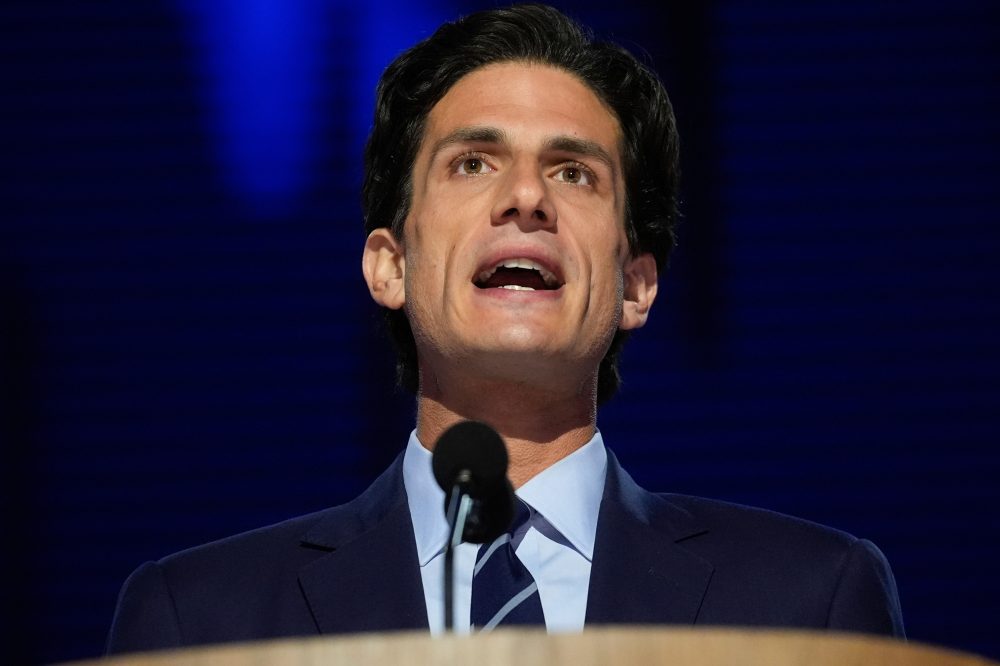

NEW YORK — When Jack Schlossberg announced his bid for Congress in New York City last year, his Kennedy family heritage immediately thrust him into the spotlight.
The 33-year-old had already built a following on social media, partly through his sharp criticism of his relative Robert F. Kennedy Jr., who served as health secretary under Trump. Schlossberg had been making appearances in Democratic political circles, clearly embodying the image of Kennedy family royalty.
Now, as he competes in a packed race for a coveted Manhattan House seat, Schlossberg enjoys a unique edge that none of his rivals can match: a popular television series about his family that has reignited public fascination with the Kennedy dynasty.
Despite his family connections and the buzz surrounding “Love Story: John F. Kennedy Jr. & Carolyn Bessette,” the grandson of President John F. Kennedy maintains that his support comes naturally.
“They don’t just like me because I’m a Kennedy. Ask them how they feel about RFK Jr.,” he said. “They like me because of my experience, my ideas and they trust me because they see what’s going on with their very own eyes.”
A major criticism facing Schlossberg centers on his lack of elected office experience, though he’s attempted to turn this into a strength by positioning himself as an energetic outsider whose substantial online following demonstrates his ability to energize young voters and introduce innovative ideas to Washington.
Even with his limited political background, Schlossberg’s campaign has drawn significant attention and financial backing, including an endorsement from former House Speaker Nancy Pelosi, who has historically supported Kennedy family members.
Schlossberg, whose complete name is John Bouvier Kennedy Schlossberg, has expressed disapproval of the “Love Story” series, previously denouncing it as an attempt to profit from his family’s fame.
“I don’t watch much TV,” he said.
However, many viewers did watch, and the series achieved success, reinforcing the lasting appeal of the Kennedy family mystique, particularly among younger audiences discovering them for the first time.
Locations where Schlossberg’s aunt and uncle once spent time have drawn fans of the television show, with women in leather jackets and men in dress shirts and ties waiting in lines to enter. Recently, a crowd assembled in Washington Square Park for a JFK Jr. lookalike competition where young men wore suits, backwards caps, or rollerblades while trying to replicate his appearance.
Schlossberg himself has adopted one of his uncle’s iconic looks — cycling while wearing a suit, tie, and backwards cap with a heavy chain bike lock around his waist — in a photograph featured on his campaign website that was published before the show premiered.
However, questions remain about whether the Kennedy name still carries enough influence to impact elections. George Arzt, a veteran Democratic political strategist in the city, expresses doubt.
“I don’t think that gets you votes,” he said. “People will say ‘Who’s Schlossberg?’ And they’ll go ‘He’s the grandson of JFK.’ So? What’s that going to do for me?”
Schlossberg argues that voters he encounters care more about his policy positions than his family background, including his proposal to make rent payments tax-deductible.
He dismissed concerns about his limited professional background, pointing to his work at the State Department’s environmental division, his combined law and business degree from Harvard, and several political commentary pieces he authored for Vogue. He also highlighted his social media activity, which has sometimes been unconventional. Last August, he shared a video wearing a blonde wig while reading a letter that first lady Melania Trump had written to Russian President Vladimir Putin.
“I’m the only one who has engaged millions of people on a progressive and aggressive political message,” he said. “I’m not just an influencer who’s hawking products. I make informative videos.”
Schlossberg confronts strong competition in the June primary, which typically determines the winner in this reliably Democratic district.
The current representative, Congressman Jerry Nadler, who is stepping down, has endorsed his former staff member Micah Lasher, a state Assembly member with extensive New York political experience who presents himself as an experienced, serious contender.
“The voters of this district are highly informed voters. They do their homework before they make their decisions,” he said.
State Assembly member Alex Bores has also entered the race and secured local endorsements, including backing from former Congresswoman Carolyn Maloney, who represented portions of the district for many years before redistricting led to her losing her seat to Nadler.
George Conway, previously married to former Trump advisor Kellyanne Conway before becoming a prominent Trump critic, joined the Democratic race earlier this year.
Conway, an attorney who helped establish the anti-Trump Lincoln Project, acknowledges that Schlossberg benefits significantly from his family name and the enthusiasm surrounding “Love Story.” However, he believes voters will ultimately choose someone with greater experience.
“There’s something very appealing about a young, fresh face and I think he’s very smart to play that up,” Conway said. “But I also think there’s something to be said for an older, experienced fresh face and that’s what I’m trying to be.”