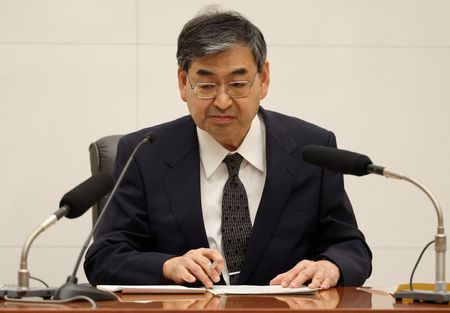

A Bank of Japan board member who cast the only dissenting vote against the central bank’s June interest rate increase says he wants clear evidence of demand-driven inflation before he will back any future rate hikes — though he acknowledged that rising costs are spreading through the economy faster than expected.
Toichiro Asada, speaking to Reuters on Monday in his first interview since joining the BOJ board, said he opposed the June decision to lift rates to 1% — a 31-year high — partly because of uncertainty surrounding Middle East developments and their potential effect on output and employment.
Asada was appointed to the board by Prime Minister Sanae Takaichi, who is regarded as a supporter of loose monetary policy. Analysts have interpreted both Asada’s appointment and that of another new dovish board member, Ayano Sato, as an effort by the Takaichi administration to encourage the BOJ to keep rates low in support of its large spending agenda.
For Asada to back a rate increase in the future, he said Japan would need to be on a sustainable path toward the BOJ’s 2% inflation target. Crucially, he wants that progress to be powered by the economy itself — not just external cost pressures.
“Moreover, I believe it is necessary to confirm that such achievement is being supported by endogenous economic forces, such as rising wages and demand,” he said, noting those forces are not yet strong enough to justify tightening.
Still, Asada made clear he is not categorically against rate increases. “I am not always opposed to rate hikes. I voted against one this time, but I intend to make decisions based on an assessment of prevailing conditions at each point in time,” he said.
He noted that while crude oil prices are declining and consumer inflation is easing somewhat, the pass-through of higher oil prices to a broad range of goods has been occurring at a “relatively rapid pace” — a development that could eventually push prices higher across the economy.
On the question of how the BOJ should approach future decisions, Asada emphasized flexibility over any fixed schedule. “The BOJ should respond flexibly to changes in economic, price and financial conditions and conduct monetary policy appropriately,” he said. “The pace of any tightening should likewise be determined after carefully assessing domestic and overseas economic, price, and financial developments.”
The BOJ raised rates in June and has signaled it is prepared to continue hiking as inflation has remained near its 2% target for four consecutive years. A Reuters poll of analysts found that most expect another rate increase sometime between October and December.
Asada also weighed in on Japan’s so-called neutral interest rate — the level at which monetary policy neither stimulates nor restrains the economy. He described it as “rather low” but said pinpointing an exact figure is difficult. BOJ staff estimates place Japan’s nominal neutral rate somewhere between 1.1% and 2.5%.
“The neutral rate should not become an objective in itself. Policy should remain anchored to the goal of price stability,” he said.
Asada called for closer coordination between fiscal and monetary policy, arguing that monetary tools alone have limits when it comes to addressing weak demand or supply-side constraints. He pointed out that many businesses cite labor shortages and rising material costs as barriers to investment, even as the government pushes efforts to encourage it.
Wholesale inflation in Japan accelerated in May at its fastest pace in three years, driven largely by a weak yen that has pushed up import costs, compounded by rising fuel prices tied to the ongoing Middle East conflict.
“Given these circumstances, achieving price stability through appropriate monetary policy is important as a foundation for expanding growth-oriented investment,” Asada said. He also noted that while monetary policy does not directly target currency exchange rates, it “does take inflation and employment into account.”
On the subject of the BOJ’s bond-buying program, Asada said the central bank’s recent decision to pause its gradual reduction of bond purchases — a move analysts viewed as an attempt to keep bond yields from rising too sharply — could help protect investment by limiting the negative effects of excessive yield increases.
Looking further ahead, Asada said the BOJ will eventually need to have a broader conversation about the ideal size and makeup of its balance sheet, which is currently shrinking as bond redemptions outpace monthly purchases. He suggested the BOJ should focus on how far the ratio of its government bond holdings to nominal gross domestic product should fall from its current level of around 80%.
“Once the ratio has fallen to a level considered appropriate, I believe the size of the BOJ’s balance sheet should thereafter grow broadly in line with nominal GDP growth,” he said.