
NAIROBI, Kenya — Large-scale police and military deployments in the capital cities of Kenya and Tanzania brought planned protests to a halt on Tuesday, as both East African nations observed July 7, a date that carries significant historical weight for each country.
For Kenya, July 7 is a day that honors the struggle for multiparty democracy that took place in the 1990s. For Tanzania, the date marks the 72nd anniversary of the founding of what has since become the country’s ruling political party.
Protesters in Tanzania had intended to use the day to demand democratic reforms in the wake of October’s disputed election, and to call for the release of opposition leader Tundu Lissu, who remains behind bars facing treason charges.
In Dar es Salaam, Tanzania’s main commercial city, both police and military personnel were stationed throughout the area, and no protesters were seen gathering. An annual trade fair that was already underway continued under a heavy security presence.
On Monday evening, Tanzania’s Home Affairs Minister, Patrobas Katambi, addressed journalists and made clear that Tanzania was not a place where outside forces could dictate when protests would occur. He stated that the government stood ready to defend public order against any threat.
Political analysts note that the Tanzanian government has been on heightened alert ever since the October election and the violent crackdown that followed, during which hundreds of people lost their lives.
Wade Green, an analyst with Aldebaran Threat Consultants, said that for protesters to succeed in Tanzania, they would need to “catch the security forces off-guard because their guard is so up right now.”
Green went on to say: “Unless the protesters were really strong and organized, there would be no way to overcome the lethality that the Tanzanian security forces unleashed last year and are willing to unleash again.”
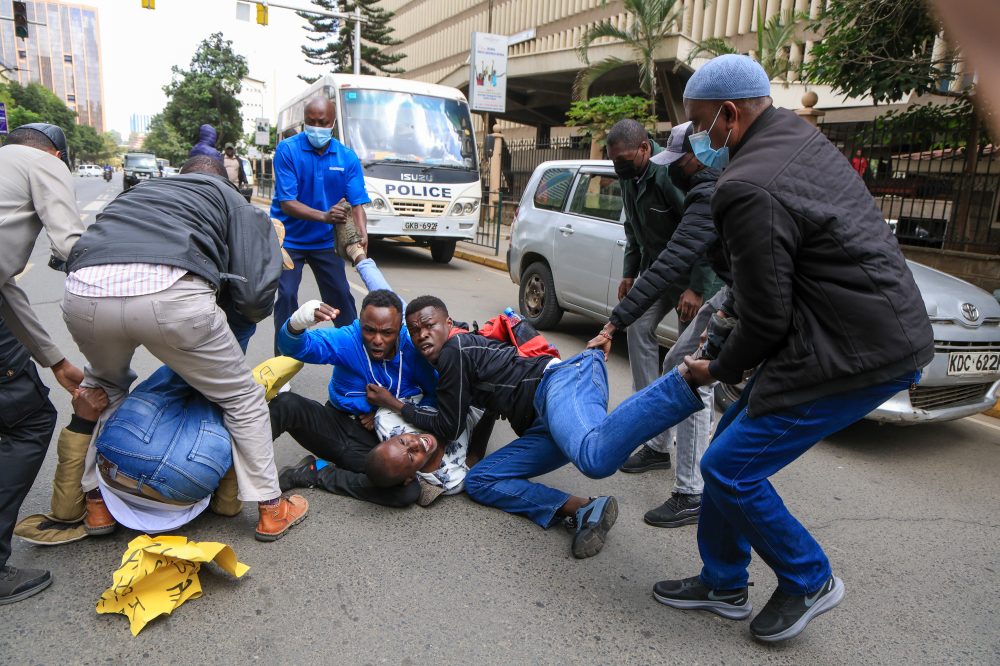
Meanwhile, in Kenya’s capital city of Nairobi, police surrounded parliament buildings with barbed wire and shut down major roadways. Several businesses in the area also closed their doors. A small number of people were taken into custody.
Kenyan opposition politician James Orengo criticized the overwhelming police presence in Nairobi, calling it an attempt to intimidate ordinary citizens.
“These are the characteristics of a police state. You find police deployed even when there is no fracas, there is no march, there is no demonstration, there are no vehicles on the road, and even holding a press conference becomes difficult, but we are undeterred,” Orengo said.