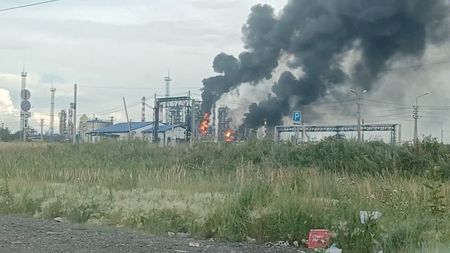

Russia’s largest oil refinery has gone offline following a Ukrainian drone attack, according to two industry insiders who spoke on Tuesday.
The strike, which took place Monday at the Omsk refinery deep in Siberia, ranks among the farthest-reaching attacks Ukraine has carried out since the conflict began — a war now entering its fifth year.
The shutdown of the facility, which leads all Russian refineries in gasoline production, is expected to make fuel shortages worse throughout the country.
Anatoly Seryshev, President Vladimir Putin’s representative in Siberia, confirmed the damage in an official statement Tuesday. “Facilities at the Omsk oil refinery were damaged as a result of (Monday’s) attack. No plant personnel were injured,” he said. Seryshev added that “damage assessment is currently under way, and competent services have organized restoration work,” though he offered no specifics about how operations had been affected.
Gazprom Neft, the company that owns the refinery, had not responded to a request for comment as of the time of reporting.
Industry sources said a crude distillation unit known as CDU-10 caught fire and sustained damage during the attack. That unit is responsible for roughly 38% of the plant’s total output, with a daily processing capacity of 24,580 metric tons.
Since Tuesday, the Omsk refinery has stopped listing gasoline and diesel for sale on the Saint Petersburg International Mercantile Exchange, according to exchange data.
A second major processing unit, CDU-11, was also taken offline, the sources said. That unit handles 37% of the refinery’s capacity and can process 24,000 tons of oil each day. While CDU-11 was not directly hit, critical network connections needed to run it were damaged. The sources noted that CDU-11, which began operations in 2023, may be able to restart in the near term.
The refinery also has two mothballed processing units — CDU-7 and CDU-8 — each capable of handling 10,000 tons per day, which could theoretically be brought back online.
In 2024, the Omsk refinery processed approximately 22 million tons of oil, equivalent to around 440,000 barrels per day, producing 5 million tons of gasoline and 8 million tons of diesel, according to the sources.