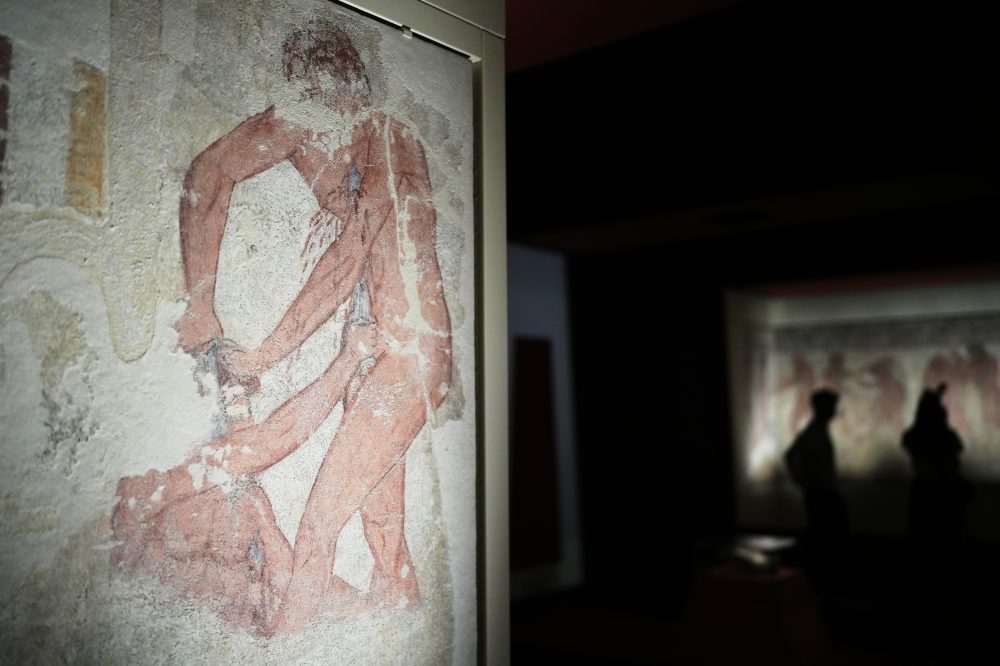

ROME (AP) — Ancient Etruscan paintings that have been held in private hands for more than a century are now on public display in Italy, as the country’s Culture Ministry continues its aggressive push to reclaim major pieces of the nation’s cultural heritage.
The ministry announced back in May that it had purchased the fresco panels from members of the Torlonia family, one of Italy’s oldest noble families. The Torlonia family has long held one of the country’s most significant collections of antiquities, much of which has never been accessible to the public.
The Francois Tomb was first uncovered in 1857 by French archaeologist Alessandro Francois in Vulci, on land belonging to the Torlonia family. Two years later, in 1863, the frescoes were removed from the burial site and absorbed into the Torlonia collection. The contents of the tomb were divided among Francois, his colleagues, and the family.
Italy’s government has been working to gain control of the tomb since 1921, as part of a broader effort to return artifacts and antiquities to the Italian public — pieces that were acquired or looted during the surge of archaeological excavations throughout the 1800s and beyond.
The tomb’s contents are now on view at Rome’s Villa Giulia National Etruscan Museum, which opened the exhibit to the public on Wednesday. In addition to the fresco panels, the display includes jewels, Etruscan vases, and other items originally found inside the tomb. Those pieces, which are now held by museum collections around the world, were loaned to Italy specifically for this exhibition.
The tomb was reportedly purchased for 15 million euros, roughly $17 million, making it the Culture Ministry’s third major art acquisition of the year. Earlier in 2024, the ministry spent 14.9 million euros — about $16 million — on Antonello da Messina’s “Ecce Homo,” and $35 million on a rare Caravaggio portrait depicting Maffeo Barberini, who would later become Pope Urban VIII.
The purchases have been funded through the ministry’s annual acquisitions budget. Culture Minister Alessandro Giuli has made it a priority to focus spending on fewer, high-value cultural treasures rather than spreading funds across a larger number of lesser works, according to ministry officials.
Giuli described the tomb as a “fundamental” piece of Italian history, saying it is now being returned to the Italian people where it belongs.