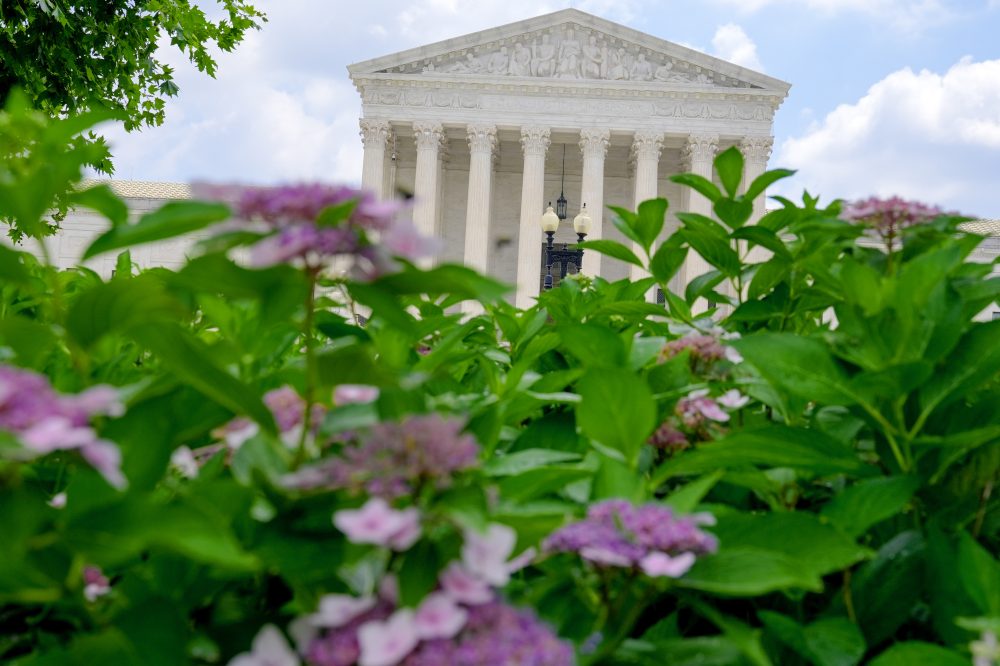

The Supreme Court is set to issue its ruling Tuesday on President Donald Trump’s executive order that would strip citizenship from children born in the United States to parents who are in the country illegally or on a temporary basis.
The decision arrives on the last day of a Supreme Court term that has largely revolved around Trump’s sweeping assertions of presidential power — and the court has mostly ruled in his favor throughout.
Just a day earlier, on Monday, the court handed the president a significant victory by ruling he has the authority to dismiss the heads of independent federal agencies without cause. The one exception was Federal Reserve governor Lisa Cook, who will keep her position while she legally contests Trump’s attempt to remove her over allegations of mortgage fraud.
To understand the legal backdrop of the birthright citizenship debate, it helps to look at how other nations handle citizenship. Outside the Americas, most countries operate under the principle of jus sanguinis — Latin for “right of blood” — meaning a child inherits citizenship from their parents regardless of where they are born. No European Union member state, for instance, grants automatic and unconditional citizenship to children born to foreign nationals.
American law, however, has deep roots in English common law, which traditionally granted citizenship based on where a child was born — a concept known as jus soli, or “right of soil.” The United Kingdom itself moved away from that approach with the British Nationality Act of 1981, which now requires that at least one parent be a British citizen or hold “settled status” for a child born in the UK to receive citizenship.
When the justices take their seats at 10 a.m. ET Tuesday, they are expected to move directly into delivering the remaining opinions of the term. Opinions are typically announced starting with the most junior justice and working up in seniority, meaning Chief Justice John Roberts — who may be the author of the birthright citizenship ruling — would speak last.
On the question of firing agency heads, the court ruled that presidents may remove those officials freely, regardless of federal laws requiring cause for dismissal and a 91-year-old precedent that had constrained executive power in that area. The Federal Reserve was carved out as a special exception given its unique role in setting interest rates.
The six conservative justices formed the majority in overturning the court’s previous unanimous ruling known as Humphrey’s Executor, which had been designed in part to insulate agency decision-making from political pressure.
“We hold that such protection from removal is contrary to the separation of powers enshrined in the Constitution,” Chief Justice John Roberts wrote on behalf of the majority.
In addition to the birthright citizenship case, the court is also expected to rule on whether states may bar transgender athletes from competing on girls’ and women’s public school and college teams, and whether a federal law more than 50 years old that limits how much political parties can spend in coordination with congressional and presidential candidates should remain in place.
The oral arguments over birthright citizenship stretched more than two hours in a packed courtroom that included Trump himself — making him the first sitting president ever to attend Supreme Court arguments — along with actor Robert De Niro, who was seated in the section reserved for justices’ guests.
During those arguments, the administration’s top Supreme Court attorney, Solicitor General D. John Sauer, faced a steady stream of skeptical questions from the justices, who probed both the legal foundation of the order and its real-world implications.
Justice Ketanji Brown Jackson pressed on the practicalities of enforcement, asking, “Is this happening in the delivery room?” as she questioned how the government would actually determine who qualifies for citizenship at birth.
Chief Justice John Roberts suggested Sauer was leaning on narrow, unusual exceptions to citizenship law to build a sweeping argument about undocumented immigrants. “I’m not quite sure how you can get to that big group from such tiny and sort of idiosyncratic examples,” Roberts said.
Among all nine justices, Clarence Thomas appeared most likely to support the administration’s position.