
ATHENS, Greece — Israeli military operations have systematically eliminated Iran’s highest-ranking officials in a series of targeted strikes.
The campaign began with the death of Supreme Leader Ayatollah Ali Khamenei in the conflict’s initial phase. Subsequently, Ali Larijani, who served as secretary of Iran’s Supreme National Security Council and ranked among the nation’s most influential figures, was also eliminated. Multiple other senior military and political officials have been killed as well.
With such extensive losses among Iran’s top echelon, questions emerge about the country’s current leadership structure and who maintains operational control.
Iran’s governmental system centers around the supreme leader position, which has served as the ultimate authority since the Islamic Republic’s establishment following the 1979 revolution that toppled the shah.
Following Khamenei’s death, his 56-year-old son Mojtaba Khamenei received swift appointment as the new supreme leader. The younger Khamenei, known for maintaining a low profile, has remained absent from public appearances since the airstrike that claimed his 86-year-old father’s life.
Despite never holding an elected or appointed governmental role, the cleric had been widely viewed as a potential successor. He maintains strong connections with Iran’s influential paramilitary Revolutionary Guard.
His ideological stance is reportedly more extreme than his father’s positions. In his official capacity, he now oversees Iran’s military forces, and nuclear program decisions fall under his authority.
However, questions persist about his actual control over the nation.
“I’m not sure who’s running Iran right now,” Israeli Prime Minister Benjamin Netanyahu stated during a Thursday evening press conference. “Mojtaba, the replacement ayatollah, has not shown his face. Have you seen him? We haven’t, and we can’t vouch for what exactly is happening there.”
The Israeli strike that killed his father also claimed the life of Mojtaba Khamenei’s wife, Zahra Haddad Adel. American and Israeli intelligence sources indicate he sustained injuries in the same attack.
“Iran’s command and control structure is in utter chaos,” Netanyahu declared.
According to Burcu Ozcelik, a senior research fellow specializing in Middle East security at the Royal United Services Institute, a UK-based defense and security think tank, the elimination of numerous Iranian leaders will transform the theocratic system, though changes may unfold gradually.
“Leadership matters, and the loss of key decision-makers spanning politics, intelligence, internal security and (the) army will have transformative consequences,” Ozcelik stated.
“The fixation on the terminology of ‘regime collapse’ is obscuring the fact that the regime is already changing” as a result of the military strikes and leadership assassinations. However, she noted that the war’s complete impact on the country may require time to fully manifest.
“We need to be prepared for change that may take years, not weeks or months.”
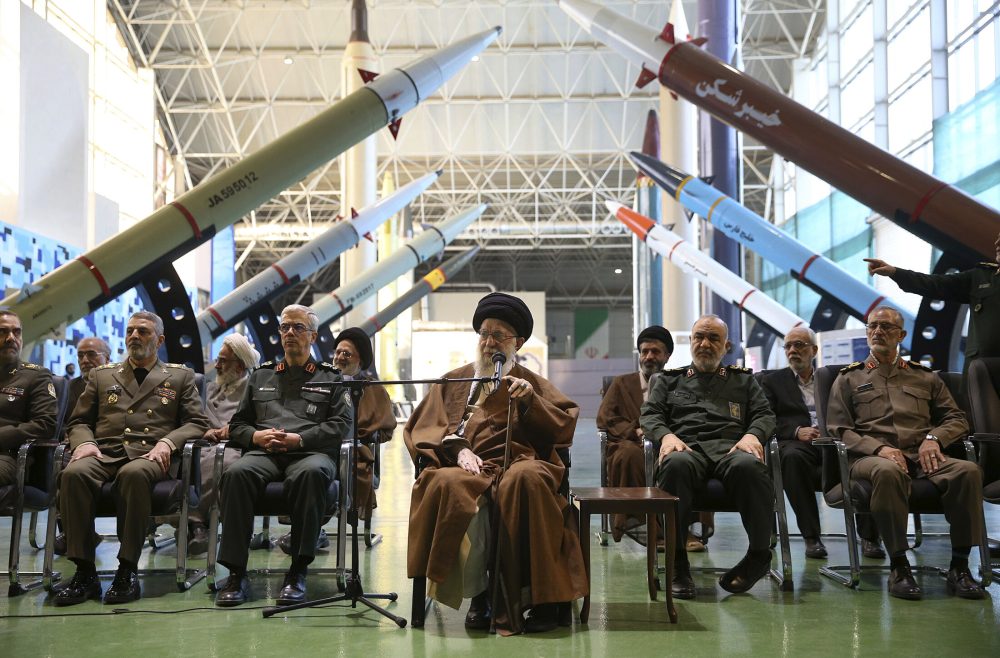
Many experts believe actual authority now lies with Iran’s formidable paramilitary Islamic Revolutionary Guard.
“The Revolutionary Guard is the state now,” explained Ali Vaez, Iran project director at the International Crisis Group. Prior to the conflict, civilian leadership was “subservient entirely” to the supreme leader, while the Guard represented the country’s second-most powerful institution.
However, with the elder Khamenei deceased and his son lacking equivalent authority, “it is really the Revolutionary Guards who are running the country.”
The Guard emerged from Iran’s 1979 Islamic Revolution as a protective force for the Shiite cleric-led government. It subsequently gained constitutional recognition and functions alongside Iran’s conventional military.
The Guard’s overseas operations unit, the Quds Force, played a crucial role in establishing what Iran calls its “Axis of Resistance” opposing Israel and the United States. It provided support to Syria’s former President Bashar Assad, Lebanese militant organization Hezbollah, Yemen’s Houthi rebels, and additional regional armed groups.
During the conflict’s early stages, Iranian Foreign Minister Abbas Araghchi indicated that the country’s military forces were operating without centralized governmental oversight.
“Our … military units are now in fact independent and somehow isolated and they are acting based on instructions — you know, general instructions — given to them in advance,” Araghchi stated during a March 1 Al Jazeera interview.
When questioned about Tehran’s attacks on other Gulf states, including Oman, which had served as an intermediary in recent U.S.-Iran nuclear negotiations, he responded: “What happened in Oman was not our choice. We have already told our … army, armed forces to be careful about the targets that they choose.”
The prospect of Israeli or American military action against Iran had long been anticipated. The Islamic Republic had incorporated this possibility into its strategic planning, establishing numerous backup plans, according to Vaez.
“I think the mistake in the U.S. and in Israel is that they ended up believing their own rhetoric that Iran is akin to a terrorist organization, that decapitating the regime or removing one or two layers of political elite would result in paralysis and collapse,” Vaez observed. “Whereas this is a state, … it has multiple layers of leadership.”
Even with all senior commanders eliminated, he noted, subordinate officers can assume their predecessors’ responsibilities. “The expectation that this regime will … implode by removing a few dozen senior leaders, I think is nothing but an illusion.”