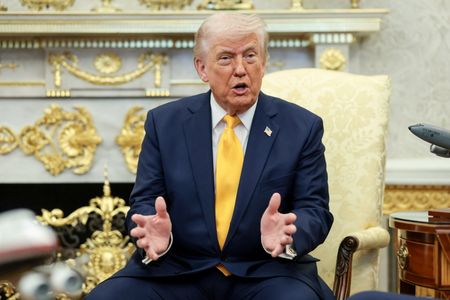

NUUK/COPENHAGEN – Political candidates from Greenland are using President Trump’s interest in purchasing their Arctic homeland as a bargaining chip to secure greater concessions from Denmark in next week’s parliamentary elections.
Trump’s public desire for the United States to obtain Greenland has spotlighted the remote island home to 57,000 residents, highlighting ongoing concerns about Denmark’s investment in military defense, infrastructure development, and economic growth.
“The most important thing for us in this election is the sovereignty of the Greenlandic people,” stated Juno Berthelsen, 43, who represents the opposition Naleraq party that supports independence. “The Greenlandic people … should always be at the centre of any conversation about Greenland.”
The Naleraq party, whose name translates to “point of orientation” in the indigenous Kalaallisut language, has put forward five candidates including Berthelsen to compete for Greenland’s two parliamentary seats in Denmark’s national legislature. Greenland operates as an autonomous territory under Danish sovereignty.
UNPRECEDENTED MOMENT
Although many residents view Naleraq’s push for immediate separation from Copenhagen as hasty or misguided, others recognize Trump’s territorial ambitions as an opportunity to address decades-old complaints against Denmark.
As global superpowers increasingly compete for Arctic influence and climate change creates new shipping lanes while exposing natural resources, Greenland’s strategic value has become undeniable. This forces Copenhagen to demonstrate its value as an ally rather than taking the relationship for granted.
Any appearance of Danish negligence could strengthen Trump’s argument for American involvement.
Numerous Greenlanders criticize Denmark for unfairly profiting from their fishing sector, preventing economic self-sufficiency, and failing to shield the over 17,000 Greenlanders residing in Denmark from prejudice.
Anna Wangenheim, who serves as Greenland’s health minister and represents the Demokraatit party alongside Prime Minister Jens-Frederik Nielsen, believes Trump’s demands have triggered a necessary confrontation.
“The fact that we are in the eye of the hurricane in the Arctic means that we have a very great opportunity to have much greater influence than we have had before.”
SEEKING REPRESENTATION
Aage Josefsen, a 55-year-old bus operator in capital city Nuuk, views the election through a straightforward lens: determining who truly represents Greenland’s interests. “The Greenlandic government should have more say in meetings, instead of Denmark just speaking on Greenland’s behalf,” he explained.
Campaign platforms from Greenlandic politicians include establishing a maritime patrol unit staffed by local fishermen and hunters, restructuring fishing operations to keep more profits on the island, and requiring Danish students to study Greenlandic history and culture.
Denmark’s left-leaning Prime Minister Mette Frederiksen confronts a competitive election despite gaining support for her firm resistance to American pressure regarding Greenland, as many Danish citizens express frustration with increasing living expenses and social service strains.
Political experts suggest Frederiksen may find it difficult to secure a parliamentary majority, making every vote critical – including those from Greenlandic representatives – for maintaining her leadership position.
Candidates are also demanding revision of the 1951 military cooperation agreement between Denmark and the United States, which was negotiated without Greenlandic participation.
“It must be something that Greenland can also see itself reflected in, a defence agreement about our land,” explained Ane Lone Bagger from the Siumut party.
SHIFTING ATTITUDES
Bagger noted that Trump’s pressure has already altered Danish behavior. “Suddenly there are apologies and this and that,” she observed.
In the previous year, Denmark issued formal apologies to thousands of Greenlandic women who were subjected to forced contraception procedures from the 1960s through 1991.
This changed approach from Copenhagen is exemplified by Frederiksen, who has established herself as Greenland’s strongest advocate, making multiple visits to the territory and mobilizing European allies against American pressure.
She has clearly stated that Greenland’s destiny belongs solely to its people to determine.
However, many islanders worry that international political tensions overshadow their everyday concerns.
For Inuujuk Louis Petersen, a 24-year-old taxi driver campaigning for Demokraatit in Nuuk’s Danish parliamentary race, the situation carries both personal and political significance.
Greenland never requested to become the center of superpower competition, he noted. “It is of course at the expense of the life we have always been used to,” he said. “And that was peace and quiet.”